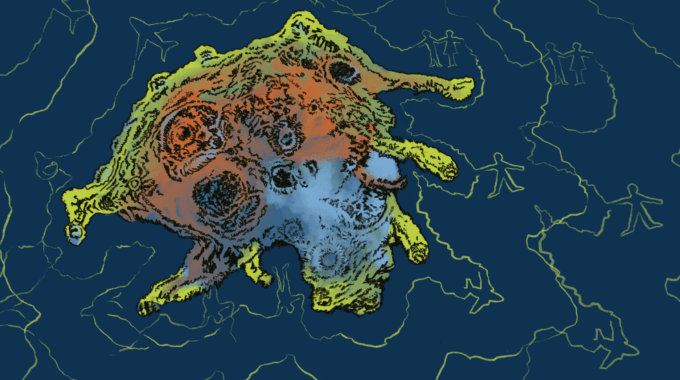
Illustration by Paola Bilancieri.
The number of politams, unusual organisms created by the fusion of a politician and an amoeba, has increased considerably worldwide and is causing widespread concern both in the scientific community and among the public at large. People have reason to be worried since politams, although they could do a great deal of good for the world, mostly have a nefarious effect on people’s quality of life, particularly among those who are most vulnerable.
An amoeba, on the other hand, is a type of cell or unicellular organism that has the capacity to alter its shape by extending and retracting pseudopods, temporary arm-like projections that emerge in the direction of movement. Pseudopods are used for ingestion, a process called phagocytosis, in which they encircle and engulf live prey or particles of scavenged material. Some amoebas are predatory and survive by consuming bacteria and other organisms. Others are detritivores and feed on dead organic material.
Some amoebas can infect other organisms and cause serious disease. Such is the case of Entamoeba histolytica, which causes amoebiasis, or amoebic dysentery, a widespread disease in the developing world. Another is Naegleria fowleri, a freshwater species that can be fatal to humans if introduced through the nose.
This latter species of amoeba is believed to have infected the brain of a famous politician, causing severe damage to his thought processes and leading to serious public health policy mistakes that affected millions of people worldwide. This is a perfect example of the workings of a politam.
In some instances, politams can significantly increase their size, allowing them to perform unexpected feats. In May 2025, a large politam is known to have engulfed a huge Boeing 747-8 luxury jetliner from a distant land and brought it intact to the United States, where it was placed at the pleasure of its new owner, to whom it was given as a gift in an unusual display of selfless generosity by the Qatari government.
In other cases, the actions of pseudopods, which show a marked preference for benefiting the family and friends of the politams that possess them, have enabled these creatures to engulf extraordinary amounts of money, in obvious disregard of conflicts of interest or laws specifically designed to prohibit such behavior.
Politams are not always successful, however. Recently, a leading politam decided to completely clean up a swimming pool near his residence that had been invaded by all kinds of unusual guests, giving it a bad smell and an unflattering appearance. Despite all efforts and the tireless work of thousands of pseudopods, the pool remains in a state of disrepair, looking even more unappealing than before.
Fusion with an amoeba also grants politams other unusual abilities. Because of the amoeba’s extraordinary flexibility, politams can move forward and backward repeatedly, allowing them to change both shape and opinion on a wide variety of subjects. When confronted about this tendency, politams respond that such conduct is merely part of their personal growth and evolving understanding of important issues.
Many amoebas form cysts to survive adverse conditions, a characteristic that has been transferred to politams. For example, when they become the target of investigations, subpoenas, or unfriendly journalists, politams encase themselves in a thick protective cyst composed of lawyers, spokespersons, and procedural delays.
Politams survive on nutrients supplied by their hosts. Although they claim to be serving the public, researchers have noticed that politams derive almost all their sustenance from the very organisms whose resources they consume.
While amoebas respond quickly to chemical signals, politams respond equally quickly to polls. Recent experiments carried out at the University of Tierra del Fuego, Argentina, show that a politam can reverse its position with remarkable speed when exposed to favorable polling data, a phenomenon known as pseudopodal realignment.
Like amoebas, politams have no rigid structure. As a result, unlike organisms burdened by moral principles, politams, lacking a fixed ideological skeleton, display extraordinary flexibility in matters involving taxes, war, public health, morality, and even the practice of golf.
Amoebas are extraordinarily adaptable and have been found living in a wide variety of environments. Politams are also remarkably adaptable and can thrive in democracies, dictatorships, monarchies, and even failed states, suggesting an evolutionary versatility unequaled in the natural world.
As a result of their remarkable capacity for adaptation, when confronted with clear evidence of wrongdoing, corruption, or incompetence, politams do not perish. Instead, through a process known as metamendacity, they rewrite their own history and, unfazed, claim to have always supported the opposite position.
Which leads me to a final thought: the politams’ contribution to humanity should never be underestimated.