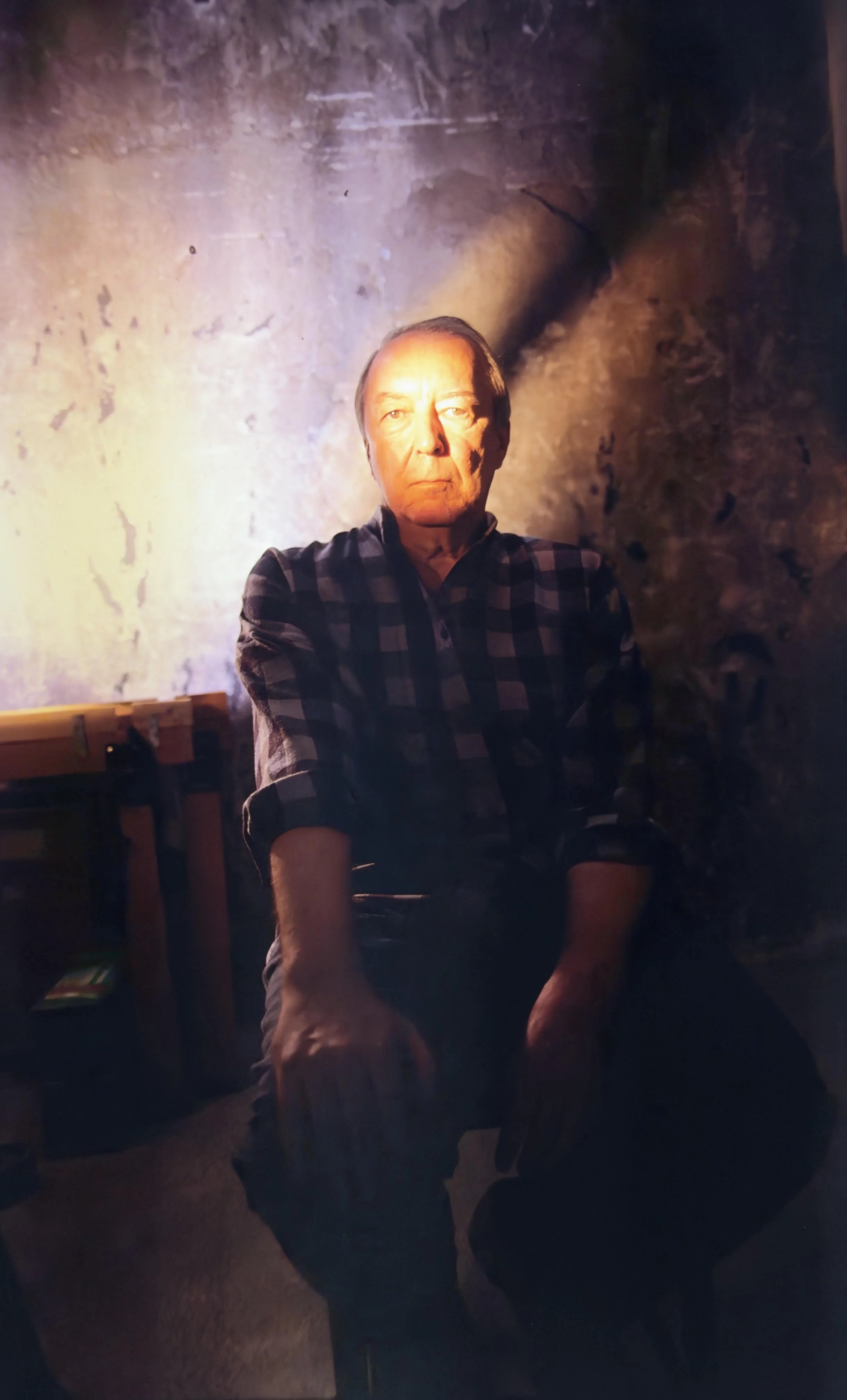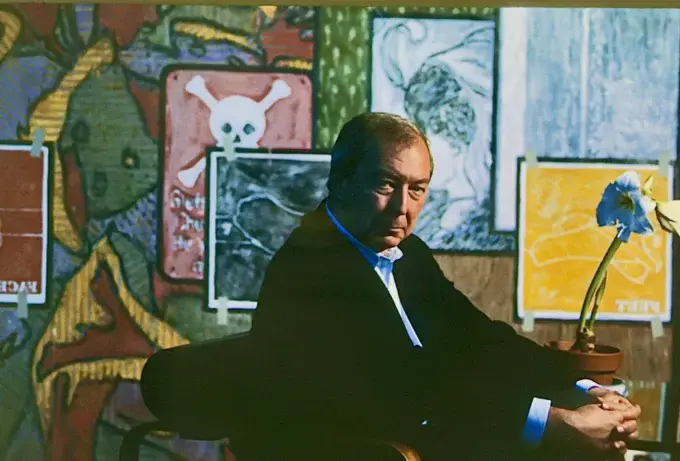
Jasper Johns, photographed by Richard Schulman.
Fictional Truths
For twenty-five years, I merely wanted to be in the room, alone in the room with the last conversation. That moment will never return. Yet, could there be another? My eyes knew the truth: I was recording a history. Now everything I heard and saw has faded into a collection of memories, the kind that inexplicably vanish before I can grasp their significance. Having photographed Jasper Johns three times, there was no reason to expect the man to be the same old soul living under older skin; his qualities lie beyond nearly a century of living. I was recording a history.
A “requiem” for living: I have traveled to many cities to photograph artists. Often, I considered what I would encounter when I entered the church of another. I knew that I was capturing a moment that mattered, photographing the face of time, like finding an old watch face worn down over the years, I accidentally unearthed from the loneliest pages of my archives. Something that time froze. Years later, that frozen moment cushions the best and worst of memories.
I wonder now, as I wondered then, was I in their studio merely to photograph a face? Thousands of portraits later, I cannot answer. Yes, I was struck by the creative process, the giant and tiny canvases, the grand gestures and the intimate, but at the core I think I was there to hear the memories of others.
Many adventure stories start with place “A” and head to place “B.” I wanted to hear with my eyes about the journey and then again about how those journeys shaped them.
Jacob Lawrence’s “Migration Series” epitomizes me more than I could possibly share. It encompasses the glory and the struggles of travel along with the adventures, the music and the landscapes. When I spoke to Lawrence, he couldn’t wait to share, empathetically laying himself naked to the skies to map out in colors a world not mine. Let’s take it a step further; am I Studs Terkel? Nope! But I wanted my eyes to record time with the voices of others: Man Ray from Philadelphia to Paris; Marc Chagall from Vitebsk, Russia to Saint-Paul-de-Vence, France; Fernando Botero from Medellin, Colombia to Monaco; Willem de Kooning from Rotterdam, in the Netherlands to East Hampton, New York; Ed Ruscha from Nebraska to Los Angeles. My feet, my eyes, moving like a rumba with theirs.
I only asked these and other artists to share the mindful road trips of world landscapes, urban dreams, and the venturing mind. All I really wanted was a chorus of thousands to whisper as Helen Sinclair from Bullets over Broadway, to whisper commandingly, “Don’t speak!”
I wanted to know about their lives. If I could extend the hallucinatory dream a bit: I was never a Vasari, yet what else was I doing in the studios of artists across so many periods of time, if not recording the lives, if only for a few words, with my ears in their hands.
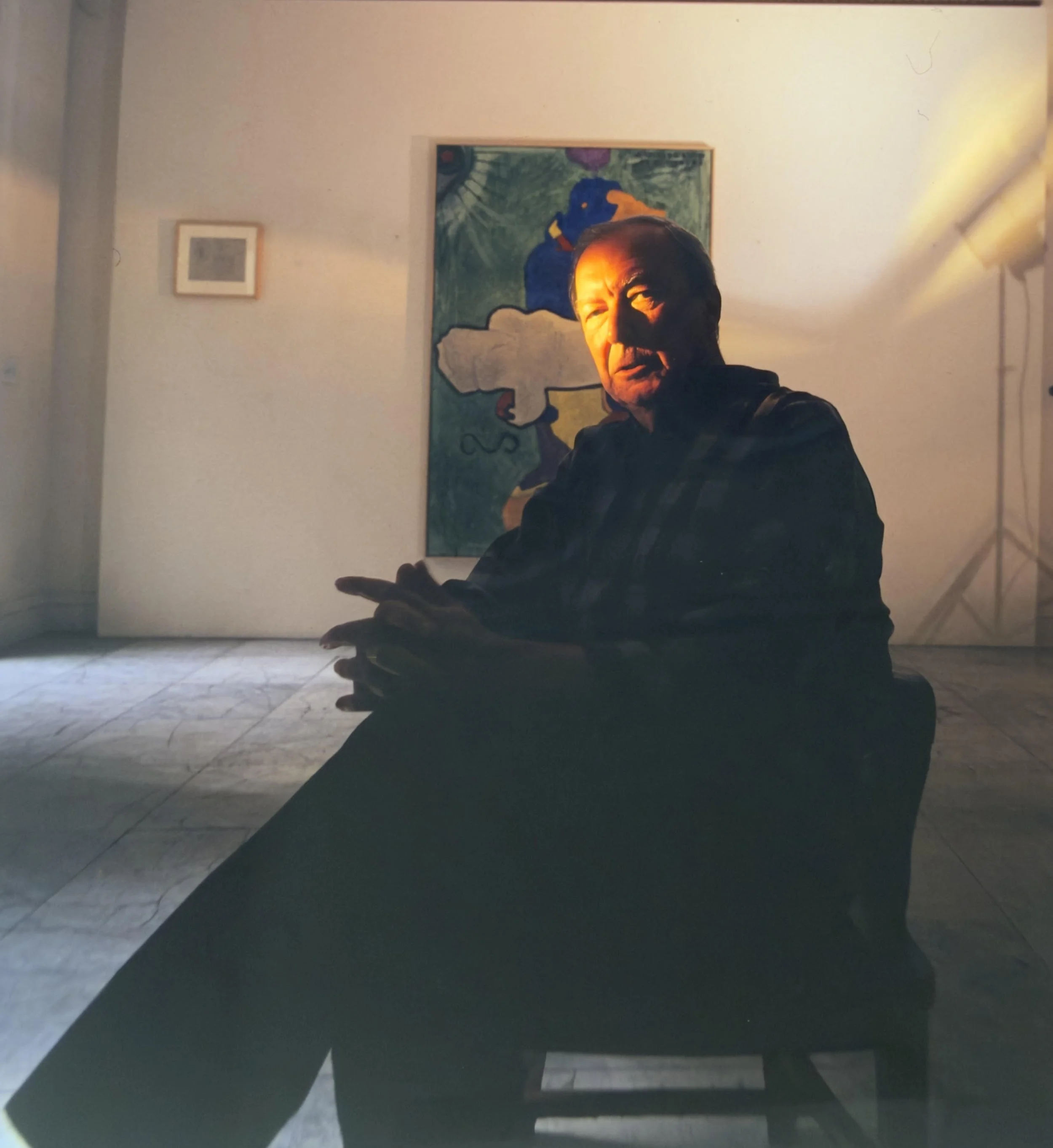
Remembering an artist of Jasper Johns’ magnitude is an easy feat of feast: Thirtyish years my senior but just the two of us sharing a moment that would never come again, yet somehow might; like the last drink of water until it is not.
When you enter his domain, you are not merely talking; you are at an intersection, intersecting. You are instantly transported to a conversation of your own making: Was there Oldenburg , Rauschenberg ,Warhol, Rosenquist, Lichtenstein “or are you just photographing me”?
The whole point of twenty-five years was to connect art history that belonged to me, my time on earth, my art.
My eyes have always turned to alternate centuries in books and art. It is simply my norm. Yet there is an infectious love for the soul of someone that can touch a canvas with their story. Standing in one of those studios, I am enraptured not by mere talent, but by the encampment of ideas sitting, flying, and posing before me in colors and imaginations unknown to me at the time.
My mind has a brevity switch: don’t say too much, don’t think too much; yet I knew Jasper Johns wanted participation. He wanted a voice, not of reason, but eyes filled with curiosities to share my art world, my days, my captures with his, and see the artists he knew through my own views.
This was chess of thought: no winner, no loser, just me on my toes. I was not seeking his famous flag paintings; I was merely looking for the arc of his time. The intimacy and sensation of something more regal than I had imagined.
I espied a number of canvases. They were not hidden from view, but they were standing like toy soldiers for another moment.
The few in view, I knew. What I didn’t know were the grand studies.
I imagined my Spartacus captured in the Roman Colosseum… a mass of discovery if only…