(This big book came out in 2023, won many prizes and reached a broad readership. I’ve often been asked my opinion of it.)
A series of interlocking encounters with memorials both musical and physical, Time’s Echo: The Second World War, the Holocaust, and the Music of Remembrance by Jeremy Eichler, former chief music critic of the Boston Globe, has a weighty, monumental bearing. Its solemn reflections center on—or, as Eichler might put it, listen to—four works spawned by the ungraspable twentieth-century crimes of the book’s title. Eichler enjoins us to hear the traumatic resonances, culturally and politically fraught, of Richard Strauss’s Metamorphosen, Arnold Schoenberg’s A Survivor from Warsaw, Benjamin Britten’s A War Requiem, and Dmitri Shostakovich’s “Babi Yar” Symphony, as well as other compositions by these composers.
A prelude and coda enclose the volume, which is divided into two parts. Pairs of chapters devoted to each of the composers follow in reverberant succession. In these spaces, lofty and lugubrious, we regard the works and their shifting meanings as our guide explicates them in a voice that is measured and often melancholic. Eichler doesn’t make use of musical notation (though he occasionally includes the letter names of notes) because he doesn’t need to. His descriptions are poetically evocative yet also specific, often brought into relief by intertextual references that assume a high level of refinement and knowledge from the reader, as in A Survivor from Warsaw, when “a high piccolo stammers out an irregular rhythm, as if dreaming of Mahler’s famous birdcalls over the abyss.” Eichler’s readings can be both energetic and elegiac. At Strauss’s memorial (to himself and his accommodations with the Nazi regime? to German music?), Eichler enjoins us to hear a work that “surges and crests almost wildly, as if its expressive content might overwhelm the slender vessel of its form, while at other moments it spirals outward to envelope the listener in a delicate haze of beauty and rue.”
Heard and seen in these echo chambers are the great figures of Art, most of them German. Bach, Beethoven, Brahms, Mozart, Mendelssohn, and Mahler appear along this back-and-forth journey of memory and music; Schiller and Lessing, Heine and Rilke, Kant and Kafka, Einstein and Mann, Wittgenstein and Zweig, and finally Freud are among many others seen and heard here. Russian, French, and English luminaries, and even an occasional American, are consulted: Pushkin, Mandelstam, Yevtushenko, Proust, Apollinaire, Shakespeare, and Wordsworth.
Earthly remains are exhumed, heroes and villains are reanimated through texts, tones, and cultural artifacts such as the desks of Beethoven and Schiller. These objects are often placed in startling, revelatory juxtaposition, as when Eichler visits Richard Strauss’s home in Garmisch-Partenkirchen in Bavaria. In Strauss’s study, an eighteenth-century bust of Gluck given to the composer by Joseph Goebbels stands not far from a painting of a Hasidic boy in his fur hat. The picture had belonged to Paula Neumann, grandmother of Strauss’s wife. Neumann died in the Terezin death camp.
Over the book’s gate of entry are two epigrams that introduce some of the load-bearing literary, philosophical, and cultural elements to be encountered inside: Theodor Adorno insists that history is the very content of music; the novelist W. G. Sebald tells us that time is solipsistic, measuring nothing but itself. Sebald is a continual presence in Time’s Echo; his habit of including small, uncaptioned black-and-white photographs in his novels is emulated by Eichler.
Slipping past these two twentieth-century titans (though the great gadfly musicologist Richard Taruskin, who makes a late cameo, never missed a chance to bash Adorno as vastly overrated), we find ourselves, when the narrative begins after the turn of a page, reclining with Goethe beneath a mighty German oak—the same tree that would later die and be felled within the Buchenwald concentration camp.
Monsters haunt these pages and its places, the murderers and wreckers of the Temple of Art and Learning: Hitler, Goebbels, Mengele, Stalin. Putin, having launched “his new war of aggression,” makes an appearance in the book’s final stages.
Eichler’s dedication to Bildung—to the ennobling value of culture in which music is a vital catalyst—is reflected in his graceful erudition. With rigorous scholarship and humane liberalism, he illuminates the dedication of so many European Jews to culture. None was more dedicated, even messianic in his zealous devotion, than Arnold Schoenberg, whose A Survivor from Warsaw “lasts only about seven minutes, but . . . is music of concentrated intensity and fierce dramatic power.” Eichler venerates Bildung and mourns its erasure by the Nazis. While condemning Richard Strauss’s accommodations with Hitler, Eichler laments that Hitler “had, in only twelve years, brought about the destruction of the entire edifice of German culture.” Time’s Echo is an eloquent attempt, if not at repair, then at recognition of the value of what was lost. Eichler’s impressively wide-ranging and always apposite references to and across European culture put his commitment to its ideals into uplifting practice.
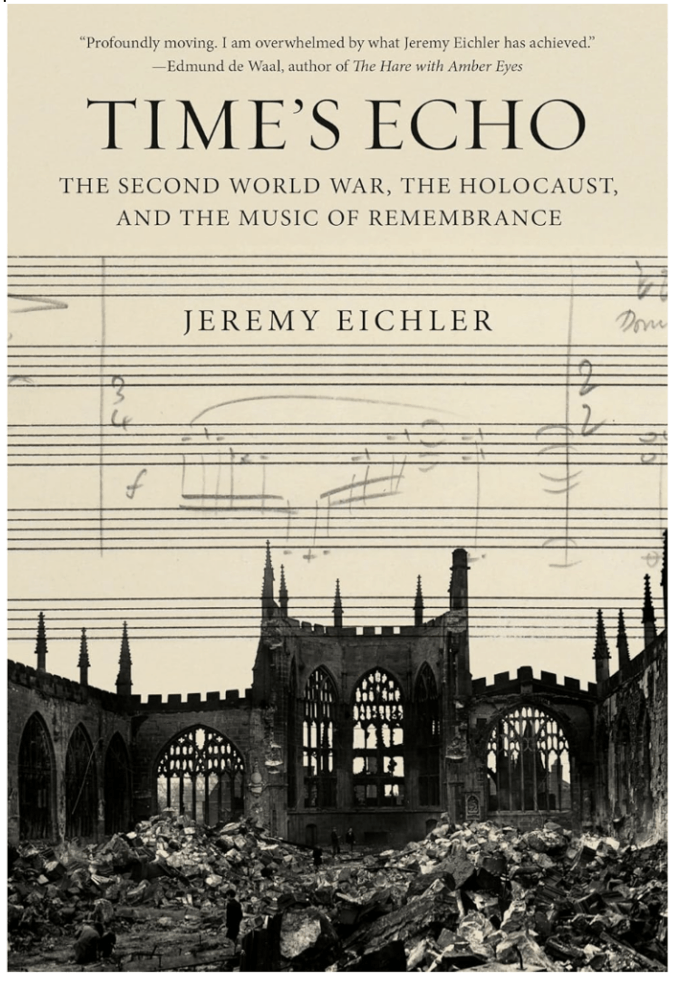
The dustjacket presents a photograph of Coventry’s medieval cathedral reduced to rubble by Nazi bombs in January of 1940, except for some crenellated, spire-crowned walls, their stained-glass windows vanished, but the stone tracery miraculously intact. Above the wreckage spreads a fragment of the autograph score of Britten’s War Requiem. The work was commissioned to mark the consecration of the new cathedral in 1962, a structure that preserved, through architectural dialogue between the modern and medieval, all the remaining ruins. The artful cover design of Time’s Echo captures the thesis of the book: that music is a uniquely powerful, even essential, medium for confronting pain; it is an art that encourages—perhaps even demands—in works such as these reflections on personal and collective trauma and the tragedies of history that cannot be confined to the past. As Adorno, Sebald, and Eichler himself remind us, the past remains present, even if that presence is not acknowledged as openly as it is, for example, by the Coventry architecture. That Britten’s autograph score rises above the cathedral rubble gestures toward transcendence, toward a better world that leaves behind, yet does not forget, the realities of extermination camps, mass executions above open pits, fire-bombings.
Eichler tallies the human dead at Coventry (568 killed, 863 injured) and tells us that the “bombing instantly became a symbol of Nazi savagery.” As result, he then reports, “Allied bombing campaigns gained momentum.” No mention is made of Alexander Kluge’s Luftangriff auf Halberstadt am 8. April 1945 (The Airstrike on Halberstadt on 8 April 1945) nor of Sebald’s devastating confrontation with the Allied air war that killed so many civilians and destroyed so many cultural monuments.
Each of the monumental musical works leads Eichler, camera in tow, to real monuments: to Coventry Cathedral; to the Cenotaph in London; to the vanished Ukrainian ravine of Babi Yar where more than 30,000 Jewish residents of Kiev were murdered by the Nazis in September of 1941. Eichler also makes his pilgrimages to the graves of the composers: Strauss’s at his villa in Garmisch-Partenkirchen in Bavaria; Schoenberg’s in Vienna’s Central Cemetery, his remains removed from Los Angeles and interred back in his homeland in 1974. We visit the reconstructed monument to Mendelssohn outside the Gewandhaus (the original was destroyed by the Nazis in 1936) in Leipzig, and the invisible Holocaust memorials in the German city of Saarbrücken, where the names of murdered Jews are placed on the bottom of cobblestones and facing into the earth. We see a photograph of the plaque that marks the cornerstone of the New York Holocaust memorial that was never built.
Eichler’s itinerary is heavy with portent and loss. Light glimmers occasionally and his gaze turns upward in the book’s coda, to the sky above the Mendelssohn monument. Then dusk enfolds the statue and the author.
(To be continued next Friday, but with other monuments and music)