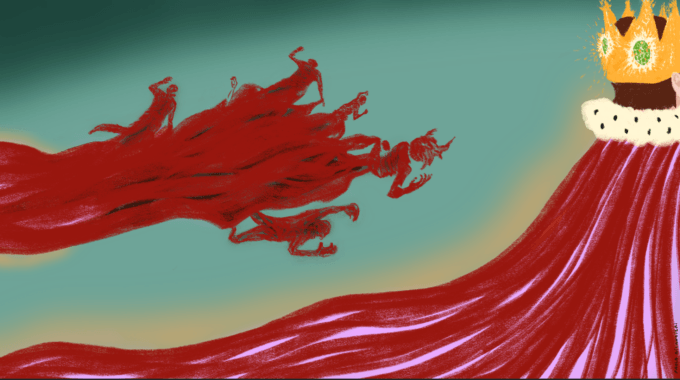
Illustration by Paola Bilancieri.
History gave us the term “Pyrrhic victory” to describe triumphs so costly they hollow out the very meaning of success. King Pyrrhus of Epirus learned this the hard way. After defeating the Romans at Heraclea and Asculum in the third century BC, he surveyed his decimated forces and reportedly declared, “One more victory over the Romans and we are completely done for.” His words endure because they capture a truth that transcends eras: a victory that destroys the victor is no victory at all.
Today, that ancient warning echoes with painful clarity in the aftermath of the war in Iran. Some leaders insist on calling the outcome a victory, but the landscape they leave behind tells a different story — one of immense civilian loss, environmental devastation, and a profound erosion of moral and political credibility. If this is victory, it resembles defeat in every meaningful sense.
The U.S.–Israel strikes on oil facilities, water infrastructure, and industrial sites have caused profound environmental damage. As a result, civilians of all ages — especially children, the elderly, people with chronic illnesses, and those displaced from their homes — bear the greatest suffering.
UNICEF has issued increasingly stark warnings that Iran’s children are paying the highest price for the violence unleashed in the country. In some of its latest statements, the agency condemns the strikes that have leveled schools and hospitals, including the attack in Minab that killed 168 girls between the ages of seven and twelve. UNICEF calls these deaths “a brutality measured in children’s lives” and insists that classrooms and clinics are protected spaces under international law. With strikes reported across eighteen provinces and families describing widespread trauma, the agency urges all parties to protect civilians, safeguard essential infrastructure, and prevent a generation from being shaped by unrelenting fear.
The human toll is immeasurable. Beyond those killed directly by bombs and missiles are the millions whose lives have been upended by displacement, hunger, disease, and the collapse of essential services.
Hospitals and medical services are under increasing strain, with disruptions affecting the delivery of critical health care. Damage to 442 health facilities across the country is disrupting access to essential services for an estimated 10 million people, according to Iran’s Ministry of Health and the Iranian Red Crescent Society (IRCS). Save the Children reports that pregnant women across the region are being forced to give birth in unsafe conditions, without essential supplies and sometimes without electricity.
Schools, hospitals, homes, bridges — the architecture of everyday life — have been reduced to rubble. These are not the trophies of victory; they are unmistakable signs of a society’s future being dismantled. In the name of victory, justice has been sidelined. Accountability has evaporated, and the international norms meant to restrain the powerful have been treated as optional. When nations abandon the principles they once pledged to uphold, the world becomes more dangerous for everyone, not only those living in the conflict zone.
Pope Leo XIV, addressing bishops of the Chaldean Catholic Church, condemned the war unequivocally. He reminded them — and the world — that no cause can justify the spilling of innocent blood. He urged them to proclaim that God does not bless conflict, and that disciples of peace cannot stand with those who wield the sword one day and drop bombs the next.
The economic costs of the attack on Iran are staggering. University of Michigan professor Justin Wolfers casts serious doubt on the Pentagon’s estimates. He argues that when all factors are considered — the Tomahawk and Patriot missiles fired, the warplanes flown and, in some cases, lost, and the rest of the gear consumed — the costs are far higher.
Only in Iran, the US and Israel bombings have killed more than 3,000 people, and injured more than ten times that number. To these must be added the medical care of all those injured and in need of permanent rehabilitation. His estimate is that the war will ultimately cost hundreds of billions of dollars.
As in all wars, arms manufacturers and dealers gain is humanity’s loss. Arms manufacturers are experiencing significant profit surges from the Iran war, driven by rising stock prices tied to new Pentagon contracts. In addition, the near shutdown in oil and gas deliveries has led some countries, like South Korea and Japan, to an increased use of dirtier fuels like coal.
The war has not resulted in almost any of the objectives set by the US and Israel. The Iranian regime has not been eliminated, just replaced by even more aggressive leaders, and there has not been a total destruction of Iran’s capacity to build missiles, which are able to reach Israeli main urban areas.
What remains after this confrontation is a landscape of ruins — quiet, but deeply incriminating. They reveal a truth that official narratives cannot conceal: when victory is measured in poisoned rivers, shattered homes, grieving families, and the collapse of justice, what has been achieved is not victory at all. It is a defeat — not only of human rights and international law, but of the very spirit that makes us