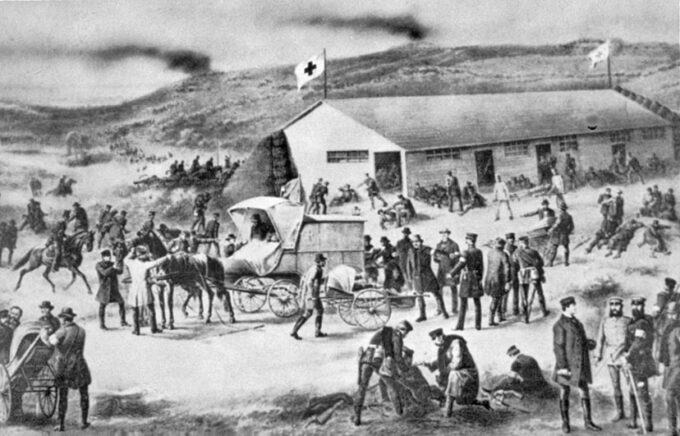
The International Red Cross in action, 1864. Public Domain.
The United States is going through a period of gloom and doom. Confidence in its institutions has fallen, politics is deeply polarized, and talk of decline has now become mainstream. The American Dream has turned into a global nightmare. But most importantly, the question is not simply whether the United States is declining; it is whether there can be a national renewal.
The United States has renewed itself before as part of broader social awakenings. During the nineteenth century, revival movements helped generate the moral energy behind some of America’s most important reforms. Beginning in French-speaking Switzerland and spreading across Europe and the U.S., the specific Réveil Movement was a moral and institutional amplifier that transformed discontent into civic action.
Why is the Réveil relevant today? This is not to suggest that Christian evangelism will necessarily produce a revival in the United States. On the contrary, the Réveil was not confined to a particular church orientation. Rather, it represented a broader spiritual awakening that challenged the dominant rationalism of the Enlightenment and reasserted the importance of emotion, personal faith, and civil activism.
The significance of the Réveil therefore lies less in its specific religious expressions than in the conditions that gave rise to it and its response. The nineteenth-century Enlightenment placed its faith in reason. We place ours in algorithms, AI and influencers. Then, people believed that scientific progress would solve social problems. Today, many assume that better technology, more data, social media, and smarter markets will do the same. If a revival is possible in the present era, the key question is whether there exists a comparable hunger for meaning, community, and civil activism to that which fueled the Réveil.
This is not an argument about China’s rise, America’s debt, or whose GDP is bigger. It is about the potential for a renewal. The historic Réveil emerged during a period of profound change and uncertainty. Could a similar awakening emerge from today’s atmosphere of pessimism and division? Can a nation that appears exhausted politically rediscover the energy needed to renew itself?
Le Réveil was less a theological revolution than a spiritual reawakening. Across Europe, the Réveil inspired schools, orphanages, Bible societies, charitable associations, prison reform, and missionary work. In Geneva, it helped shape a civic culture that influenced Henry Dunant and his followers. After witnessing the carnage at the 1856 Battle of Solferino, Dunant and his colleagues founded the humanitarian International Committee of the Red Cross (ICRC) as a spinoff from the Public Welfare Society of Geneva. In this sense, revival movements are best understood less as originators of reform than as accelerators—turning latent ethical concern into a durable institutional form.
Outside Europe, a similar revival took place in Britain and the United States. In Britain, the evangelical revival helped energize the anti-slavery movement, culminating in the abolition of the slave trade in 1807 and slavery throughout most of the British Empire in 1833. Revivalist networks also supported prison reform, education for the poor, and campaigns against child labor and other social abuses.
In the United States, the Awakening helped inspire some of the most important reform movements of the nineteenth century. The abolitionist movement drew heavily on revivalist ideas about the equality of all souls before God and the moral duty to confront injustice. Activists such as Frederick Douglass, William Lloyd Garrison, and Harriet Beecher Stowe appealed not merely to political interests but to the nation’s conscience. As Douglass put it, “I prayed for twenty years but received no answer until I prayed with my legs.”
Reformers such as Horace Mann championed universal public education as a means of creating informed and responsible citizens. Many of the women who organized the landmark Seneca Falls Convention of 1848, the first major women’s rights convention in the United States, first gained experience through religious and abolitionist networks that had emerged from a revival culture, where reform was often framed in moral terms, such as Lucretia Mott’s belief that “the cause of the oppressed is the cause of God.”
Most relevant to today, the U.S. Great Awakening helped create a vibrant civil society. Thousands of voluntary associations sprang up across the country—from church groups and charitable societies to anti-slavery organizations and the Lyceum movement, which brought public education and civic debate to communities across the nation. Ordinary citizens increasingly believed they had both the right and the responsibility to improve society. As Dunant and his colleagues created the ICRC in 1863, Clara Barton made it transatlantic when she founded the American Red Cross in 1881.
This tradition of civic service and institution-building did not completely die after the nineteenth century. As an example, President John F. Kennedy established the Peace Corps in 1961. Like many earlier reform movements, the Peace Corps reflected the belief that ordinary citizens could contribute to the public good abroad through organized action rather than private interest alone. In the same spirit, AmeriCorps continues this legacy today by mobilizing citizens within the United States in service programs across education, poverty alleviation, and community rebuilding.
Mine is not a call for a revival of religious evangelism. As the political scientist Michael Barnett has properly noted of the Awakenings: “Evangelism provided a calling for public action and social reform.” Dunant, after all, refused a Christian burial at the end of his life. Rather than just religious reform, the Réveil movements generated a conviction that individuals had both the power and the obligation to improve society. They transformed private faith into public action.
The #MeToo movement, Black Lives Matter, Occupy Wall Street and protest movements like the recent NoG/7 demonstrations in Geneva demonstrate that moral discontent is intense today. Yet they also reveal a key difference from earlier revival movements. The great achievement of Le Réveil and the Great Awakenings was not simply that they challenged institutions; it was that they created new ones. Their legacy was not protest alone, but public schools, charities, reform societies, and lasting civic organizations.
Ultimately, the issue is not whether the United States is in decline. The real question is whether it can renew itself from within. If the United States is to experience its own réveil, it will require moral imagination and civic energy to build new organizations. The country is not suffering from a shortage of outrage. It suffers from a shortage of institution-builders.
That, perhaps, is the enduring legacy of Geneva’s Réveil. Henry Dunant, Louis Appia, Guillaume Henri Dufour, Théodore Maunoir, and Gustave Moynier did not simply condemn the suffering they saw. They built an institution that outlived them, the ICRC. The question for America today is whether it can build similar institutions through a civic revival.