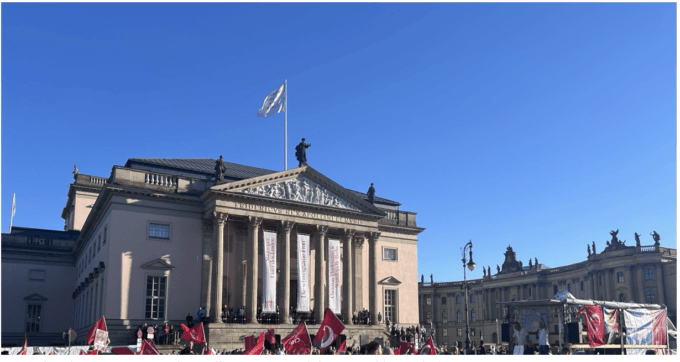
An Anti-Erdoğan moves past the Berlin State Opera. Photo: David Yearsley.
The last in the series of European spring holidays brought with it another long weekend. The occasion was Pentecost, when the mighty gusts of the Holy Spirit buffeted the Apostles gathered in a room in Jerusalem and set them to babbling in diverse languages, their belief bolstered not just by wind power but by heavenly, and therefore presumably carbon-neutral, Tongues of Flame.
A couple of millennia later, the Pentecostal weather in northern Europe was searing. Like a climatological cathedra-cum-sauna, a heat dome had erected itself over the continent. Was it the Holy Spirit trying to fire the faith, or the Angel of Super El Niño breathing hot and heavy on Berlin as prophecy of a blazing summer?
Perhaps the mysterious language of music would suggest some answers, pose relevant questions, or help at least calm apocalyptic fears.
First on the itinerary was Saturday night in the Berlin Philharmonie, the famed concert hall whose golden, faceted aluminum cladding glints with fiery purpose in the long evening light advancing towards midsummer.
The weekend was big enough to accommodate the longest symphony in the canonic repertory—Mahler’s Third. The first of this epic’s six movements alone exceeds thirty minutes, surpassing the duration of an entire four-movement symphony by Mozart or Haydn. The entire work stretches past an hour and a half.
It went by in a flash. Along the symphony’s epic arc, the colossus clung to each moment—from the eight horns proclaiming the portentous, proud opening theme to the Adagio finale’s massed intimacy, ten dozen musicians surging from whispering solace into timpani-laced, brass-boosted, blindingly radiant D-major transcendence. Along the way, the first movement’s tam-tam-and-timpani-bolstered brilliance was followed by a sylvan oboe solo ushering in a graceful menuet. In the third movement scherzo, the tiny, tightly coiled post horn contended with a military trumpet that can’t help but be heard as a late-19th-century harbinger of the impending catastrophe of the 20th.
The celebrated American mezzo-soprano Joyce DiDonato had waited patiently for the better part of an hour before rising in the fourth movement to intone Friedrich Nietzsche’s warning—“O Mensch! Gib Acht!” (“O Man, Pay Heed”)—above muted strings and a contingent of horns, no longer stentorian as at the symphony’s opening, but receded to subliminal realms. DiDonato’s husky, haunting voice imbued her admonitions with a foreboding tempered by sympathy.
Guest conductor Yannick Nézet-Séguin, artistic director of both New York’s Metropolitan Opera and the Philadelphia Orchestra, attended to these individual episodes and the work’s overall majesty with yearning devotion and characterful animation—crouching, rocking, coaxing, clawing, using every inch of his square podium.
For the fifth movement, the women of the Radio Chorus of Berlin (ROC) and the boy choir of the Berlin Cathedral rose and joined in with “bimm bamm, bimm bamm”—humming in tongues. Like the ecstatic, babbling Apostles of yore, one could understand what they meant, even if the women hadn’t intervened with their cheerful hymn: “Three angels were singing a sweet song, / With joy it resounded blissfully up to heaven.” (“Es sungen drei Engel einen süßen Gesang; / Mit Freuden es selig in den Himmel klang.”) Even amidst the exuberance, humanity wept and DiDonato pleaded for God’s forgiveness on the way to eternal joy and the finale’s message of unlimited love.
Mahler provided evocative titles for each of the movements of his Third Symphony. The first is: “Pan Marches In, Summer Awakes.” Summer is already here, and Mahler’s symphony foretold of harrowing Pentecostal heat, relieved perhaps in the sixth movement (“What Love Told Me”) with visions of off-world escape. Mahler had originally planned a seventh movement entitled “Heavenly Life.” Instead, he displaced it to his Fourth Symphony. At the close of the Third, the symphonic soul is already ascending.
At the 1896 premiere under Mahler’s own direction, the composer-conductor was called back to the podium more than ten times; the applause lasted at least a quarter of an hour. That rapturous reception was matched on Saturday night in Berlin. Although Nézet-Séguin exited and returned fewer times than Mahler had in 1896, the standing ovation he received was itself a great sforzando, unabating as he made his way through the onstage ranks, kneeling and folding his hands in prayerful gratitude before various soloists, hugging some, kissing others’ hands. The conductor glowed like a bottled-blond angel come to earth. In the Temple of Art that is the Philharmonie, the secular gave way to the sacral.
Pentecost Sunday was hotter still. The church bells rang, but we did not go to church. We took the train an hour south to Halle, birthplace of Handel and now home to a wonderful regional opera, one of more than 80 in this country. That makes for one opera house for every million German citizens and a Gross National Opera Product that accounts for a third of global output, which included the weekend’s new staging of Franz Schreker’s Das Spielwerk und die Prinzessin(The Music Box and the Princess) in Halle’s gracious, not-too-grand 19th-century opera house. With its classical pediment and columned portico, the building sits atop a gentle hill with a reflecting pond beyond the plaza. This façade worked in aesthetic counterpoint to the crazed, expressionist goings-on inside on that Pentecost Sunday evening.
Schreker was big in his day, a status attested to by this opera’s double premiere—on the Ides of March, 1913—simultaneously in two major German-speaking cities, Frankfurt and Vienna. Schreker wrote the libretto and the music. Das Spielwerk und die Prinzessin is a phantasmagoric, fatalistic tale of obsession, suspicion, rumor, massed hatred, retribution, self-destruction, and impossible hope: Richard Wagner’s Ring des Nibelungen meets Mary Shelley’s Frankenstein meets Fritz Lang’s Metropolis. The eponymous Spielwerk is never seen, though there is a reference to whistling pipes. Schreker was also an organist.
Director Nele Lindemann’s production, designed by Zana Bosnjak, elevates the unseen contraption to the level of allegory in video projections of images that morph from microchips to motherboards, viruses to cancer cells, eyes to synapses, and finally to flames—not Pentecostal, but infernal. Innovation leads to immolation. The high-born princess, the mad scientist, and the rabble self-incited to rouse and burn were lank, gothic, tie-dyed, and deadly. They moved and sang through opera’s dark province, with its imaginary castle and workshop, as if in the thrall of some irresistible force of which the orchestra is both manifestation and source.
Wanton and world-weary, the Prinzessin was sung with tremendous vocal and emotional power by Franziska Krötenheerdt. Her entire performance—hair-raising for the audience, though she had only a few greasy strands on her pale head—was one long, bizarre exit aria interrupted by riveting individual performances from the outstanding cast. Her jagged melodies and soaring lines reached fever pitch and frenzied volume in the final carnage, the locomotive to hell stoked by the massive onstage orchestra under Fabrice Bollon. These musicians were partially visible beyond the video screen, violin bows probing the gray matter. In 1913 and 2026, one could see and hear the end of both the Old Order and the present tech oligarchy. Play on, Music Box, until the flames engulf you!
Monday night we were back in Berlin at the State Opera (Staatsoper) to end the extended weekend in comedy: Richard Strauss’s Die schweigsame Frau (The Silent Woman) of 1935. Based on an Elizabethan play by Ben Jonson, the libretto was written by Stefan Zweig. Adolf Hitler intervened to allow the opera’s premiere even though the text was the work of this Jewish author. Strauss insisted that the playbill include Zweig’s name, and the production was halted after just three performances.
The piece is a non-stop display of musical and literary wit, the rampant hilarity generated by the range of knowing allusions and the torrent of madcap misdirection. The dyspeptic central figure, Sir Morosus, is an antisocial enemy of urban and domestic noise. Peter Rose sang the role with gruff impatience that in the end turned lyrical and sympathetic. The constantly shifting orchestral textures and tempos were managed with finesse, but also a freewheeling sense of fun, by Christian Thielemann, now concluding his second year as general music director of the Staatsoper.
Jan Philipp Gloger’s production was set in the present in a big Jugendstil Berlin apartment. During the overture, yet more video projection showed a computer screen and an internet search for a place to rent. The audience (many paying three figures for their tickets and not much worried about making their monthly payments) laughed at the desperate clicking through outrageous prices demanded for scant square footage.
The search was being done by Morosus’s ne’er-do-well nephew and hopeful heir, Henry. He turns up at his uncle’s apartment, moves in with a whole troupe of itinerant thespians, and helps plot to have his uncle marry one of his theatre friends acting the part of the silent and devoted potential wife. This set-up leads to much comedy fueled by endemic misogyny. The role of Henry was sung by Siyabonga Maqungo, whose resplendent, agile tenor voice could make any opera lover—or even opera hater—change his or her will to the singer’s benefit.
Women are not the only ones who endure the barbs of manly humor. Along with wordless wives, Turks are made fun of a few times too, as when Morosus is shown a trio of potential brides. “Three?” he cries. “What am I, a Turk? One is already one too many.” Later, as the second of the opera’s three acts careens towards intermission, Henry reacts to the general mayhem by asking, “What’s happening? Are the Turks loose?”
The answer that evening was: Yes. Outside, a Turkish protest bore down on the opera house. The protestors were proceeding slowly along Unter den Linden, the broad avenue that runs in front of Humboldt University, the formerly royal palaces, and current embassies to the Brandenburg Gate. One might at first have thought that this parade was part of the production, bursting not just through the Fourth Wall but the Berlin Wall to boot. These Turkish women were far from silent.
But they were not marching against Strauss and Zweig. They were protesting the imprisonment of Istanbul’s opposition mayor, Ekrem İmamoğlu, jailed now for more than a year on trumped-up corruption charges.
As the white stars and crescents on burning red backgrounds continued past the equestrian statue of Frederick the Great (who had the opera house built in 1740), the audience filtered back in for more hijinks and, at last, a happy ending—not of Mahlerian transcendence or heavenly redemption, but of utter earthly frivolity.