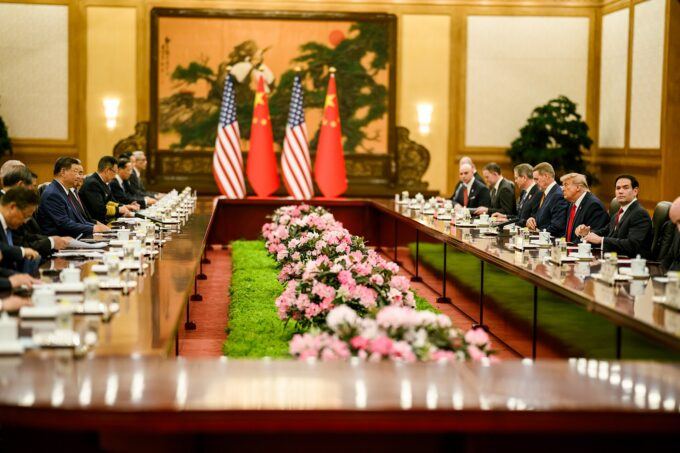
Photograph Source: The White House – Public Domain
During Donald Trump’s embarrassing trip to China, China’s Secretary General Xi Jinping made a speech, in which he said, “We must not be caught in the Thucydides Trap”. It’s notable in that it places the US and China on the same level, and as facing the same danger (the Chinese expression that was translated as “we”, translated literally, becomes “America and China”, which makes it slightly clearer just who is in danger of this entrapment). And it’s a useful, if obvious, statement that, in order to avoid this trap, these two superpowers must find a way to cooperate.
But what is the Thucydides Trap? The expression was coined by novelist Herman Wouk (The Caine Mutiny) in a talk at the Naval War College during the Cold War (16 April, 1980). It was revived by political scientist Graham Allison in 2017. It refers to a statement in Thucydides’ The Peloponnesian War, that the true cause of that war was the rising power of Athens. Allison argued that this phenomenon–where the challenge to a hegemon by an upstart power leads to war–occurs often enough to deserve a name, and so named it The Thucydides Trap.
As a candidate for a Law of Politics, The Thucydides Trap has received much criticism. Each of the wars Allison gave as examples of countries having fallen into this trap has too many peculiarities to be explained by a single causal factor. And stripped of those peculiarities, the Law is reduced to something close to a tautology, about as useful as “quarrels often precede fights”. Moreover, it lends support to the notion that wars are caused by structural factors, something that “break out”, rather than something caused by human agency, leading to the corollary that the people who facilitate them need not feel responsible for what they have done. Moreover, understanding that “if things go on like this, it could lead to war” is not a dependable deterrent, if the policymakers in the quarreling countries are confident that they would win that war (hubris).
But most certainly we need to avoid falling into that trap, and to that end I think we need to look more carefully at what the Historian himself had to say about it. Thucydides never used the word “trap”, put great emphasis on human agency (arguably was the inspiration for Hannah Arendt’s notion of “action”) and had a way of spreading out his messages all through the book in such a way that many readers fail to notice the connections among them. Several years ago, in my book Radical Democracy (Cornell, 1996), I devoted some pages to searching out those connections.
Below is an extraction of those pages.
Democratic Empire Athens
Few contemporary writings in praise of Athenian democracy have survived. Historians rely heavily on the Funeral Oration of Pericles, as recorded by Thucydides. Textbooks often refer to this speech, typically referring to the paragraph on the constitution and on the spirit of equal justice and mutual tolerance that prevailed among the citizens. It is important, however, to read this paragraph in the context of the whole speech, and moreover to consider the speech in the context of the entire work of Thucydides. In that context, the historian intends the speech to explain not so much Athens’s domestic happiness or justice as its extraordinary and unprecedented form of power.
Thucydides, the first political historian (arguably the first historian) in the West, begins his work by seeking to demonstrate that the war he is chronicling is “a great war, and more worthy of relation than any that had preceded it.”Not only is it the greatest war, but “the greatest movement yet known in history, not only of the Hellenes but of a large part of the barbarian world – I had almost said of mankind.” He does not simply make this point in passing, but argues it at length. In ancient times, he says, there was nothing to compare to this war: “Before the Trojan War there is no indication of any common action in Hellas.” Agamemnon’s expedition against Troy “ may be pronounced on the evidence of what it effected to have been inferior to its renown and to the current opinion about it formed about it under the tuition of the poets.”As for the tyrants, “their habit of providing simply for themselves, of looking solely to their personal comfort and family aggrandizement, made safety the great aim of their policy, and prevented anything great proceeding from them.
Finally, the historian says, the tyrants were overthrown and two great powers emerged. The first of these he introduces by reference to its political institutions: Lacedaemon had “enjoyed freedom from tyrants which was unbroken; it has possessed the same form of government for more than four hundred years . . . and has thus been in a position to arrange the affairs of other states”.
The other power was Athens, but here the historian says nothing about the form of government of the polis. Instead, he introduces the Athenians by telling of something they did: at the time of the second Persian invasion “the Athenians, having made up their minds to abandon their city, broke up their homes, threw themselves into their ships, and became a naval people.
In modern times we have examples of peoples abandoning their cities in the face of enemy invasion but always in the form of streams of fleeing refugees, taking with them as many of their possessions as they can carry. The transformation of citizens into refugees also amounts to a kind of political change of state: the dissolution of the city as a political entity. The Athenians, Thucydides tells us, left architectural Athens behind them, even destroying the buildings so as to emphasize the point, but brought the polis with them. Let us admit that Thucydides is exaggerating (in fact some Athenians stayed behind) , as he sometimes does to make his idea clear. What he has done in this short sentence is to give us a brilliant image with which to grasp the unprecedented nature of the power generated by this fusion reaction called Athens.
Thucydides details the many circumstances that led to the war, but the “real cause”, he says, was “the one which was formally most kept out of sight.” This was “the growth in the power of Athens”. [This is the passage on which the Thucydides Trap hypothesis has been founded.] Thucydides does not romanticize what the Athenians did: the war was “without parallel for the misfortunes that it brought upon Hellas” and the book’s descriptions of the horrors of war are without parallel in historical writing. At the same time it is the power of the Athenians that gives the historian a tale to tell.
Thucydides tells us that one of his historiographical innovations was “computing by summers and winters” rather than by using genealogies or the names of magistrates as the way of ordering the events in time. This method was not simply a clever new discovery that earlier historians had not hit upon. The point of Thucydides’ opening paragraphs is to tell us that until now the method of ordering the events of Hellas according to summers and winters would not have yielded a story. Chroniclers up to then had told the different stories of different cities, for which the genealogies of the leading families were adequate to order the events. Thucydides’ narrative is “more worthy of relation” than any other because this is the first time that all Greece was entangled in public events on such a scale. It is the first time that public events on that scale had been ordered so as to be tellable. Thucydides is able to be the first political historian because the world itself was forcibly reordered into “historical” form. And, says Thucydides, what forced the world into that form was Athenian power. All Greeks had to be either participants or audience: the leading cities joined one side or the other, “while the rest of Hellas stood straining with excitement”.
This history forms the context for Pericles’ speech. Seen in that context, some of the sections we might tend to dismiss as mere bombast take on new meaning. Thucydides, who has already said that his book will be “a possession for all time”, has Pericles say,
The admiration of the present and succeeding ages will be ours, since we have not left our power without witness, but have shown it with mighty proofs; and far from needing a Homer for our panegyrist, or others of his craft whose verses might charm for the moment only for the impression which they gave to melt at the touch of fact, we have forced every sea and land to be the highway of our daring, and everywhere, whether for evil or for good, have imperishable monuments behind us.
State of Democracy/State of Plague
We should to forget that this speech was given at a funeral. The bodies of the first young men to die in the war had been laid out for three days in public, there had been a procession with wailing, the bodies had been buried. Before Pericles stand the parents, sisters, brothers, wives, children of these dead young men; his task is to induce them to shift their attention from the brute fact of the dead bodies which they have just seen go into the ground to the political body for which the men have died. In this it is a classic wartime speech, a kind of battle between the eye and the ear, in which Pericles works to convince his audience to grant less credibility to what they have seen to what they can hear: his words. “You must yourselves realize the power of Athens, and feed your eyes upon her from day to day, till love of her fills your hearts [and] all her greatness shall break upon you”.
The speech is a brilliant success, it is all that its reputation says it is. One can sense that Pericles knows that he has done his job well when he concludes, “And now that you have brought to a close your lamentations for your relatives, you may depart.”
In the very next paragraph, Thucydides tells us that soon after this speech, the plague appeared in Athens. Let us assume that it is no coincidence that this subtile historian placed his descriptions of the Funeral Oration and of the plague back to back. For the description of the plague is precisely the logic of the Funeral Oration turned on its head. It is as if the repressed body has returned to take vengeance on Athens for having been slighted and to remind the Athenians that from its logic, death is merely death. If Pericles’ speech is a triumph of the mind over the body, the plague “first settled in the head, [and] ran its course from thence through the whole of the body.” Against the blank absurdity of death, Pericles has set the beautiful order of the city, an order in which a just relation of cause and effect is guaranteed: sound policies bring good results, virtue is recognized and rewarded, and the future is guaranteed as a space in which actions in the present will continue to ramify and in which they will be remembered. The Plague, Thucydides tells us, overturns this logic of cause and effect. The disease itself, he says, had “no ostensible cause”. Moreover, no sort of medical treatment had any effect on it. “Some died in neglect, others in the midst of every attention. No remedy was found that could be used as a specific; for what did good in one case, did harm in another. Strong and weak constitutions proved equally incapable of resistance, all alike being swept away.” And if wisdom brought no result, neither did virtue gain a reward. “There was the awful spectacle of men dying like sheep. through having caught the infection in nursing each other. ….. This was especially the case with such as made any pretensions to goodness”.
With no reasonable relation between cause and effect, the future disappears as an intelligible category, and neither nor virtue remain as sensible guides to action…..
Fear of gods or law of man there was none to restrain them. As for the former, they judged it to be just the same whether they worshipped them or not, as they saw all alike perishing; and as for the last, no one expected to be brought to trial for his offenses, but each felt that a far severer sentence had been already passed upon them and hung over their heads, and before this fell it was only reasonable to enjoy life a little…..
Finally, as though the plague were determined to drag the logic of the Funeral Oration down to its final degradation, it made even proper funerals impossible.
All the burial rites before in use were entirely upset and they buried the bodies as best they could. Many, from want of the proper appliances, through so many of their friends having died already, had recourse to the most shameless sepultures: sometimes getting the start on those who had raised a pile, they threw heir own dead body upon the strangers’s pyle and ignited it; sometimes they tossed the corpse which they were carrying on top of another that was burning and so went off.
Earlier in his scientific description of the disease, Thucydides notes,
All the birds and beasts that prey upon human bodies, either abstained from touching them (though there were many lying unburied) or died after tasting them, In Sophocles’ Antigone the most extreme expression of the pollution brought down on Thebes by Creon’s refusal to bury Polyneices was that domestic dogs ate of the body and “brought the stench of [his] great crime to each hearth.
With what extraordinary dry restraint does Thucydides conclude the previous passage: “But of course the effects which I have mentioned could be best studied in a domestic animal like the dog”.
+++
Athens’ state of democracy, as Pericles describes it, and the state of plague are mirror images of one another. The latter is the deconstruction of the former, which help us to see what it is made of. …. But Thucydides is no objective social scientist; he has a moral tale to tell as well. And the state of democracy in in Athens is not only democracy, it is democracy-at-war, democratic empire, “to speak somewhat plainly, a tyranny”, as Pericles says later. The absolute sacrifice of the body which Pericles calls for in the name of democracy is actually needed to protect and expand the empire. Athens is a fusion reaction without a vessel to contain it. While political virtue and their laws keep the Athenians mostly just to one another, outside the polis is a moral void, with little to slow them down. The Athenians are pure action, “they were born into the world to take no rest for themselves and to give none to others, said a Corinthian speaker at the beginning of the war; “We cannot fix the exact point at which our empire shall stop”, says Alcibiades toward the end.
Yet Thucydides suggests that there is something, a kind of rudimentary principle of international justice, which the Athenians could have used to contain their endless expansion. He mentions it several times, most forcibly through the lips of the people of the tiny island of Melos.
From the Island to the River
You will remember the story. It is a time of truce between Athens and Sparta. The Athenians have landed on Melos, and invited the citizens to show them why they should have any choices other than to surrender or to die. In an eerie parody of the Socratic method, the Athenians propose that instead of exchanging speeches, the two sides could better get to the truth of the matter by engaging in a dialogue : “Take us up at whatever you don’t like and settle that before going any farther.” The Athenians further propose the both sides dispense with “specious pretenses”: the Athenians will not argue that they have a right to their empire, and in return the Malians should not argue that they have done the Athenians no wrong, “since you know as well as we do that right, as the world goes, is only a question between equals in power, while the strong do what they can and the weak suffer what they must”.
In response, the Melians, under the Athenian demand that they speak only from interest and never from justice, argue that the Athenians would find it expedient that they “should not destroy our common protection, the privilege of being allowed in danger to invoke what is fair and right, and even to profit by arguments not strictly valid if they can be got to pass current”. The argument is remarkable. In the international (or strictly speaking , “interpolitical”) arena, there is no law. Fairness and right do not exist, but it is expedient to act as if they do. For whom is it expedient? Fairness and right, apparently, are useful only for the weak. But the Melians argue that the strong, even when they have the power to ignore and destroy these principles, should not, but should leave them as a “common protection”. They should do that because of the factor of fortune which is “is sometimes more impartial than the disproportion of numbers might lead one to suppose”. You are the stronger, but you cannot know that you will be the stronger forever. So even the Athenians ought leave those principles intact, against the day when their power may fail them. Or rather, especially the Athenians, “as your fall would be a signal for the heaviest vengeance and an example for the world to meditate upon”.
But the Athenians’ power is too great for them to take such a possibility seriously. They cannot form an image of themselves reduced to the position of pleading for just treatment. One can almost hear the amused contempt in their voices when they reply to the Melians, “This …. is a risk we are content to take.”
After more fruitless exchange, the dialogue ends, the Melians resolve to fight, and the siege of Melos begins. The Melians soon surrender to the Athenians, “who put to death all the grown men they took, sold all the women and children for slaves, and subsequently sent out five hundred colonists and occupied the place themselves”.
What is this grisly little tale about? We are not told that the capture of Melos was of any particular strategic importance in the war. As for the dialogue itself, there is no clear winner, both sides use flawed reasoning; what lesson, if any, does the historian want us to draw from these events? For many modern scholars, the lesson is that there is no lesson, if “lesson” means a solution to the dilemma posed by the moral void at the center of international politics. The historian, however, at least in this case has a different take on the question ; for him the story is not over yet. This is shown by the way he has located this dialogue in his narrative. As with the Funeral Oration, the meaning of the Melian Dialogue is revealed in the sentence that immediately follows it. The sentence is, “”That same winter the Athenians resolved to sail again to Sicily”.
The Melians were not sentimentalists, but seers. In the dialogue they give an accurate prophesy of the Athenians’ fate , and in the Athenians’ inability to conceive of such a fate we are given an accurate measure of their hubris. Thucydides hammers this point home. He has already told us that this war was the greatest movement in history; of the Athenian defeat in Syracuse he says: “This was the greatest Hellenic achievement of any in this war or, in my opinion, in Hellenic history; at once the most glorious to the victors and the most calamitous to the conquered. They were beaten at all points and altogether; all that they suffered was great; they were destroyed, as the saying is, with a total destruction, their fleet, their army-everything was destroyed, and few out of many returned home.”
The historian’s description of the last battle is a vision of ultimate human horror. If the final degradation of the State of Plague is the pollution of the dogs, at Syracuse the Athenians themselves are reduced to the level of the dogs. In an agony of thirst they are driven into a river, where the Syracusan and Pelopponesian soldiers “came down and butchered them, especially those in the water, which was then immediately spoiled, but which they went on drinking just the same, mud and all, bloody as it was, most even fighting to have it.
This, I believe, is the true image of the Thucydides Trap, according to Thucydides.