Photo: Marlboro/
While pundits argue about who had the upper hand during the recent summit between Donald Trump and Xi Jinping, with the inevitable talk of rising and declining powers (the Thucydides Trap), there are much deeper political undercurrents. Marlboro cigarettes, long a symbol of rugged American masculinity, are under attack. The New York Times recently ran an op-ed entitled “How American Cool Dies.” For decades, American influence rested not only on economic and military strength, but on cultural domination — soft power. Today’s contest may no longer be over who rules the world, but who defines it. America may be losing not just geopolitical dominance, but symbolic dominance as well.
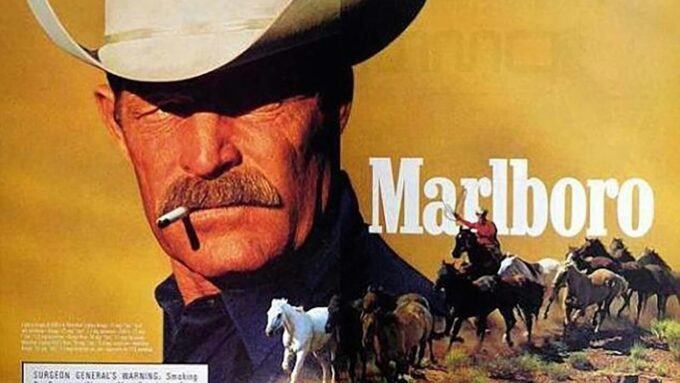
Few symbols captured that domination more powerfully than the Marlboro Man. The Marlboro Man ad campaign, launched in the mid-1950s at the height of U.S. post-WWII power, was historic. Before the cowboy-themed ads, Marlboro sold roughly 18 million cigarettes a year. Within two years, sales exploded to about 20 billion cigarettes, a 300% increase.
The iconic cowboy galloping on horseback embodied an entire American mythology. Alone, or with a few fellow cowboys, the Marlboro Man was strong, virile, independent and conquering, all that was the American myth at the time. He projected American power that much of the world admired, and often imitated.
The unraveling of the myth came from several directions. Materially, Philip Morris International (PMI) has already begun retreating from the cigarette era. Its chief executive, Jacek Olczak, even declared that “cigarettes belong in museums” as the company shifted toward alternatives such as vapes. Several famous Marlboro Men later died from smoking-related diseases, turning Marlboro cigarettes into “cowboy killers.” The mythology that once symbolized vitality and masculine confidence increasingly came to symbolize decline and mortality. Cigarette packs that once sold freedom now carry images of rotting lungs, cancerous throats and dying smokers.
But the real damage to the Marlboro mythology was cultural, not medical. Lung cancer weakened cigarette sales; popular culture radically altered the cowboy image. Brokeback Mountain made this shift visible, challenging the rugged image of the Western frontier archetype. The 2005 Ang Lee film about two ranch hands in a romantic relationship won three Academy Awards and helped reshape the cowboy myth. Brokeback Mountain exposed how fragile the John Wayne–Clint Eastwood frontier masculinity had become. The cowboy did not disappear because smoking became unhealthy. He disappeared because the American myth he represented lost cultural authority.
The Marlboro Man may have lost cultural relevance, but the strategy behind him did not. Only the symbols changed, not the logic linking identity and smoking. That logic now reappears in Philip Morris International’s promotional Marlboro campaign, which critics say repackages cigarettes as lifestyle identity.
Mark Hurley, vice-president at the Campaign for Tobacco-Free Kids, argued: “You can’t claim that cigarettes belong in a museum while launching a global campaign to make Marlboro cigarettes a core part of how young people see themselves,” Kat Lay quoted in an article in The Guardian.
Lisda Sundari, chair of Indonesia’s Lentera Anak Foundation, said the PMI campaign closely tied smoking to personality. “What makes it concerning is not only the cigarette branding itself, but the way the campaign connects smoking with identity, self-expression, confidence, belonging and lifestyle,” she said. “A slogan such as ‘I AM Marlboro’ presents the brand almost as part of someone’s personality or social identity, which can strongly appeal to young people who are still in the process of identity formation.”
The Marlboro Man is gone. Marlboro sales are steadily declining. But the myth never fully disappeared — it only changed form and identity.
The Marlboro Man was just one expression of a broader American projection of “cool” as a form of cultural power. The link between identity, self-expression, confidence, belonging and lifestyle included American clothing as well. As Henrik Sunde Wilberg wrote in a recent New York Times editorial: “The United States’ cultural and stylistic output was not just omnipresent but cool, even countercultural — even among those who despised the country’s role in global affairs.”
Wilberg highlights how American clothing is still “cool,” but now largely in vintage form — often in faded denim, military surplus jackets, varsity sweaters, and work clothes from 1950s Middle America. He recognizes the importance of American soft power and the nostalgia surrounding that vintage period. “While the clothes at stores like Union Fade…testify to the enduring appeal of American style, they are now historical artifacts more than part of a living present; deposits of the material culture of American empire, disseminated along the geopolitical pathways of the post-war world order. This material sediment is meant to outlast the American century.”
American symbolic power has not totally disappeared. Nike, Apple, Hollywood, Netflix, hip-hop, and Silicon Valley culture are still globally aspirational, but they no longer project a singular national myth in the way the Marlboro Man once did. The older image of America’s frontier masculinity has fragmented into a diffuse landscape of algorithms, brands, and subcultures. American influence persists, but its symbolic coherence, like its geopolitical hegemony, has weakened.
In this sense, both cigarettes and clothing have shifted from aspiration to artifact. Marlboro cigarettes and vintage American clothing are no longer about the future; they are about the past. Wilberg even asks: “Can anyone halt the destruction of a lifetime of American cool?”
Soft power becomes visible precisely when it begins to disappear. The backlash against Philip Morris International’s attempts to sell Marlboros to a younger generation could hardly be further from the era when the Marlboro Man projected American geopolitical dominance. Similarly, the appeal of vintage American clothing reflects a nostalgia for a moment when “cool” was widely associated with the United States.
Images matter because empires are partly theatrical projections. America once sold more than products; it sold an identity. The Marlboro Man was an entire mythology of frontier conquest, masculinity, and freedom. His clothing—cowboy hat and boots—belonged to that image.
As Wilberg notes about MAGA and nostalgia: “To the materially and culturally dispossessed, the Make America Great Again movement was from its inception a collective vintage fever dream…”
Great powers decline twice: first in reality, then in imagination. The deeper question is not whether China will surpass the United States economically or militarily, but whether anyone under the age of thirty still identifies with the American archetype of Marlboro cigarettes, vintage denim, and all. When that desire fades, the empire is already halfway gone.