
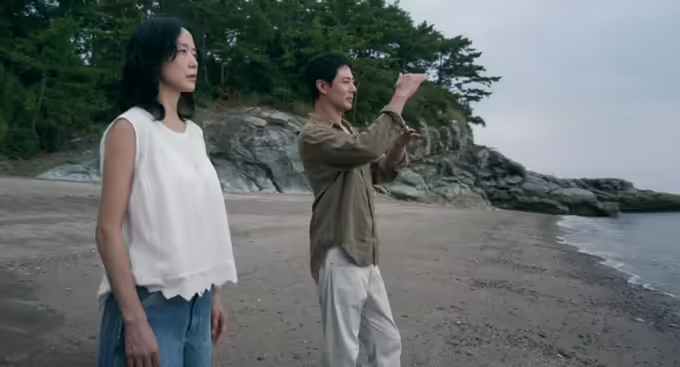
Still from Possible Love. (Netflix)
Even when the world seems bent on setting itself alight, the arts remain. A song played at a funeral can offer a kind of consolation that no explanation can provide.
When I lost my parents as a child, I eventually found a way of approaching that loss by editing old cinefilm. The images could not explain what had happened, let alone undo it. But they allowed me to look again, recover something of the people who were gone and give the past a place in the present.
That is one of the things the arts do best: they help us live with what cannot be altered. As Kurt Vonnegut wrote in A Man Without a Country, “They are a very human way of making life more bearable.”
Art often reaches us before we understand why. I have experienced this with the Henry Moore sculpture in our local park, now away on loan. Perhaps its absence has shown me how much art becomes part of the fabric of our lives.
T. S. Eliot wrote that “genuine poetry can communicate before it is understood”. Art can also expand our sympathies. A novel or play lets us inhabit unfamiliar lives and see the world through another. As Irish director Paul Donnellon said of the South Korean-American co-production Possible Love this week: “It was one of those films where you are brought into other people’s lives and learn something.” It can also, of course, bore us to death. Not every work changes us, but the possibility is always there.
The arts connect us to the past as well as to one another. Folk songs, traditional crafts, photography, architecture and certain theatre preserve traces of who we are, where we come from and what we value. I used to enjoy telling Suggs’s late mother that her son’s work with Madness was an important form of folk music. Popular music can capture the rhythms and language of its time.
As David Schwimmer’s clammy writer character in Junk suggests, this impulse can be taken to absurd extremes. But without the arts, history risks becoming just an inventory of events. Art does not merely help us understand the world. It can challenge it as it is.
“Resistance and change often begin in art,” said Ursula K. Le Guin. Change begins when we recognize injustice or imagine things differently.
Kafka understood the menace of unaccountable authority. In The Trial, a man finds himself accused by a mysterious bureaucracy whose rules he cannot understand and whose power he cannot escape. Its nightmare is not just the injustice of the system, but the denial of a meaningful way of challenging it.
Picasso’s Guernica made the horrors of fascist violence an enduring indictment of war. Orwell’s Animal Farm exposed how revolutionary ideals can be betrayed by the people who claim to serve them. Across generations, writers, musicians and filmmakers have risked censorship, imprisonment, exile—sometimes even death—to express ideas that those in authority would rather suppress.
Art is not automatically virtuous. It can bolster prejudice just as easily as challenge it, and propaganda can be as cleverly constructed as protest. Its importance is not as some kind of guarantee to make us feel better, but an ability to reveal, question and unsettle: to expose the assumptions by which we live and to help us imagine alternatives.
The creative industries contributed an estimated £145.8 billion to the UK economy in 2024 and supported 2.4 million jobs. But these figures are not the real story. Behind them are artists and creatives whose work brings places to life and sustains local businesses. Creativity is not separate from the productive economy. It helps drive it.
Yet the true value of the arts goes beyond what figures can measure. They nurture the curiosity and imagination that allow us to confront familiar problems anew, make unexpected connections and question what we take for granted. A 2025 OECD report, Creative Minds in Action, explores how young people express creative thinking through storytelling, design and problem-solving. Festivals, concerts, community theatre and galleries create shared experiences that bring people together.
If we defend the arts only because they generate jobs, improve health, spice up innovation or bring in visitors, we accept only the narrow definition of value that the arts themselves can help us question.
Their deeper value lies in imagination. Before something can be built, invented or changed, someone must first conceive of a possibility beyond the present.
Art can also show something we had not realised we were missing. I experienced this once at the National Gallery’s 2004 exhibition Russian Landscape in the Age of Tolstoy. The paintings introduced me to a tradition of nineteenth-century Russian landscape art largely unfamiliar to British audiences. Their vastness struck me: until then, I had associated that kind of scale and openness almost exclusively with the American landscape. If a whole landscape tradition could sit just out of view, what else are we failing to imagine?
Art can also reveal the limits of our imagination. Paul Gauguin traveled to Tahiti in search of a world beyond European society conventions, but the paradise he painted was partly a projection of his own desires, rather than some faithful portrait of the life he found there. His paintings remain powerful, but they also remind us that art can reveal as much about the assumptions of the artist as about the world depicted. Imagination can open our eyes to seriously unfamiliar possibilities. It can also turn other people’s lives into the scenery for our own dreams.
Of course, AI can now generate images, music and stories at extraordinary speed. It sounds as though Danny Boyle’s use of it in Ink raises a more interesting question than whether machines can make convincing images. He used AI to animate old photographs, create mice and help depict Margaret Thatcher—I haven’t seen it—while insisting that actors should not be replaced without good reason. The real question is not what the technology can do, but whether an artist has good reason to use it.
The arts remind us that human life is not simply a problem to be solved or an output to be optimised. They help us exercise that judgement. Without imagination, we surely risk mistaking the limits of the present with the limits of what is possible.
In the end, the arts make life about more than survival. But human beings have always made music, told stories, decorated objects, danced, painted and celebrated. Artists have never been content simply to survive. Artists want to make sense of life and find something worth celebrating in their short time here.
A society that values only what can be counted, priced or measured risks forgetting what makes life valuable. For many, the arts are not just some optional extra to human existence.
As Vonnegut put it: “The arts put man at the center of the universe, whether he belongs there or not.”


