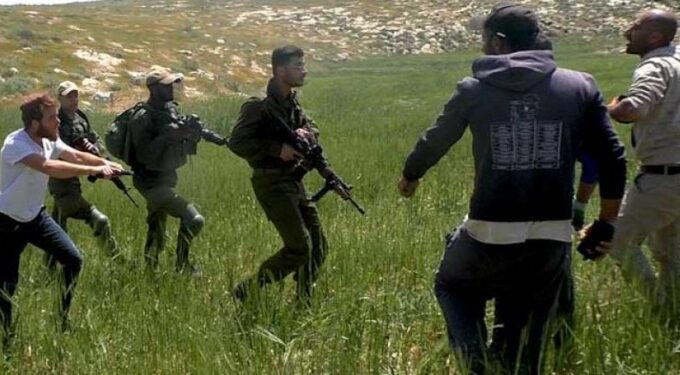
Armed Israeli settlers terrorizing Palestinian villagers in the Hebron Hills. Photo: Basel al-’Adrah, BT’selem volunteer. CC BY 4.0.
+ More Palestinians were killed (143) and injured (674) by Israeli forces in October than in any other month since the so-called ceasefire went into effect. The Gaza Health Ministry reports that among those killed by Israeli forces were 23 children, 11 women, and two elderly people. The injured included 190 children and 129 women.
+ Israeli forces killed five Palestinian police officers in airstrikes last week. At least 75 Palestinian police have been killed by Israeli forces in Gaza since the ceasefire agreement of last October.
+ With winter approaching, there is a shortage of 200,000 tents for the displaced people of Gaza, yet fewer than 100 have been permitted into the Strip by Israel. This week, two young Palestinian girls perished in a tent fire in the refugee camp at al-Mawasi.
+ The October 2025 ceasefire agreement calls for 600 aid trucks to enter Gaza daily. But Israel, which has now closed the Rafah Crossing, has allowed an average of only around 200 trucks per day, severely curtailing the flow of humanitarian aid, food, fuel, and cooking gas entering the Strip.
+ Selma Dabbagh writing on Moral Injury in Gaza:
On 19 October, the World Food Program announced that it would be reducing its monthly food assistance in Gaza, providing support to 1.1 million people rather than 1.6 million. On 22 October, the head of the Bakery Owners Association warned that the remaining bakeries in occupied Gaza would cease operations within 48 hours because of the lack of flour in the territory and Israeli entry restrictions. “Things are really, really difficult,” the Palestinian diplomat Marwan Yaghi said to me, “especially with the Israeli action coming on the way. Inshallah this will end soon.”
+ Our long-time contributor Neve Gordon on how Israel uses international law as a license to kill:
I think Gaza is exposing something much deeper and much more worrisome than just the simple failure or inability of international law to stop criminal actions. So Israel is using international law to claim that all its actions in Gaza, which include the leveling of 90 percent of its infrastructure, the killing of probably close to 100,000 people, among them around 20,000 children, damage to all of the hospitals in Gaza, to all the universities in Gaza, to 85 percent of the schools in Gaza, are legal. And if Israel gets away with this, if Israel can use international law to justify genocide, then international law has lost all of its meaning.
+ During the early morning of October 26, Israeli forces raided the home of Palestinian journalist Marah Awad in the village of Beit Ummar, north of Hebron. The soldiers interrogated Awad about her writings and accused her of “incitement.” They seized her phone and computer. She was cuffed and taken into custody. When her brothers objected, they were beaten. A few hours later, an Israeli soldier posted a photograph of Marah Awad on social media, showing her with her hands bound and her eyes blindfolded. No charges have yet been filed against her.
+ Samer Khuwaira, a Palestinian journalist with Radio Hayat, was released from an Israeli prison in January, after serving nine months without being charged with any crime. He was arrested again this week for allegedly “inciting terror online,” after he gave an interview with Haaretz on the appalling conditions inside Israeli prisons. While he was in prison, Khuwaira contracted scabies, as have many other Palestinian detainees, and his weight dropped by nearly 50 pounds. Israel has presented no evidence of any crimes he is suspected of committing. Three weeks ago, Khuwaira described the circumstances of his arrest last year:
Four days after I was arrested, they took me for questioning. The police officer asked if I had Facebook, then opened my page and said, ‘Oh-ho! Look at this, you’re inciting against us.’ I told him, ‘ How is that incitement? I posted a photo of a young man the army killed in Nablus and wrote that Israel had killed him. That’s all. A news headline and a news report. I’m a journalist covering Palestine, not Senegal. When something happens in Nablus, I cover it.
+ The number of Israeli attacks on the West Bank in October surpassed 2700, increasing by 53% since September. Israeli forces committed 1,764 attacks, while settlers carried out another 1027 attacks.
+ Israeli settler attacks on Palestinian land and property in October…
+ All attacks 1027 / Monthly average for the year: 587
+Property vandalized: 384/ Monthly average for year: 247
+ Property seized or stolen: 296 / Monthly average for year: 76
+ Crops destroyed: 166 / Monthly ave for year: 100
+ Land bulldozed: 48
+ Religious sites attacked: 32
+ New Outposts attempted: 28 / Monthly average for year: 17
Source: Colonization and Wall Resistance Commission.
+ More than 4,498 olive trees were destroyed or damaged, according to the Palestinian Wall and Settlement Resistance Commission. At least 165 cases of olives were stolen, as well as 384 sheep. According to the Palestinian government, the Israeli raids in Hebron have inflicted direct economic losses of more than $3.8 million per day. The damage to infrastructure in the West Bank is close to $2 million.
+ “They see us here and they just don’t care,” a Palestinian villager in southern Hebron told journalist Gideon Levy about the relentless raids by Israeli settlers. “At night they steal our sheep and by day, the olives.”
+ After Israeli settlers besieged his home in the Hebron village of Wadi Rakhim for nearly a month and then poisoned the family’s well, Palestinian farmer Yousef Shanaran told Al Jazeera: “No water, no food, nothing at all I’ve got. Nobody is allowed to bring anything to us.”
+ During its ongoing military raids on Hebron, the Al Jazeera correspondent Muntaser Nassar, along with more than 20 Palestinians, were arrested and detained during the Israeli siege on the village of Dura. The detainees were reportedly bound, harangued and beaten by Israeli security forces before they were eventually released.
+ While Netanyahu claims that settler violence in the Occupied West Bank is driven by “drug-addled teens,” his own former head of the Mossad, Tamir Pardo, points the finger at the Netanyahu-led government: “That’s the Israeli government, full stop. We’re talking about policy. When you see who supports them with vehicles, with money, with permission to do whatever they’re doing, it’s clear.”
+ Before the Midterm elections, Trump announced he was going to stop all payments to Israel next year. He later admitted it was intended to counter arguments made by Democratic politicians, like Abdul el-Sayed:
“As far as paying Israel, Bibi Netanyahu and I have made a deal that we give Israel $4 billion a year, and we made a deal months ago that we’re stopping, and they’re fine with it,..Because they don’t need it…I asked them. Bibi Netanyahu brought it up. He said, ‘I think it would be appropriate if we do not receive aid…’ They’ve become a very successful country. They don’t need it, and we won’t be paying Israel. If they did need it, I would say keep it going.
+ In a post-midterm social media post, JD Vance tried to distance himself from the debacle by blaming the Iran war for the demolition of GOP candidates and asserting that to recapture lost electoral ground the GOP needs to put distance from itself and Israel…In this sense, at least, Vance is willing to go where Kamala Harris feared to tread.
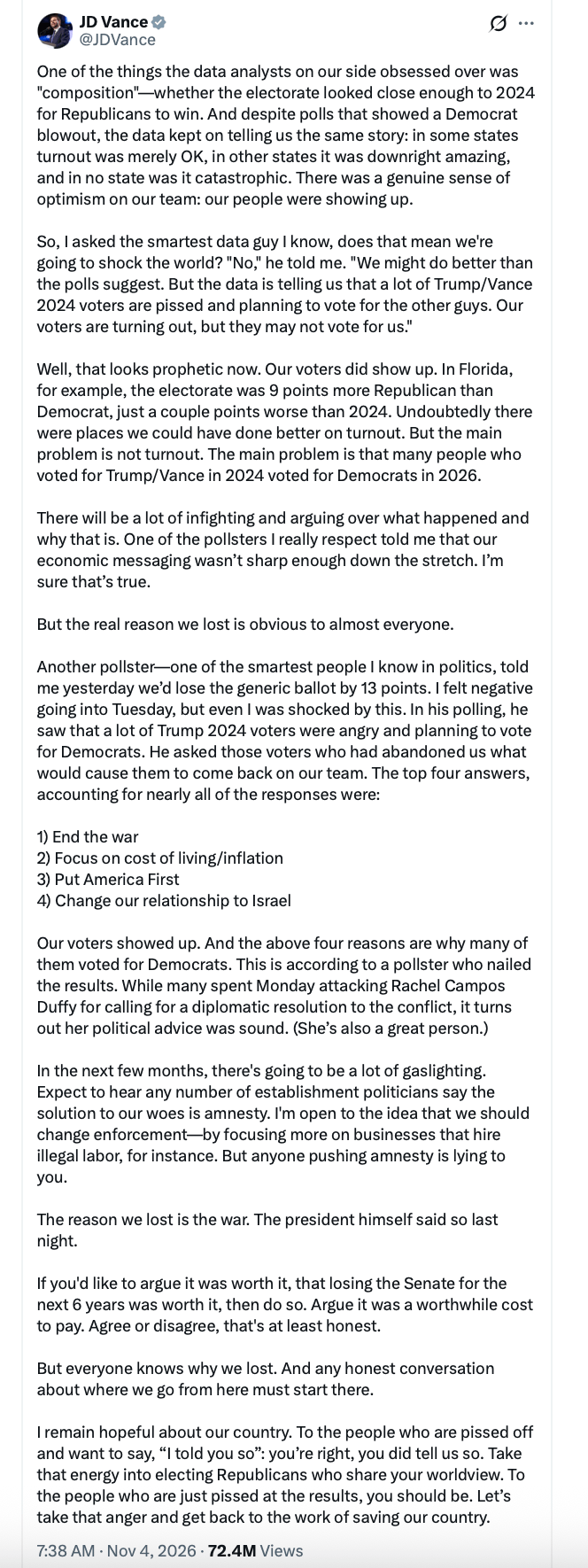
+ The New Yorker’s Jason Zengerle on JD Vance’s tweet that the GOP lost because of the Iraq War and could win back voters by distancing the US from Israel:
I thought Vance’s tweet was, not surprisingly, very calculated. He didn’t so much throw Trump under the bus as try to bring him on board his bandwagon by essentially putting words in Trump’s mouth—about how the war was the reason Republicans lost yesterday. Trump made some gestures in that direction in his various interviews last night, but he never said it as explicitly as Vance did. And you can already see Vance both distancing himself from Trump and the war but also acting as if he and Trump agree on this. I think that’ll be the line he—and a lot of other ambitious Republicans—try to walk these next two years.
The other thing that I thought was very noteworthy about Vance’s tweet was his contention that one way Republicans can win back voters who abandoned them is by changing the U.S.’s “relationship to Israel.” The presumed Republican Presidential front-runner for 2028 is going to spend the next two years sounding a lot more like Abdul El-Sayed than Mike Rogers.
+ Israel’s Ambassador to the United Nations Danny Danon on JD Vance:
I think it’s unfortunate that many made the link between rising prices, mainly oil prices, and the situation here in Israel. The decision to attack Iran was the decision of the United States. It wasn’t our decision. We supported the U.S. effort, and we think it was the right decision. It’s very easy to always blame Israel for everything, but that is not the case.
+ By Sunday night, Trump seemed to be echoing Vance. He told Ross Douthat in an interview with 60 Minutes: “They didn’t like the war. They didn’t like the fact that gasoline went up, because I had it down to a low. And there’s great dislike, incredibly, for Israel.” Trump told Dotuhat that he intended to make Israel “pay us back” for the war on Iran: “Without us, Israel wouldn’t exist, Israel would not exist except for Donald Trump.”
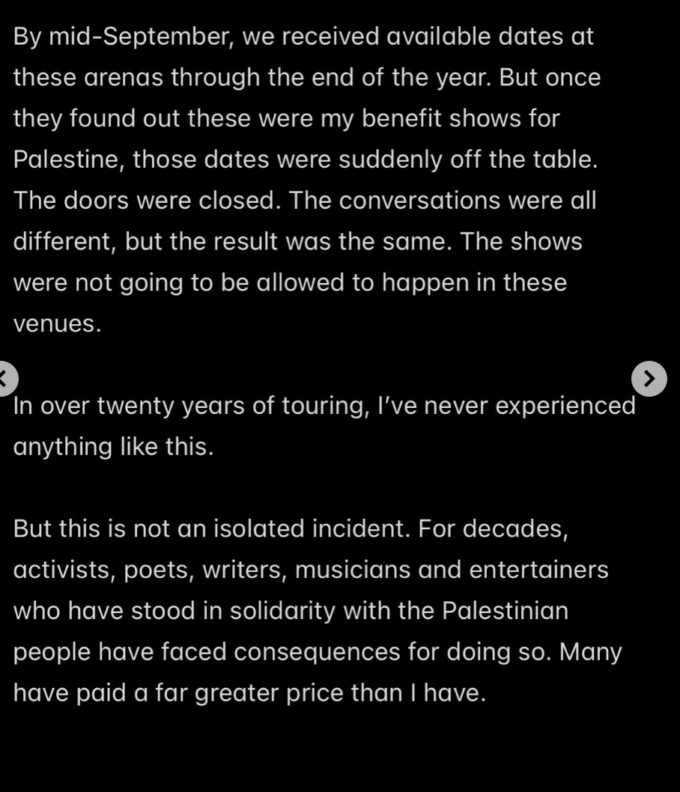
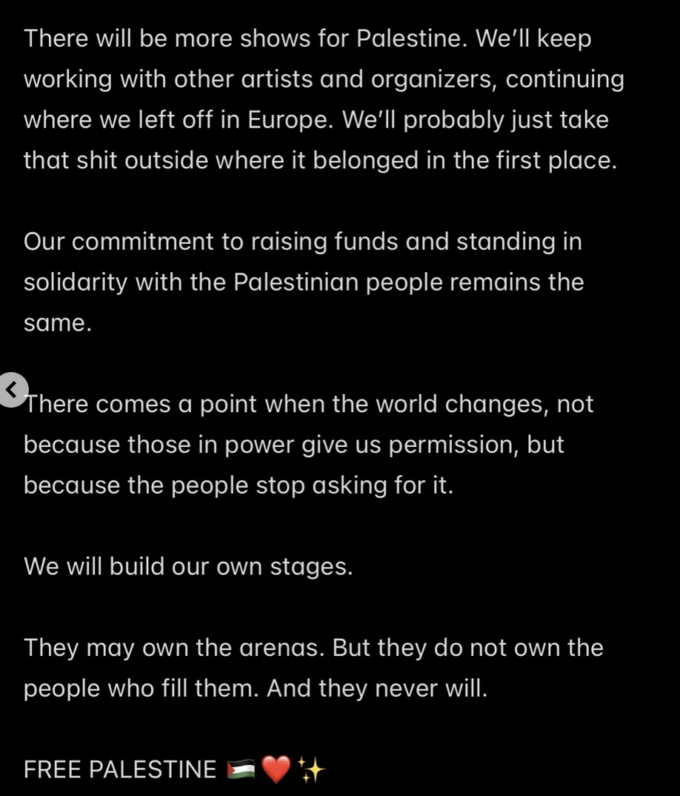
+ In a lengthy social media post, Macklemore claims US arenas refuse to book his benefit shows for Palestine…

+ Let’s close with a quote from the Jewish Biblical scholar, Uriel Simon, who died last month at the age of 97, on how the Jewish State has been corrupted from within by its treatment of Palestinians:
A country that is always forced to live by the sword can’t be a Jewish state, because militarism, isolation, self-righteousness and arrogance will corrupt it from within. While I share Gush Emunim’s deep affinity to the Land of Israel as a holy land and as the only place where the prophetic vision can be fulfilled, I’m nonetheless hurt by the religious public’s callousness toward the injustices inflicted on Arabs, both past and present.