
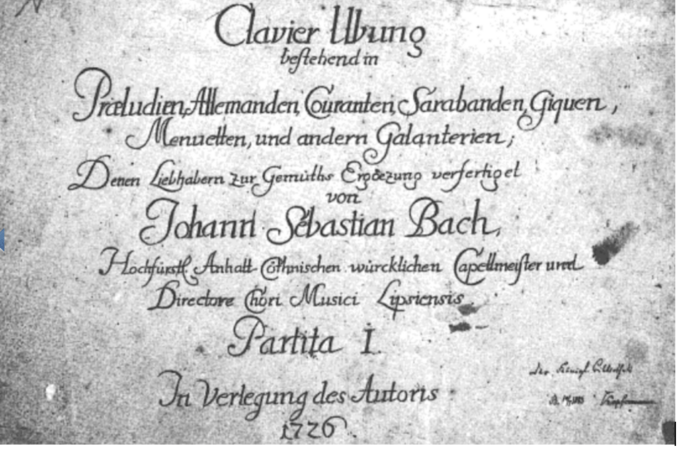
Three hundred years ago this week, Johann Sebastian Bach announced in the “news section” (Nouvellen) of his local newspaper, the Leipziger Post-Zeitungen of November 1st, 1726, that he his latest keyboard piece was now on sale.
“Notice is hereby given to elegant music lovers that the Capellmeister and Director Music of Leipzig, Mr. Johann Sebastian Bach, intends to publish an opus of Clavier Suites, of which the first Partita is already finished and can be obtained from the author himself. The rest shall be continued one by one as soon as they are completed.”
The forty-one-year-old Bach had up to that point published nothing aside from the cantata from 1707, Gott ist mein König (BWV 71), that had been performed and then printed in praise of the newly inaugurated City Council of Mühlhausen, where the young organist was then employed. Before publishing a single page of keyboard music Bach’s fame was built on his reputation as a player of astounding ability and breathtaking showmanship. His compositions circulated among his many students and admirers in manuscript copies.
With the 1726 newspaper advertisement, Bach declared himself ready to weigh his prospects for success in the burgeoning market for printed music. He wouldn’t perish if he didn’t publish, but here was an opportunity to accrue prestige and perhaps profit.
The notice of Opus 1 came out two months before New Year’s trade fair in Leipzig, one of three that took place each year in the city. These important commercial and cultural events attracted merchants and performers from across Saxony, other regions of German-speaking Europe, and even far beyond. The fairs were marked by the diversity and richness of their offerings—textiles, wigs, clothes, luxury goods and staples, and, perhaps most important, books. Leipzig’s central square and the alleys leading off it resounded with fiddlers and singers, magicians, street-theater players, many having traveled from great distances. There were non-human attractions, too: elephants, apes, tropical birds, and snakes.
Since the advent of music printing, the issuing of an Opus 1—an Opera Prima—was a crucial act for any composer, but it had a special kind of importance in the eighteenth century. Volumes promising leisure, refinement, and improvement of the soul were increasingly being offered in printed form to the public. As had long been the case, a first publication established composerly credentials, and Bach’s was a financial venture not without risk, since the composer acted as his own publisher. The music was also a declaration of, and advertisement for, his standing as the greatest German keyboardist of his generation. Fed by Enlightened discourse in the public sphere, the market’s appetite would determine the merits of the menu. Bach must have had robust hopes for his program of “keyboard practice” (Clavierübung)—the name he gave to this ambitious project. From the start, he hoped that his Opus 1 would be talked about, marveled at, and sell briskly.
Crucially for Bach’s publishing endeavor, printers and engravers from across Germany came to the fair, as well as possible agents for the sale of the publication elsewhere. Could the latest keyboard music from Leipzig’s top musician and Germany’s leading organist compete with the fair’s other offerings? Would this product prove desirable among consumers of keyboard music? Would the typical print run of 200 copies be enough to satisfy demand and curiosity? Bach’s decision to publish within a few years of his move to Leipzig certainly had to do with his proximity to the three annual trade fairs.
With the 1726 appearance of the first partita in B-flat (BWV 825), enthusiasts (Liebhaber), as the title page of the volume put it, would now be able to buy for themselves something from the city’s new Music Director, the famed organist, Johann Sebastian Bach. Those outside the composer’s circle of students, family, and professional colleagues would at last be afforded the opportunity to play and to study one of his suites. More expensive than having a hand-written copy made, the purchase of the new print allowed one the chance to play the latest from Germany’s leading keyboardist and to elevate one’s skills while refreshing the spirit, that is, to enjoy Bach’s unique mode of Keyboard Practice.
In 1732 one of the age’s most talented and educated women, Luise Adelgunde Victorie Kulmus, wrote about her encounter with Bach’s Opus 1—its six suites collected together and published together the year before—to her fiancé Johann Christoph Gottsched, Germany’s leading literary theorist. Her letter describes the demanding delights of the second partita sent to her in Danzig from Leipzig by her suitor, founder of the Deutsche Gesellschaft and a sometime collaborator of Johann Sebastian Bach’s, whom we’ve already met as an avowed enemy of the quodlibet. “The keyboard pieces by Bach … that you sent are as difficult as they are beautiful,” wrote the young woman-of-letters and amateur musician. “Even when I have played them ten times I feel as if I’m still just a beginner.” Bach had an elevated—and elevating—view of amateurism. The several print runs of the first installment of the Clavierübung, and the extension of the series to four volumes culminating in the Goldberg Variations of 1741, attest to the success of the project, or at least to the tenacity of its composer and sometime publisher—Bach himself.
What would buyers like the Gottscheds have experienced on picking up a copy of the first partita at the Bachs’ apartment adjoining the School of St. Thomas? Opus 1 begins with a prelude in the pastoral mode well-suited for the leisurely passing of time—the “Zeitvertrieb” advertised on the print’s title page. Interesting yet deceptively undemanding, the music unspools above the quickly fading drone of the pedal point. A long-held B-flat in the left hand soon fades, but the stability it projects is reinforced and renewed by a B-flat continually reiterated in the right hand and emphasized by a trill and turn. The broader contour of the right-hand melody wends its way leisurely upward by step with rusticated elegance. Some might have thought it all a bit too involved for the pastoral atmosphere, but shepherds must work too, occasionally exploring the shadows and crags in search of lost sheep. Some leisure-seeking keyboardist might object that this suite is hardly the venue for taxing intellectual labors, especially when these intensify with the appearance of the opening theme in the lowest and then in the middle part. These contrapuntal demonstrations sound like departures from pleasant meadows onto rockier ground.
Refashionings of the theme and the syncopated sequences trace a meandering path that eventually arrives at the opening theme, with its trills and turns, now deep in the bass register and a cadence to the home key that is extended by a coda that brings back the opening material, now in the right hand but accompanied with fuller and therefore more awkward left-hand chords, the pleasant landscape broadening into chromatic vistas. For all its apparent opening calm, this partita won’t be a mere pleasant promenade, like that along the tree-lined path gracing the banks of Leipzig’s Pleiße River favored by the city’s leisured classes.
European people and goods had come to the fair, and so Bach’s Opus 1 journeys virtually to the other nations of Europe. The ensuing, sometimes argumentative Allemande (the German dance) is followed by the burrs and barbs of an Italian Corrente, which give way to a brooding French Sarabande. This is followed by some so-called Galanterien (gallantries)—those types of fashionable dances advertised on the title page as value-added attractions. In his first public outing for one of his suites, Bach offers a smart pair of modish Minuets, the first frisky and sometimes needling, the second slyly restrained.
The arrival at the final destination determines in so many ways the feeling that lingers after the journey. This concluding number is a riot of acrobatic hand-crossing—one of the trendiest, show-stoppingest tricks then being trotted out by Europe’s leading keyboard conjurers (Scarlatti and Rameau) from Italy to Spain to France. It is as if Bach was intent on out-prestidigitating not only his foreign rivals but the jugglers and sleight-of-handers who had come for the fair.
Whatever the sales in 1726-7, twenty-first-century demand for Bach’s artefacts has been robust, to say the least, though he is unlikely to have made much from them during his lifetime. A copy of the first edition of his partitas went for just under 230,000 euros in a 2012 Sotheby’s sale. The volume had probably been sold by Bach for 2 (or maybe 3) taler in 1731, a sum held to be about $200 these days—not cheap by present standards and higher than the price for other keyboard collections of the day. But even the inflation-adjusted figure is three zeroes short of a six-figure payout.
At that 1726 Leipzig fair, a visitor or local could drink imported Turkish coffee and maybe even buy a shrunken Turkish head; acquire Florentine crucifixes; smoke American tobacco; and pick up garments made of English wool.
Bach’s musical wares have outlasted them all.
Coming up: A review of Barbara Kingsolver’s new novel, Partita


