Andie Stewart. Ikons in America: Tony Kushner’s Classic in Unorthodox Renderings. Self-published, 122pp, $29.99.
Nothing stranger in American religious life—and there is a great deal strange, in the eyes of the world—can be found than Mormonism. The great graphic novel artist Noah van Sciver’s Joseph Smith and the Mormons (2022) offered a literal rendition of the improbable backstory, and won big prizes for his work. Raised in a Mormon family that broke apart with divorce, Van Sciver can look deeply into the nineteenth-century Americana of frontier fanaticisms and fabulists that may even, arguably, have led to the triumph of Donald Trump as a “type.” But surely led to P.T. Barnum, Billy Sunday, and … Mitt Romney, the Mormon candidate almost elected president in 2012.
Most interested readers know about mysterious golden tablets “discovered” (but never exhibited to much of anyone) by Joseph Smith in upstate New York, revealing the unknown and totally imaginary saga of white people and their catastrophic wars in North America centuries before Columbus. Smith apparently found household items buried by abandoned pioneer communities and jumped to the wildest, Sci-Fi conclusions, then elaborated at great length. This is obviously one of the best ways to build a following.
Tony Kushner, widely regarded as the greatest American playwright since Arthur Miller (if not so prolific so far, anyway), took up Mormon themes in the famed drama about the AIDS crisis, “Angels in America.” The psycho-sexual crisis posed to Mormonism by modern American society, most especially New York society, finds its creative exploration here.
Like the dying Roy Cohn, who more than anticipated the lawyerly tricks of Donald Trump, the Mormon characters stand in for themes too large, even, for their LDS church. Friendly critics have observed that Kushner digs deep into Mormon theology and its symbolism, but also the distance between beliefs and the lives of believers caught in personal and social conflicts and contradictions. Kushner uses his Mormon characters as Outsiders not entirely distant from other outsiders in the American order.
But let us listen to Andie Stewart, a trans theorist and schoolteacher living in Providence, Rhode Island, because he/she has a very special angle on all this.
In his reading, religious history and Western history itself takes a remarkable turn when Leo III, the Byzantine Emperor, orders the banning of ikons and this becomes the original“iconoclasm,” 726 AD (or CE, Christian Era). This initial “iconoclasm” ended in 843 CE when Empress Theodora restored their legitimacy. 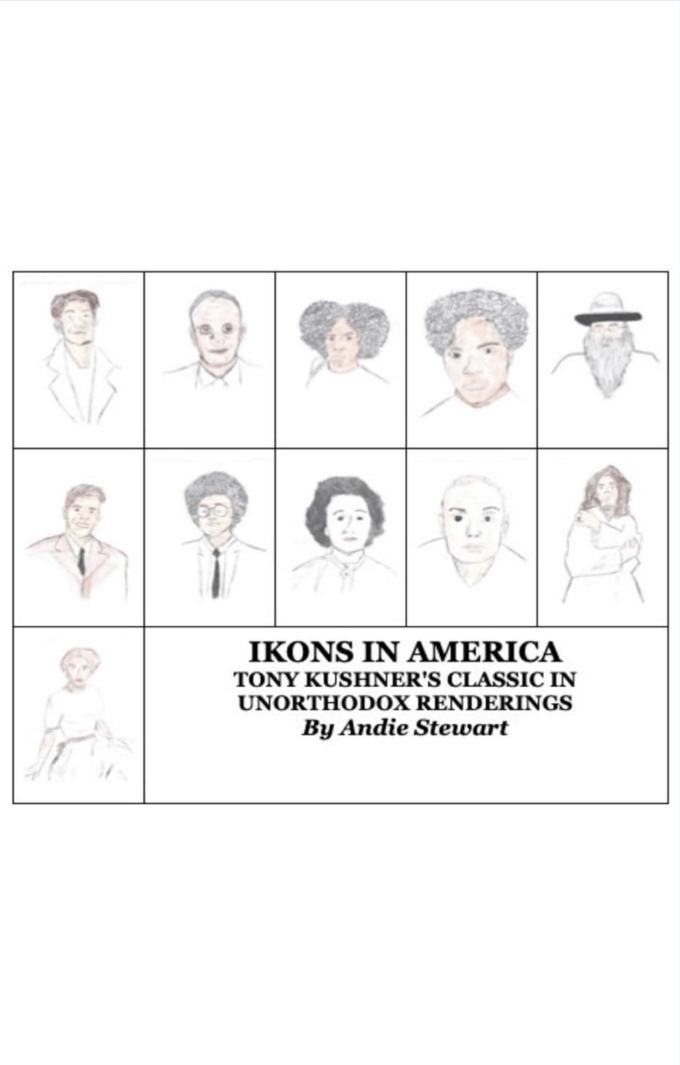
The famous Great Schism, two centuries later in 1054, and not unrelated to the earlier events, placed Orthodox Christianity in its own world, distant from the Roman Empire.The destruction of Christian (“Catholic”) church art by upstart Protestants in the sixteenth century and later, can be said to have followed Leo’s iconoclastic impulses. The renunciation and destruction of medieval church art in much of Europe naturally suppressed, left behind amid bloodthirsty religious wars, a vast history in holy images. Mormonism, the church of the Latter Day Saints (LDS), almost inevitably reinvents something like the ikon or icon for its otherwise improbably invented body of faith.
Historians have long since detailed the wild fantasies in the Book of Mormon, embodied forever after in LDS doctrines. Horses, cows and all manner of creatures—not to mention chariots, silk and swords—had apparently (i.e., imaginatively) been brought over by the centuries-earlier white immigrants and thus become part of the cosmology of the Prophet. If a fanatical Islam, as we are told today, preaches a recovery from history and the forceful return of a monotheism, Mormonism makes more sense: early Mormon texts suggest that Joseph Smith qualified as the modern prophet Muhammed.
Stewart astutely interprets Kushner as giving voice to Walter Benjamin’s theses on history, written not long before his suicide at the Swiss border in 1939, when he realized he could not escape the Gestapo. Benjamin’s angel of history (or rather, in history) is powerless to change fate. He or she actually moves backward into the future, as history rushes by. He/she offers,then, a kind of redemption, perhaps the only kind possible, through a remembrance of history’s victims. Stewart gathered these nuggets of insight into the specifics by studying an oral history of Kushner, surely an invaluable source of study in drama (and more) for our time. He also reminds us that Kushner himself is a Brechtian to the core, with the audience itself very much on stage.
In “Angels in America” (I can speak only, as a viewer, for the several-part television production), the Angel cannot open his/her wings and halt the carnage. If Mormonism seeks to advance history through prophecy and deeds, Benjamin and Kushner wish to end history as we know, i.e., the false “progress” all around us ripping society and the natural environment apart.
All this happens on stage (and in the film) with some of the most memorable dialogue and acting we would be likely to see again in our lifetimes. That Kushner places Roy Cohn at the deathbed site of Ethel Rosenberg (as if she had died in bed and not in the electric chair) and that in the end she can actually forgive Cohn (as a real-life prosecuting attorney) for murdering her speaks not only against Cohn, a mere historical character. Kushner indicts the right-wing evangelical Christianity, the big congregation and big money Jerry Falwell and his competitors, for reigning in their bejeweled domain in the very age of AIDS. Can they really be forgiven? The Mormons’ wandering on the Manhattan scene usefully complicates the setting and characters: this is a definitively American saga.
That Joseph Smith imagined a “Mark of Cain” on dark-skinned peoples that determined the righteous conquest/extermination of Native Americans is clear enough, but this was a vision shared more or less across American Protestantism, encompassing, if in a less lethal sense, black slaves and post-slavery nonwhites. That a Barnumesque Roy Cohn would identify the Rosenbergs with Cain (despite Cohn being Jewish himself!) is a bit beyond my theological ken. But the clue, for Stewart and presumably for Kushner, is surely buried in theology.
The LDS emerges historically, instinctively, one might say, in an 1830s-style rejection of God as Substance. The American spirit incarnate—or perhaps the version of the spirit precisely identified and rejected in the skeptical writings of Mark Twain—offers God’s Kingdom achieved through a total destruction actually welcomed by believers. Charles Brockden Brown, the first American novelist of note, viewed the frontier as the source of madness as well as of random violence without any meaning or rational explanation. If the frontier—that is, expansion into the frontier, conquest of the frontier—defines and continually redefines our society (and civilization), then we would-be socialist salvationists have a hard row to hoe, indeed. American capital as the American spirit must have the Middle East! We must have Russia! And so on.
Stewart’s own drawings mark the last 100 pages, more or less, of this book. They might well fall into the category of “found art,” like the old drawings discovered in carefully preserved albums from Camp Kinderland, the Red-leaning, secular Jewish summer camp for kids, still alive from the 1930s. The spirit is larger than formal technique and speaks to us directly.
The book ends with two appendices. The first covers the mass entertainment media treatment of Mormonism in recent decades—mostly crime drama in one way or another. The second is, supremely a series of quotations from Mark Twain himself. No one grasped the kernel of American mentality so well. His comic review of the Book of Mormon, published in part of a chapter from Roughing It (1872) is a takedown to remember but also so much more. Clearly and desperately, we need more Mark Twains today.
The book ends, but for a couple of paragraphs, with the commendation of two documentaries made by Ivy Meeropol, granddaughter of the Rosenbergs. Her own personal story (the first) pitted against the real story of Roy Cohn (the second), can be seen with Angels in America as a pageant that we should not turn away from. Roy Cohn is now named Steven Miller.