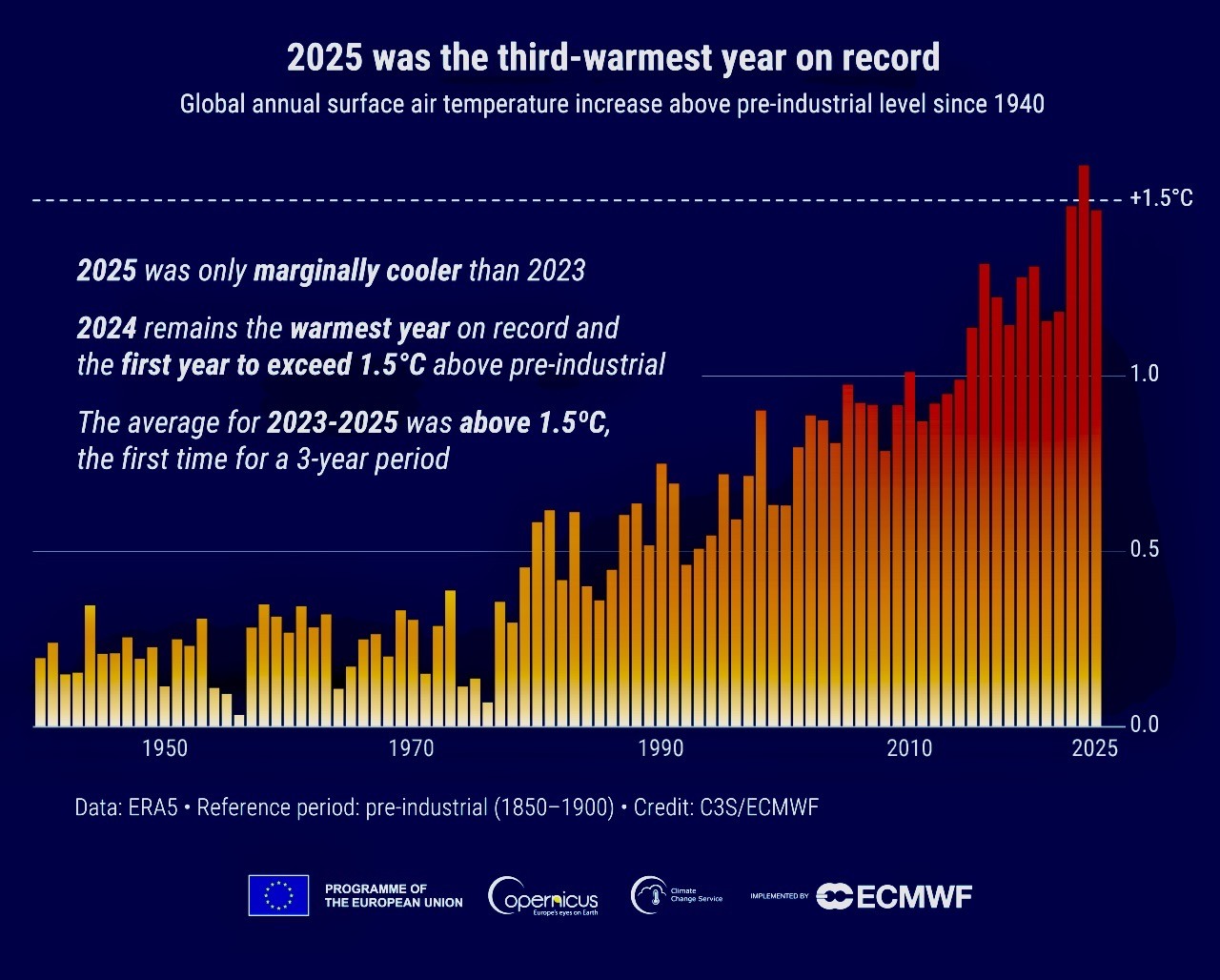
Global temperature, 1950-2025. The temperature of the year 2024, the “warmest year on record,” exceeded the 1.5 degree Celsius. EU Copernicus.
Prologue
Global climate temperature is a key factor in the survival of the Amazon rainforest, indeed the survival of humans, civilization and the Earth. According to Copernicus, the European Union’s Earth Observation Program,
“Europe and the world are in the warmest decade [2020s] on record…. Heat stress is recognized by the WHO [World Health Organization] as the leading cause of global weather-related deaths. In areas with dry and often windy conditions, high temperatures also contributed to the spread and intensification of exceptional wildfires, which produce carbon, toxic air pollutants like particulate matter, and ozone, which impacts human health. This was the case in parts of Europe – which experienced its highest annual total wildfire emissions – and North America… These emissions significantly degraded air quality and had potentially harmful impacts on human health at both the local and larger scales…. The fact that the last eleven years were the warmest on record provides further evidence of the unmistakable trend towards a hotter climate. The world is rapidly approaching the long-term temperature limit set by the Paris agreement [1.5 o Celsius]. We are bound to pass it; the choice we now have is how to best manage the inevitable overshoot and its consequences on societies and natural systems…. Atmospheric data from 2025 paints a clear picture: human activity remains the dominant driver of the exceptional temperatures we are observing. Atmospheric greenhouse gases have steadily increased over the last 10 years.”
Rising global temperature and deforestation threaten the Amazon rainforest
The Amazon forest, the largest tropical rainforest, supports millions of animals and plants while absorbing about a billion tons of anthropogenic carbon dioxide per year. And yet, despite the immense importance of the Amazon forest, business as usual keeps degrading it: “at least 17 percent of the Amazon rainforest has already been cut down, burned or otherwise lost.” A recent study concluded:
“Humanity is putting unprecedented pressures on the Amazon forest system through global warming and land use changes. As the Amazon forest may undergo self-reinforcing transitions, these pressures could lead to system-wide changes across major parts of Amazonian ecosystems.”
Brazilians and foreigners have been burning the Amazon rainforest. Fires kill trees, animals and indigenous plants. In the Amazon, fires are weapons of war. They make dust of millennial life and even human culture that grew in the midst of ancient trees, rivers, creeks and wildlife. Indigenous Brazilians have been paying a genocidal price for growing up and respecting their sacred forest. European Christians grabbed the Amazon and nearly exterminated the local people.
Fires have been ravaging the Amazon since the early sixteenth century when the Portuguese invasion and conquest of the Amazon rainforest.
Memories of fire
In February 1992, I went to Fortaleza, a beautiful city in the state of Seara in northeast Brazil for an academic conference. The purpose of the conference was to prepare the ground for the international climate discussion in Rio de Janeiro, which took place later in 1992.
In the 1990s, the current president of Brazil, Luiz Inacio Lula da Silva, was a leader in trade unions. Then as now, he talked about saving the Amazon. But talk is cheap. Deforestation of the Amazon continues to this day. Indeed, forest grabbers were so determined to convert the forest into mining, agricultural plantations, logging business, animal farms and small farms that those who protected the forest became targets and often victims of assassination.
The idea of agrarian reform, during which the state brings organized violence to an end and then allocates small pieces of land to the needy, never became policy. Strangely enough, my paper at the 1992 conference was about agrarian reform. The conference director, however, did not allow me to deliver my paper. He directed me to a conference room with a dozen or so professors, where I discussed my proposal.
But before returning to the University of New Orleans, I spent a week in Amazonas, the capitol of the Amazon. I joined a few Brazilian zoologists studying frogs. We traveled to a tributary of the giant Amazon River, swam and observed frogs and numerous other wildlife. In general, I was so enthusiastic I did not mind seeing small crocodiles not far from our swimming water hall. Then sleeping under those magnificent trees was heaven. I also climbed a tree and observer the canopy of the forest loaded with beauty: flowers and fruit. That magnificent icon remained with me forever. My mind wondered from Pythagoras, the harmony of the Spheres to Aristotelean zoology and its beautiful and perfect animals and nature: sacred Mother Earth.
The abyss of deforestation
I departed from the Amazon city of Manaus in the darkness of midnight. I kept looking at the forest bellow the aircraft and was struck by the fires consuming it – in late February 1992. No wonder the rainforest is on the borderline of what experts call “tipping point,” namely a state of dreadful biological existence that could be its last.
President Lula keeps saying he is slowing down deforestation. Maybe he is. But that’s not enough. The Climate Summit in Brazil in November 2025 failed to even pass a resolution for phasing out fossil fuels that cause most of climate chaos that is exacerbating deforestation. Climate chaos and deforestation are brothers of nemesis. Each supports the ill-effects of the other. And together, they are shutting down the lungs of the planet, the Amazon rainforest.
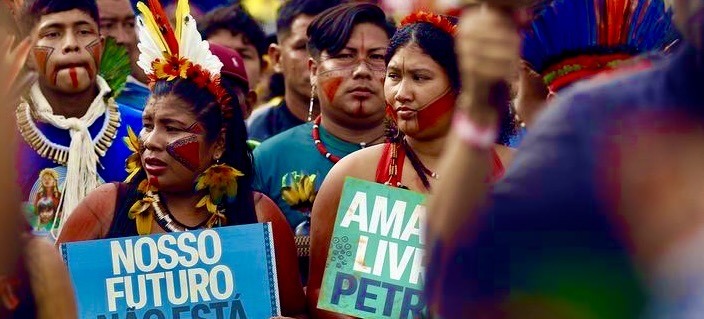
Agência Brasil / Bruno Peres. Global March and protest of Indigenous Brazilians during COP30, the Climate Summit, Belem, Brazil, Nov. 2025. UN News, 17, Nov. 2025.
Epilogue
Scientists and politicians have known for decades that the vast tropical Amazon rainforest of Brazil is necessary for a healthy Brazil and healthy planet. Time has come to become serious about phasing out fossil fuels and act to protect the Amazon from deforestation. Affluent countries like the US, China, Russia, the European Union ought to help Brazil to put deforestation out of business. Think of the Amazon as your health bank account. Restoring the Amazon would be a great beginning of seeing nature for what it is: beautiful and perfect: home for millions of animals and plants and indigenous people.
An Amazon without deforestation would recover its former health. It would become a school for the rest of the planet. All forests everywhere deserve protection. Humans must finally realize they are part of nature. Skyscrapers in New York, Moscow, Beijing and London offer no protection from climate chaos. Human health and flourishing depends on healthy and flourishing nature. It’s that simple. Therefore, phasing out fossil fuels would become self-evident truth for rebuilding a more humane, solar and wind-energy future that brings us closer to nature, its beauty and riches. The struggle over the Amazon rainforest is the struggle for a more sustainable world.