While the labour movement often seems at its lowest ebb, what Marx identified as capitalism’s main internal contradiction – the overaccumulation of capital at the world scale – has never been worse in absolute terms. Capital is especially frenetic within financial circuitries, amplifying extreme uneven development across the world system, but especially in the periphery and even middle-income Asia, as a result of the accompanying geopolitical stresses, at a time of extraordinary Artificial Intelligence bubbling in the New York Stock Exchange.
Although the excess capacity of productive capital, is – in this cycle of accumulation – mainly emanating from the east coast of China, as documented by Mercator (a Berlin imperial think tank justifiably worried about competition), it’s a more general tendency of capitalism. David Harvey has described the most visible and volatile aspect of overaccumulation as a “surplus of liquidity sloshing around in the world’s money markets. The rising mass of money seeking opportunities for ‘productive’ investment is harder and harder to accommodate.”
The logic of displacing overaccumulated capital includes not only moving it across space and time, i.e. the imperialist expansion of the system (‘shifting’) or the use of credit to pay later for today’s consumption (‘stalling’). Also the system turns more to accumulation by dispossession through – as Rosa Luxemburg described it, capitalism ‘eating up’ the non-capitalist spheres of life – as a way to make up for declining profits in the productive sector (‘stealing’).
Now, in addition, more than ever in recent memory given that shifting-stalling-stealing techniques are facing exhaustion, a battle emerges who bears the cost of devaluation of the most exposed components. According to Harvey’s seminal (1982) account in The Limits to Capital:
When government intervenes to stabilize accumulation in the face of multiple contradictions, it succeeds only at the price of internalizing these contradictions. It acquires the dubious task of administering the necessary doses of devaluation. But it has some choice as to how and where it does so. It can locate the costs within its territory through tough labour legislation and fiscal and monetary restraints. Or it can seek external relief through trade wars, combative fiscal and monetary policies on the world stage, backed in the end by appeal to military force. The ultimate form of devaluation is military confrontation and global war.
To avoid massive economic devaluations, states are now forced to collaborate, e.g. in global financial bailouts. Yet what was once an effective approach by G20 rulers against devalued banks and investment markets – mainly in the forms of temporary but potent monetary loosening (‘Quantitative Easing’ and lowered interest rates) and fiscal expansion in 2008-09, or against Covid-19’s economic damage during 2020-22 lockdowns – now appears impossible. Witness Trump’s coming (mid-December) hosting of the G20 gathering, yet his exceptionally narrow, neoliberal, climate-destructive self-mandate for the event at his Miami golf club.
Meanwhile, waves of U.S.-Israeli military destruction across West Asia are weakening the durability of Trump’s version of imperialism. These include not just genocide in Palestine and mass murder in Iran and Lebanon, but devastating energy, petrochemical and fertilizer (hence food) disruptions due to the Strait of Hormuz closure.
Moreover, add to that Washington’s rapidly-collapsing soft power, which even before Trump went to war against Caracas, Tehran and (soon) Havana, and alienated Europe by threatening a Greenland invasion, was also savagely self-harmed: in early 2025, USAID’s massive medical, climate and emergency-relief funding was fed into Elon Musk’s Department of Government Efficiency woodchipper (along with millions of lives – although the woke-neoconservative National Endowment for Democracy was ultimately saved from the initial cuts).
Add to this turmoil the likelihood Trump will lose his tight grip over Congress in November, in part because of a lasting scandal over his former best friend Jeffrey Epstein’s pedophilia potentially implicating him, and also in part because, internal to his regime, the war-mongering neocon-oriented politicians and adventurists at the Pentagon and State Department have defeated paleo-conservative geopolitical isolationists. Short-term financial winners are to be found in the U.S. Military Industrial Complex, Big Oil and Technofeudal corporates, at the expense of everyone else.
This all appears untenable, but Trump’s project – behind which lies not just a neo-fascist ideology but the danger of a longer-lasting ‘Muskism’ regime of accumulation – could well continue, given how little geopolitical resistance he’s finding in the broader community of nation-states. Widespread hype and – at minimum – hope have turned now to helplessness, after BRICS failed to lead a de-dollarization drive last year, when hosted by Lula da Silva at the Rio de Janeiro summit (or in 2024 by Vladimir Putin at Kazan). The BRICS could not even provide a unified response to Trump’s tariff wars, or respond to attacks on fellow member Iran.
The bloc’s fabled spirit of resistance had simply evaporated. Several BRICS governments joined Trump’s Board of Peace in February: Egypt, the United Arab Emirates and Indonesia (though the latter has had second thoughts), with Saudi Arabia also considered a BRICS member, and with India an official observer to that Gaza construction mafia, one that no European leaders dared endorse.
Or recall Narendra Modi’s mid-February visit to the U.S. for trade negotiations (which entailed rejecting Moscow-supplied, highly-subsidized oil and gas as part of the deal), and then to Benjamin Netanyahu on February 25-26 to promote massive arms sales. The Tel Aviv appearance was just two days before Iranian Supreme Leader Ayatollah Ali Khamenei and dozens of top military leaders (and 168 school girls) were suddenly murdered in Israel-U.S. attacks, in the midst of supposed peace negotiations.
This split left even once-virulently pro-BRICS commentators like Pepe Escobar resigned that the bloc had fallen into a ‘very deep coma.’ (I prefer to think of the Board of Peace membership and many other BRICS’ geoeconomic, multilateral-institutional, Trump-appeasing and environmental-policy practices as all too often deserving a different slur, subimperial, a term popularized by Brazilian dependency theorist Ruy Mauro Marini after the 1964 coup.)
Uneven resistance to deindustrialization
With the anti-Trump backlash so weak, aside from Iran’s military resistance, on May Day it is timely to at least glance at working-class forces operating under some of the most extreme pressures. Two metalworking trade unions in the United States and South Africa reveal fight-back potential but leadership confusion.
In both economies, manufacturing has shrunk to historically low levels over the past thirty years, from 16% to 11% of GDP in the U.S. and from 20% to below 11% in South Africa, with the latter suffering much more rapid deindustrialization in 2025. Appealing to a layer of once-powerful unionized workers, Trump imposed widespread protective tariffs against imports in 2025. He can claim a slight uptick in industrial productionsince he took office, although correlations with his trade policy are not yet certain.
Tariffs were first imposed in February 2025 on steel, aluminum and auto imports, and then in early April on countries against which U.S. producers experienced trade deficits. This was followed a week later by a pause – and imposition of a 10% base tariff on all imports – once U.S. financial markets rebelled against Trump (even dumping U.S. Treasury bills). There followed a set of new tariffs in August 2025, carrying much more of a political than economic rationale.
These also entailed ‘transactional’ deal-making for Trump, when he settled scores or achieved greater familial wealth through real estate deals (e.g. in Vietnam). His powers were, however, questioned by those arguing Congress has the constitutional mandate to regulate trade, and the presidency can impose tariffs only as a genuine emergency measure, a point the U.S. Supreme Court agreed with in February.
But even if corporations are lining up for compensation for tariff damages, Trump’s former lead trade negotiator Robert Lighthizer claimed soon thereafter: “The decision does not seem to significantly change the leverage the president has in dealing with the trade issue, and the administration is working to use other statutes through which Congress explicitly delegated tariff authority to the executive branch.”
South Africa was penalized by Trump at a 30% rate in comparison to 15% for most African economies and 10% for neighbouring Swaziland (‘Eswatini,’ a society with a far higher manufacturing/GDP ratio and relative trade surplus with the U.S. due to a long-standing super-exploitative special economic zone). This difference is explained in part because the repressive monarch King Mswati agreed that his prisons would accept U.S. deportees during Trump’s xenophobic clampdown on undocumented immigrants.
And India and Brazil faced 50% tariff barriers because of Trump’s attempt to intimidate their governments into imposing energy sanctions on Russia (for India) and release a rightwing former president who had attempted a 2023 coup d’etat (Brazil).
Although South Africa was ultimately not excluded from a one-year Africa Growth and Opportunity Act extension in early 2026, Trump had lashed out against the G20 bloc’s hosting in Johannesburg a few weeks earlier. On his Truth Social platform last November 26, Trump once again conjured up fake news: “horrific Human Right Abuses endured by Afrikaners, and other descendants of Dutch, French, and German settlers. To put it more bluntly, they are killing white people, and randomly allowing their farms to be taken from them.”
Trump threw Pretoria out of the 2026 G20 – with no resistance by others in the group – and claimed, “South Africa has demonstrated to the World they are not a country worthy of Membership anywhere, and we are going to stop all payments and subsidies to them, effective immediately.”
Within South Africa, the late-2020s configuration of political parties makes significant change unlikely, what with a neoliberal-nationalist coalition in power led by Cyril Ramaphosa’s African National Congress (ANC) and the white-dominated Democratic Alliance. The 2024 Government of National Unity shifted economic policy further towards a pro-corporate position, thanks to Minister Parks Tau’s leadership of the Department of Trade, Industry and Competition (DTIC).
A typical gesture was to reject a parliamentary appeal to impose coal sanctions on Israel, on grounds of his respect for a World Trade Organization ‘non-discrimination’ mandate, notwithstanding Pretoria’s objecting to the genocide of Gazans at the International Court of Justice in December 2023, nine months earlier. By last month, Tau was also beginning to implement his 2025 intent to buy at least $12 billion worth of U.S. oil and gas, to replace stranded Saudi imports, but also to try to appease Trump and thus to lower import tariffs (especially for the auto sector).
From 2009-19, the same portfolio was held by Minister Rob Davies – a Communist Party central committee member (and Sussex-trained social scientist) – and his replacement from 2019-24 was former trade union leader Ebrahim Patel. But in spite of rhetoric to the contrary, neither embarked upon a progressive reindustrialization strategy; instead, they exacerbated the vast direct and indirect subsidization of the heavy, high-polluting industries that were later subject to more rapid deindustrialization.
Is big labour falling into Trump’s trap?
For two different kinds of response, with comparative value insofar as they both insist upon massive state intervention, consider divergent South African labour demands for alternative industrial policies: one aims to resurrect old systems but with a new face; the other reflects the need to meet basic needs in the society.
For the first, we may turn to the largest South African trade union – the National Union of Metalworkers of South Africa (NUMSA) – whose ecosocialist potential was the subject of a debate, a decade ago (one in which I suffered excessive optimism of the will).
By last December, NUMSA faced dramatic deindustrialization-induced decline: partly as a result of sustained competition from imports, NUMSA recorded only 280 000 members, down a quarter from its 2014 peak. The desperation was sufficiently extreme that the union issued this statement:
NUMSA demands that government must, with speed, address the unsustainable imbalance within BRICS which negatively affects South African when it comes to the dumping of cars from India and China. We demand that this imbalance must be addressed. In 2018 Chinese and Indian imports were less than 1%. In 2025 these imports are around 26%. It is time to take stock of the value of trade which benefits South Africa, especially the automotive industry and other sectors between SA, India and China and it is about time that we must increase tariffs and take necessary measures such as homologation.
The latter demand – homologation implies that imported cars are not meeting rudimentary safety standards – is typically considered a ‘non-tariff barrier.’ Renewed imposition of such quality restrictions represents a test of industrialization sovereignty, in a context in which inexpensive Asian imports often violate basic safety and health standards. Pretoria’s National Regulator for Compulsory Specifications claimed last year, “The illicit/noncompliant products on average range between 10% and 15% of the fast-moving consumer goods market in South Africa.”
One might also mention that Chinese workers are still not permitted to strike or even belong to independent trade unions. And environmental damage done by the Chinese economy is extreme, especially in its world-leading, still-rising CO2 and methane emissions.
In addition to hostility to Chinese cars and steel, NUMSA campaigned for punitive tariffs on Chinese tires, winning in mid-2025 but – too little, too late – still unable to prevent nearly 1000 job losses at the Goodyear branch plant.
NUMSA also reverted to a less admirable, Trump-style stance when endorsing more coal, plus imported methane gas and nuclear technology and supplies, as well as partially-privatized production of electricity:
We demand that at least 70% of new generation under the Integrated Resource Plan 2025 should be Eskom-led… We demand that flexible gas-to-power projects and gas turbine production must be accelerated to meet 2030 energy security needs. We demand that renewable energy jobs alone won’t replace coal sector employment – government must extend the lifespan of existing coal plants post-2030. We demand that Eskom must expedite the 5200 MW nuclear power program in the Eastern Cape to create sustainable jobs and provide clean, affordable electricity. The NUMSA Central Committee calls on the DTIC and the Department of Electricity to act decisively in dealing with all companies that are busy violating the commitment made on the local content targets to source Solar PV panels when they were awarded contracts. They are now dumping and using panels from China compromising jobs creation in South Africa.
In contrast, South Africa’s climate justice movement has generally stressed the need for a fully-nationalized or socialized energy grid, with electricity generation, transmission and distribution to be owned by the state and/or community electricity cooperatives. Such a fund does exist – the pilot European/UK-subsidized ($12.8 billion) Just Energy Transition Partnership (JETP) – which should be rapidly building massive new energy capacity in solar, wind and pumped storage (i.e. a natural gravity-based battery), ensuring that no worker or community is adversely affected by decarbonization.
But a much great force was at work: overaccumulation of capital. By 2025, out of 66 metals smelters that had been in operation, 55 had closed due to high Eskom prices and Chinese competition. In December 2025, NUMSA’s Central Committee (CC) also issued this set of demands:
The Minister of Electricity must give smelters a competitive electricity tariff which will ensure that all smelters that have been moth balled and put on care and maintenance are re-opened as a critical urgent matter to stop importation of jobs to other countries. As part of an industrial policy stance to drive industrialization the NUMSA CC is of the firm view that government’s industrial policy must ban the importation of strategic minerals such as chrome ore and manganese to force companies which are interested in our raw material to come and set up smelters here to drive beneficiation.
Set aside the ban on products of Chinese smelter workers, which reflects how protectionism pits some proletarians against others in a desperate attempt to shift the burden of devaluation elsewhere. NUMSA also demands nationalization of the smelters, which would justify an exceptionally generous smelting subsidy of $0.04/kWh, given that in 2025 consumers paid four times more per kWh. In March, DTIC and Eskom met that demand – but would never consider the industry’s nationalization.
Were there to be a full cost-benefit analysis, the smelters would simply not withstand scrutiny, given their three forms of ecological damage, currently carried by the planet and future generations, namely the ($1200/tonne) social cost of carbon; the depletion of non-renewable mineral resources in a manner that does not result in adequate reinvestment; and local pollution, given the role of smelting – and electricity generation from coal-fired power plants – in creating particulate matter, e.g. noxious SO2 and NO, in which South Africa has often been amongst the world’s worst sites.
The simple application of existing ‘polluter pays’ law to smelters would reveal that these firms have done so much damage that they would logically be declared bankrupt. Like the 2024 state-owned PetroSA’s purchase of a major BP/Shell refinery in Durban, in exchange for forgiving the polluter’s unpaid liabilities – a move considered by local experts and environmentalists to be a mistake, given the vast amount of deadly refinery pollution and CO2 emissions over several decades – there would and should logically be no payment made by the South African state to acquire these firms’ assets.
A broader principle of internationalism is also at stake, namely whether a union in a relatively strong position in relation to its competitors – especially in China and India – should use its ties to the state and ultra-polluting capitalists, to raise tariff barriers to trade. In March 2025, U.S. United Auto Workers (UAW) leader Shawn Fain applauded Trump’s tariffs, because
ending the race to the bottom also means securing union rights for autoworkers everywhere with a strong National Labor Relations Board, a decent retirement with Social Security benefits protected, healthcare for all workers including through Medicare and Medicaid, and dignity on and off the job… These tariffs are a major step in the right direction for autoworkers and blue-collar communities across the country, and it is now on the automakers, from the Big Three to Volkswagen and beyond, to bring back good union jobs to the U.S.
But ‘autoworkers everywhere’ apparently means within U.S. national boundaries, i.e. ‘across the country.’ A different approach by U.S. labour rights activists during the 1980s-90s attempted to ensure genuine global worker rights were attached to trade deals. At the same time, the main labour federations in Chile and South Africa – the Central Unitaria de Trabajadores and Congress of SA Trade Unions – advocated boycotts, divestment and sanctions against their countries’ dictatorship and apartheid regime, and gained U.S. worker support.
While both NUMSA and the UAW therefore have tough critiques of the way neoliberal trade policies reduced their standards of living in part through offshoring of production and import of competitive products made by repressed, lower-paid workers suffering worse environmental, safety and health conditions, the narrative is not a challenge to the logic of capitalism. Instead, it’s an appeal to nationally-oriented industrial policy for a version of capitalist ‘regrowth,’ one that ignores all the critiques of GDP and of super-exploitative gendered and environmental conditions.
Reindustrialization done differently
In the other case to consider of trade union reindustrialization ambitions, the SA Federation of Trade Unions (SAFTU) – the second largest federation, of which around half the members were from NUMSA – regularly took advantage of labour legislation that allows for ‘Section 77’ protests of a national, and general character, not just against specific targets. In 2025, these were demands offered by SAFTU for such national protests:
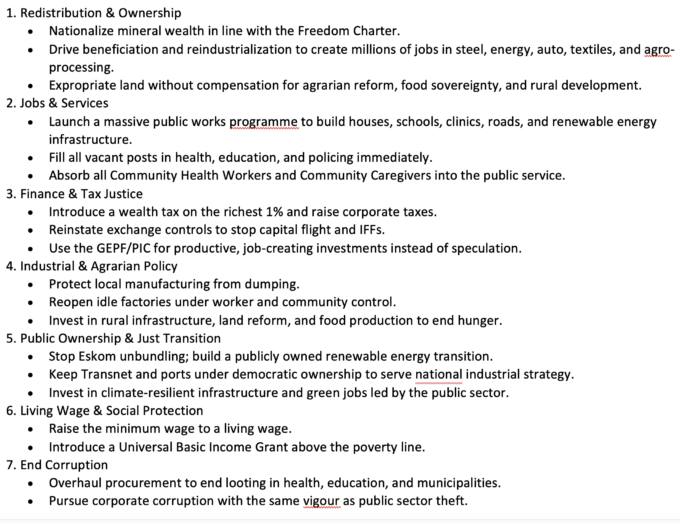
If state power ever shifted in an amenable manner, SAFTU would insist on treating the Minerals-Energy Complex much differently, as witnessed in its initial aim: to ‘nationalize mineral wealth.’ Indeed such wealth is already within the ambit of state ownership thanks to a 2002 law that treats minerals as in many other places, as sovereign wealth. But in practice underground resources are dug up and sold purely to profit extractive-industry corporations. The state receives a small royalty according to this formula: 0.5 + [earnings before interest and taxes/ (gross sales in respect of unrefined mineral resources x 9) x 100. Notwithstanding a formidable property rights clause in South Africa’s constitution, it is not inconceivable that power relations could suddenly shift.
In such a situation, it would make sense not only to change resource allocations so as to meet to basic needs, as SAFTU demands, but also to unite with other ambitious governments around the world in resisting devaluations of exposed capital – as will logically be taking place until that point is reached. The objective would be a form of what Samir Amin termed ‘delinking,’ i.e. to buck the world market in search of beneficiation alliances that could create the desired ‘millions of jobs in steel, energy, auto…’
Examples of delinking include the 2001 World Trade Organization concession that Intellectual Property restrictions on AIDS medicines could be relaxed so as to allow for generics to be acquired and supplied by states for free, leading to South Africa’s rise in life expectancy from 54 to 65 from 2004-19.
Financial delinking also exists in the forms of exchange controls (which South Africa retains to a significant extent) and questioning of inherited debt, as did Ecuadorean President Rafael Correa in 2006, in relation to corrupt Norwegian loan contracts, following a debt audit. A serious Just Transition approach, in which inherited debts (like the JETP) would be questioned – through a debt audit and subsequent ‘Odious Debt’ declaration – would then allow for a very different strategy in relation to (eco-socialist) planning of both mineral and energy inputs, and productive outputs.
The crucial dialectical problem will entail the combination of ‘degrowth’ – recognizing devaluation and deindustrialization in many of the sectors (e.g., the irrational exported aluminum by electricity-guzzler South32, or the subsidized luxury car production by German manufacturers) which is already occurring through prevailing processes of (un)creative destruction, thanks to overaccumulated-capitalist markets – and reindustrialization to meet basic needs and switch energy rapidly to solar, wind and pumped storage systems.
The latter were hypothesized by the Alternative Information and Development Centre’s ‘Million Climate Jobs’ strategy and the 350.org and Climate Justice Coalition campaign for ‘A Green New Eskom’.
These are just some of the examples, of creative civil society interventions that are harmonious with the ideals of degrowth and just transitions, to which must be added the activism of communities aiming to decommodify electricity in the face of the state’s ‘energy racism’ that leaves vast swathes of black residential areas disconnected through ‘load reduction’ (or ‘energy racism’).
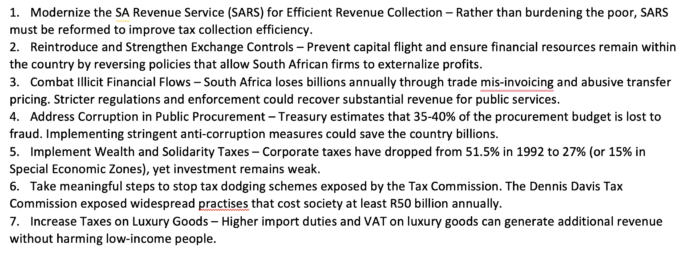
Also at that future stage, in which ascendant labour-community-environmental power gains influence over (post-neoliberal) public policy, the financing strategies capable of meeting these demands will be vital to its success. To pay for a nationalization-based reindustrialization and decommodification agenda would require, SAFTU acknowledges, major alternative sources of revenue:
If labour is not yet internationalist, then back to a national defense against devaluation
Only an internationalist eco-socialist approach will address this crisis, but there are very few forces moving in this direction today. The nationalist approach is to demand more tariff protection against China and India, more local procurement and beneficiation of minerals, with extremely inexpensive Eskom electricity to revive what are now mothballed smelters. Will such measures be acceptable to a neoliberal state, and would they keep the local industrial base alive, under this extreme level of competition?
If not (as I suspect), is there an approach to internationalism and to local proletarian interests (e.g. a socialist Just Transition within a single national state) that would follow as a political strategy, from the current deindustrialization crisis?
Two points must be made in conclusion: the beneficiation of minerals proposed by SAFTU and NUMSA does not yet incorporate the full critique of the existing mining and smelting industries that consume so much electricity, including the costs of non-renewable resource depletion, pollution, greenhouse gas emissions and excessive unpaid women’s labour in social reproduction.
One reason that these are so far not readily introduced in the left labour movement’s discourses, is the predominance of NUMSA conservatism. That union was once – in the early 2010s – firmly eco-socialist in orientation and in 2014-15 had hosted a ‘United Front’ network with South Africa’s leading leftwing social activists, though the broader activism soon fell afoul of a NUMSA leadership which by 2016 reverted to different, less-open traditions.
By the early 2020s, NUMSA had switched to a position that included unapologetic defense of coal. Indeed its members at the main Glencore coal mine were the ones, tragically, digging the energy supplies that were then railed to the main export harbour and shipped to Israel – notwithstanding the union’s progressive position in solidarity with Palestine on everything else.
Still, the fast-changing context of widespread deindustrialization will force renewed attention to how best to manage devaluation of overaccumulated capital. A major economic shift is underway which forward-looking trade unionists must recognize and react to, and this is a vital task even without the added distraction of AI-induced job loss.
The ongoing collapse of autos, steel, aluminum, petrochemicals and other vital industries that relied on exports to the West – whether to Trump’s fast-closing U.S. markets or to the EU’s and UK’s increasingly climate-conscious (carbon-taxed) markets – along with sustained Chinese competition (inevitably with further bouts of dumping), together mean that further devaluation is inevitable, no matter efforts by the likes of NUMSA to defend through tariffs and other defensive gestures.
The additional challenge for those who organize electorally amidst the vast majority of poor and working-people, ultimately, is to go far further. This will require a democratic electoral overthrow of the existing ruling Government of National Unity parties in the late-2026 municipal and mid-2029 national elections, and to ensure their replacement by a very different kind of political party coalition.
Yet in spite of NUMSA’s stated intent to craft such a broad left coalition in 2026, in advance of elections for municipalities and metropolitan areas, little can be reasonably expected in the current conjuncture, given the adverse balance of force.
Hence in the meantime, what SAFTU proposes are what French labour sociologist Andre Gorz consideredto be ‘non-reformist reforms’: they allow the working class to advance ideas about how capitalism can be improved, and since the capitalist class will not allow those reforms, the only way forward at some stage, is to insist on, and to win, eco-socialism.
And without doubt, the alliances needed for that kind of project were – notwithstanding the concrete policy demands made by metalworker leaders in December 2025, mentioned above – articulated in a statement by NUMSA in the same breath:
The CC was also very clear that NUMSA must continue to go back to its own basics that of linking shop floor struggles with community struggles. The CC reminded us that we are not a gumboots union. We are a militant red revolutionary union which must take up the fight to reverse de-industrialization by demanding beneficiation of our minerals to champion manufacturing and industrialization. Such a struggle can only win the day if it is rooted in our communities. Critical to such a struggle is to overthrow neoliberal agenda which has undermined the role of the state to intervene in the economy to build infrastructure which is critical to stimulate economic growth. The CC was clear that we must win the war against austerity measures.
One might experience this as the lyrics to a ‘talk left, walk right’ dance, and many such communities will be skeptical of the framing given NUMSA’s track record. Yet this kind of express orientation to locally-oriented, basic-needs reindustrialization – in this case articulated by the country’s major manufacturing trade union, in whose Johannesburg head office, as noted above, temptations are still dominant in the opposite direction when it comes to protectionist defense of status quo Minerals Energy Complex maldevelopment – is the only way forward to social progress and ecological sanity.
Such an approach would necessarily be based upon unity with a broad range of community and social struggles. If that can occur – as the United Front concept hinted at a decade ago – it would potentially mean a widening of the fight against devaluation of overaccumulated capital, to achieve a genuine, socialist Just Transition, instead of the ubiquitous ‘economic growth’ defined by GDP accounts, whereby social, economic and environmental wealth actually declines.
The challenge is to build a movement that can one day emerge to achieve a sensible version of degrowth for a genuine Just Transition, i.e., a feminist, anti-racist eco-socialism, in South Africa and everywhere.