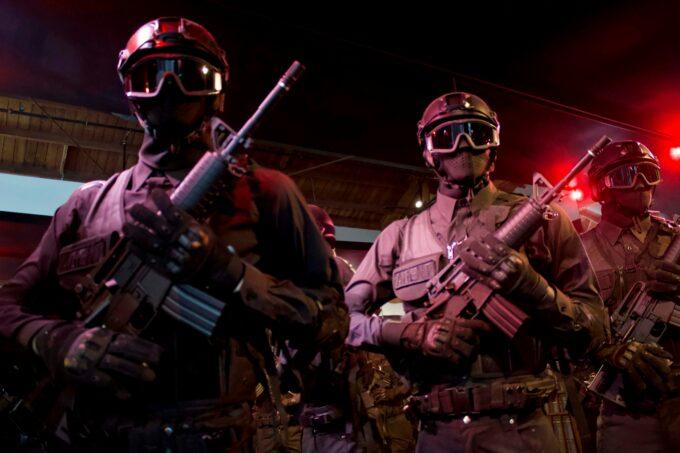
Image by Bret Kavanaugh.
Recently, I had the opportunity to stand in a friend’s kitchen eating pupusas, the Salvadoran national food, while listening to an update on conditions in Central America from Cristosal’s Noah Bullock. Cristosal is a key Central American human rights organization engaged in legal advocacy, forensic investigation, and amplifying the voices of people who are experiencing — and resisting — repression in El Salvador, Honduras, and Guatemala. Noah offered considerable detail on the conditions in those countries, but his basic message for us living so far away was simple: No matter how dark the road gets, we keep on walking. We know the sun will rise again.
So, while most of the world (and the media) is all too reasonably focused on the ever-evolving, increasingly disastrous conflicts in Iran and Lebanon, I found myself instead thinking about the countries to our south.
Benign Neglect?
During the years when our main political work involved opposing U.S. aggression in Latin America, my partner and I used to believe that the whole region would be better off if the imperial eye were focused on other parts of the world. Most Central American countries may be poor, but they’re more likely to prosper during times when Washington isn’t treating them as backyard gold mines, or pawns in a global conflict.
Take Nicaragua, for example. U.S. Marines first occupied that country early in the last century and, by the 1920s, had helped establish a dynastic dictatorship there that would last until 1979. During that time, U.S. companies profited endlessly from various forms of resource extraction, including the gold of the Las Minas (The Mines) area, comprised of the towns of Siuna, Rosita, and Bonanza; lumber from various parts of the country; and palm oil from its Atlantic coast.
In the 1950s and 1960s, the United States used its Cold War conflict with the Soviet Union as a pretext for directly meddling in the lives and politics of countries across Latin America. Bogus threats of a communist takeover, for instance, excused the CIA’s 1954 overthrow of Jacobo Árbenz, the democratically elected president of Guatemala. Carlos Castillo Armas was then installed as president, the first of a long series of dictators, much to the satisfaction of that U.S. commercial giant, the United Fruit Company, which proceeded to treat the country as its own private orchard.
When Chilean President Salvador Allende supported nationalizing his country’s two biggest copper mines, their U.S. owners benefited from a 1973 CIA-backed coup that overthrew him. The newly-installed dictatorship of General Augusto Pinochet then launched a campaign of terror, torture, disappearances, and the murder of tens of thousands of Chileans over his 17 years in power.
Similarly, the United States supported right-wing, repressive governments in Argentina, Brazil, El Salvador, Honduras, and Uruguay during those Cold War decades. However, beginning with the Nicaraguan revolution in 1979, most of those countries managed to rid themselves of their repressive rulers in the last two decades of the twentieth century.
After the Soviet Union collapsed in 1991, the United States began to push Latin America aside and focus elsewhere, sending its “Harvard boys” off to Russia and points east. Like the Chicago Boys of the 1970s, who remade Chile’s economy as a model of laissez-faire capitalism, those young Harvard economists sought to offer similar “benefits” to the benighted former Soviet Socialist Republics. Their efforts led to a fire sale of state industries and birthed a class of oligarchs whose successors still rule Russia and various former Soviet republics.
Then, beginning with the first Gulf War against Iraq (also in 1991), and especially after the September 11, 2001, terrorist attacks on New York City and Washington, D.C., the U.S. acquired a new, if amorphous, “enemy” and launched the Global War on Terror. Washington’s geographic focus then turned to Central Asia, the Middle East, and northern Africa, as the U.S. began what would prove to be disastrous wars in Afghanistan, Iraq, Libya, Syria, and now (with as-yet-unknown consequences) in Iran. Meanwhile, Latin America experienced a bit of what (in entirely different circumstances) President Richard Nixon’s advisor Daniel Patrick Moynihan once termed “benign neglect.”
An Evil Harvest
As it happened, however, during the 1980s and 1990s, the United States planted seeds in Central America that would eventually bloom as twin disasters for the region: the rise of international gangs and the ravages of climate change. While Mexico’s gangs are largely homegrown affairs, those in El Salvador began as U.S. imports. During the dictatorships and guerrilla wars of the 1980s, numerous Salvadorans, fleeing government repression, sought asylum in the United States. Thousands would settle in Los Angeles and the San Francisco Bay Area.
Once the war in El Salvador ended in 1992, many of them headed home again, some bringing the gang culture of California with them, including Mara Salvatrucha (also known as MS-13) and the 18th Street gang, both from the Los Angeles area. I got a glimpse of that form of migration in 1993, when I spent a few days in El Salvador. On a wall in the capital city, San Salvador, I saw the tag of a gang from my very own neighborhood in San Francisco, the XXII-B, or “Twenty-two-B” crew. That stood for the corner of 22nd and Bryant streets, the very corner of San Francisco where my partner and I were then living. We’d watched them grow up on our block. They were never a big deal in San Francisco, nor did they really become so in El Salvador, unlike MS-13 and the 18th Street crew.
As for climate change, we obviously can’t pin all the blame for that on the United States alone, although our current president is doing his best to drive us in that direction. (Fond as he is of fake awards, perhaps someday he’ll get one for the World’s Most Devastating Climate Changer.) Until 20 years ago, however, the U.S. was the world’s biggest emitter of greenhouse gases and, though now leapfrogged by China, it remains historically by far the world’s largest user of fossil fuels.
One result of the intensifying global climate emergency is a series of devastating droughts in Central America, which lies within the “Dry Corridor,” running from southern Mexico to Panama. That region, inhabited in many places by subsistence farmers, has historically experienced cycles of wetness and drought, corresponding in part to the El Niño oscillation, which periodically warms the Pacific Ocean’s surface, bringing fierce rainfall to the west coast of the United States and severe drought further south. In recent decades, climate change has been lengthening the drought periods and multiplying their effects. Increased heat reduces soil moisture, while rising seas contaminate estuaries and aquifers, leaving less water available for farming. A new round of droughts began in 2014 and, in 2018 and 2019, farmers across Central America would lose 75% to 100% of their main food crop, corn.
Worse yet, on our ever-hotter planet in this era of ever-more-intense climate change, the strongest El Niño in 140 years is predicted to begin later this year.
It turns out that not only has the U.S. historically treated Central America terribly, but its neglect of the region in our era has hardly been benign. Under such circumstances, it shouldn’t be a surprise that, by the end of Joe Biden’s presidency, the combination of U.S. “exports” — murderous gang violence, political repression, and drought — had led record numbers of migrants to our southern border, desperately seeking asylum in this country. And that brings us to Donald J. Trump, and his new best friend, Nayib Bukele.
In El Salvador: Trump’s BFF Nayib Bukele
President Nayib Bukele of El Salvador has called himself “the world’s coolest dictator.” He’s young, handsome, and extremely popular in his own country. Originally a man of the left, while mayor of the capital, San Salvador, from 2015 to 2019, he succeeded in reducing the murder rate there not through repression but by mending the “tejido social” — the social fabric. He rebuilt the city center, providing streetlights and surveillance cameras, thereby creating a safer central area for street vendors. He also opened up educational and recreational opportunities for the city’s youth. In addition, he made cosmetic changes symbolic of progressive politics like renaming Roberto D’Aubuisson Street, so-called in honor of a death-squad leader.
Bukele claimed that such measures alone had produced a genuine decline in the city’s disturbing murder rate. But investigations have since shown that he also followed in the footsteps of previous Salvadoran presidents by making pacts with the gangs to reduce visible violence. (For an exploration of Bukele’s agreements with them and later with Donald Trump, don’t miss the PBS Frontline film on the subject.)
His 2019 election to the presidency began his full-scale shift to the right and toward what has now become full-on authoritarian rule. In 2020, he ordered soldiers into El Salvador’s congress to force it to accept a $103 million loan from the United States to underwrite the U.S.-El Salvador anti-gang Plan Vulcan, which involved the massive incarceration of accused gang members (along with many innocents). At the same time, Bukele made an agreement with MS-13 to spare some of its key members in return for a reduction in the capital’s murder rate, which did indeed drop steeply during the first years of his first term as president. But in 2022, some MS-13 members who were supposed to be protected were mistakenly caught up in a sweep and, in retribution, murders spiked once again. As Cristosal’s Noah Bullock explained in that talk I listened to recently, the gangs have the power to dial visible street violence up or down. They use violence as a way to communicate with both El Salvador’s citizenry and its government. A display of corpses on street corners is a way of sending messages to both of them.
In 2021, having captured a majority in the legislature, President Bukele took control of the judiciary, too, by ordering an increasingly supine congress to oust the five members of the Supreme Court of Justice. Then, following a landslide reelection victory in 2024, he rewrote the constitution so that he could serve consecutive terms as president ad infinitum, while also building the now-notorious CECOT “terrorism confinement” prison, where torture and sexual abuse have become daily occurrences.
When Bukele met with President Trump at the White House during his first term, it was clear that the admiration was mutual. Trump could, of course, only dream of exercising the kind of control Bukele by then wielded over all three branches of the Salvadoran government. In 2025, after Trump’s second inauguration, he and Bukele met again and struck a deal: the United States would pay El Salvador $6 million to imprison 250 mostly Venezuelan immigrants to this country in the CECOT mega prison. The transfer of those men (over the objections of a U.S. federal judge) was chronicled in carefully-produced videos of Salvadoran soldiers frog-marching their shackled captives into CECOT, pushing them to their knees, and forcibly shaving their heads.
As investigations would later reveal, those men were not, as claimed by the Trump administration, members of Venezuela’s quasi-gang Tren de Aragua, but ordinary citizens caught up in ICE roundups. Except for a few Salvadoran citizens, who remain in CECOT to this day, they were eventually freed. Those who were released, however, described weeks of torture and sexual abuse in, among other places, a CBS 60 Minutes report that was, for a time, spiked by the new editor-in-chief of CBS News, Trump admirer Bari Weiss.
In truth, though, $6 million was chump change to a Salvadoran government used to hundreds of millions of dollars of largesse from Washington. In this case, however, Bukele got something he wanted a lot more than money. The U.S. was holding a group of nine extradited MS-13 leaders, and MS-13 wanted them returned to El Salvador. Hoping to keep the retributive killing in his country down, Bukele wanted them back, too. There was, as the Washington Post reported in October 2025, only one problem: some of those prisoners were U.S. informants, who had assisted the FBI in disrupting MS-13 activity in this country. Federal law prohibited turning them over to El Salvador, but Trump assigned Secretary of State Marco Rubio to work things out with Bukele. According to the Post,
“To deport them to El Salvador, Attorney General Pam Bondi would need to terminate the Justice Department’s arrangements with those men, Rubio said. He assured Bukele that Bondi would complete that process and Washington would hand over the MS-13 leaders.
“Rubio’s extraordinary pledge illustrates the extent to which the Trump administration was willing to meet Bukele’s demands as it negotiated what would become one of the signature agreements of President Donald Trump’s early months in office.”
Not surprisingly, repression against the press and civil society continues in El Salvador to this day. Many opposition journalists have had to flee the country. In May 2025, human rights attorney Ruth López Alfaro, head of Cristosal’s Anti-Corruption and Justice unit, was arrested. She remains in prison as of this writing. Shortly after that, Cristosal made the difficult decision to move its offices to Guatemala in order to continue its human rights work in greater safety.
Eyes on El Salvador
These days, it’s all eyes on Iran. But while President Trump is ever more desperately focused on the Middle East, maybe some of us should still be focusing on El Salvador. President Bukele (elected democratically like Donald Trump) is following the same strongman handbook that Trump has been using. The steps are the same for aspiring autocrats around the world, whether in Hungary, Russia, or the United States. Here are a few bits of guidance from that metaphorical manual:
+ Attack the judiciary, as Trump & Company have done every time they get an adverse federal ruling;
+ Capture the legislature and make it do your will, whatever gerrymandering or electoral finagling it takes in Trump’s case;
+ Attack the press and civil society organizations, labeling them, as Trump has, “enemies of the people” and “domestic terrorists”;
+ Plan to rule indefinitely, as Trump repeatedly hints he’d like to do.
Oh, and it doesn’t matter how evil your partners in crime turn out to be, whether it’s Bibi Netanyahu, Vladimir Putin, or Nayib Bukele. In his eagerness to play the strong man, Donald Trump has climbed into bed with the world’s coolest dictator — and the criminals of Mara Salvatrucha, or MS-13.
But, as Noah from Cristosal told our little gathering the other day, we have to keep on walking through the dark, knowing that every act of solidarity and resistance brings the dawn that much closer.
This piece first appeared on TomDispatch.