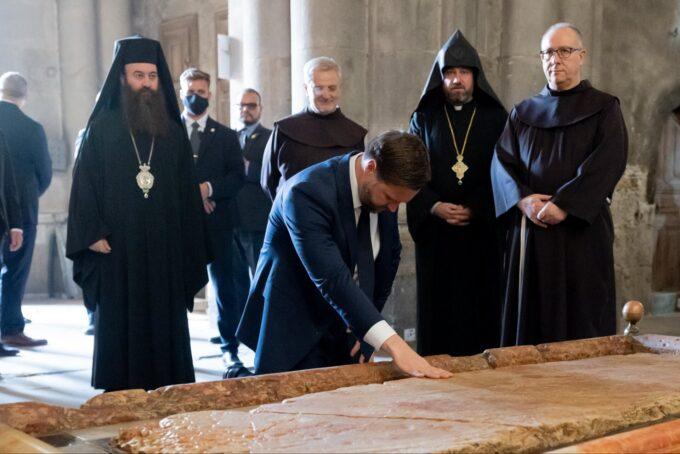
Photograph Source: JD Vance – Public Domain
On April 14, 2026, Vice President JD Vance stood before a half-empty arena at the University of Georgia, courtesy of Turning Point USA, and decided to lecture the Pope about Augustine. Specifically, Vance — who has publicly named St. Augustine as his patron saint, the intellectual godfather of his Catholic conversion — invoked the great North African bishop to push back against Pope Leo XIV’s Palm Sunday declaration that God turns away from the prayers of those who make war. The Pope, Vance said, was oversimplifying. There was, after all, “more than a 1,000-year tradition of just war theory” to consider.
What Vance apparently had neglected to check — or had checked and dismissed — was that at the very moment he was delivering this theological correction, Pope Leo XIV was standing in Annaba, Algeria — the city the Romans called Hippo Regius — at the tomb of St. Augustine himself. The Pope had traveled there to pay homage to the man who did more than anyone to shape Catholic moral theology, including the just war doctrine Vance was now wielding against him. Vance used Augustine to rebuke a pope who was, at that precise hour, kneeling before Augustine’s bones.
Call it farce — the genre where people talk loudly and confidently about things they are simultaneously, visibly getting wrong. Irony at least carries an element of surprise. This was something more brazen: a man invoking his patron saint against the very person who had just gone to pray at that saint’s grave.
The farce runs deeper than one embarrassing afternoon in Georgia, though. To understand why, you have to go back further than Vance, further than Leo, further even than the Church’s long entanglement with the politics of empire. You have to go back to a single drop of blood, and what it has meant on this continent for four hundred years.
One Drop and the Throne of Peter
America built a legal and literary tradition, particularly in the South, around a concept so brutal in its simplicity that it found no real equivalent in other societies: the one-drop rule. One drop of African blood — one ancestor, one grandparent, one great-grandparent removed from the plantation — and you were Black. Fully, legally, consequentially Black, with all the social and mortal weight that word carried.
Kate Chopin understood this. Her Louisiana stories — Désirée’s Baby most famously — turn precisely on the moment that drop surfaces: when the hidden inheritance announces itself in a child’s skin, in a feature, in a particular shade of afternoon light. The revelation destroys families. It ends marriages. It ends lives. The drop was a sentence, handed down without trial.
Pope Leo XIV — born Robert Francis Prevost in Chicago, of Creole descent, with roots in New Orleans and the Caribbean — stands, by that same American logic, as a Black man. His lineage runs through the African diaspora, through the mixing and the migration and the survival that produced the Creole culture of Louisiana and the islands. His great-grandparents were listed as “colored” on census records. The one-drop rule, that instrument American society used for centuries to strip people of their humanity, their property, their freedom, and their lives, applies here without ambiguity.
And yet.
When Leo XIV was elected in May 2025 — the first American-born pope in the history of the Catholic Church — the mainstream coverage was careful, almost clinical, in its management of this fact. There were references to his “multicultural background.” His “diverse heritage.” His years serving in Peru. The word that would have appeared in a census record a century ago, the word that would have determined where he sat on a bus, whether he could vote, whether his marriage was recognized by law — that word stayed largely off the page. The institution that elected him, and the media that covered the election, achieved something remarkable: they made history while carefully appearing to overlook the history being made.
The silence is the story.
The Conclave and the Coincidence
In 2024, Edward Berger’s film Conclave arrived in cinemas and proceeded, somewhat improbably, to become an awards-season phenomenon, winning the Oscar for Best Adapted Screenplay. The film follows the secret election of a new pope — the maneuvering of cardinals, the buried secrets and doctrinal anxieties of an institution choosing its next vessel of God’s authority on earth. The pope ultimately elected is the dark horse, the outsider, the one who had been quietly serving in Afghanistan while the others accumulated Vatican real estate and influence. He carries a secret: he was born intersex. The distinction from transgender matters here, because an intersex body refuses the binary categories the Church has spent centuries enforcing — from within, by biology, without choice or agenda.
The institution elected him anyway. Without knowing. The Church keeps accidentally choosing the people its official doctrine was designed to exclude.
The film was still in theaters when the real conclave of 2025 produced Leo XIV. Life, apparently, had been watching the screener.
The parallel is instructive rather than exact. In Conclave, the institution’s discomfort with its own choice is palpable — the film ends on a held breath, a question the camera refuses to answer. In reality, the discomfort expressed itself as quiet, careful management of the narrative. Leo’s heritage was acknowledged the way you acknowledge something you hope will stop being mentioned: a line in the biography, a respectful nod, and then a swift pivot to his years in Peru, his pastoral record, his administrative experience in Rome. Anything but the census records. Anything but the one drop.
The Caribbean, Sugar, and Capital’s Original Sin
Leo XIV’s heritage carries the weight it does because of where that heritage actually comes from — geographically, historically, economically, and yes, theologically.
The Caribbean was the first laboratory of the African diaspora in the New World. The plantation system that would eventually spread across the American South was first engineered on the islands — Haiti, Hispaniola, Jamaica, Barbados — where European capital discovered its founding obsession: sugar. Before cotton, before tobacco, before the industrial North developed its appetite for raw material, there was sugar. And sugar ran on a scale of human brutality that even the colonizers had to consciously work to rationalize.
The economics were staggering. By the mid-eighteenth century, the sugar colonies of the Caribbean were generating more wealth for Britain and France than all their other colonial possessions combined. Haiti alone — Saint-Domingue, as the French called it — accounted for roughly forty percent of Europe’s sugar and more than half its coffee. The island was the most profitable piece of real estate on earth. It was also a charnel house. Enslaved Africans died so quickly from overwork, disease, and deliberate violence that the system required continuous importation just to maintain labor levels. You consumed people in Saint-Domingue. The word “owned” was too polite.
The Church was present throughout. Missionaries arrived with the colonizers. The Doctrina Christiana was administered alongside the whip. Baptism was offered — and often required — while the legal personhood of the baptized was simultaneously denied. The theology was intricate in its self-justifications: slavery was a condition of the body, the soul remained free; the enslaved could receive the sacraments; their suffering in this life earned redemption in the next. The Church provided the plantation economy with the moral vocabulary that made it livable for those doing the living.
This legacy is the history running beneath Robert Prevost’s Creole ancestry. A useful aside: the American Civil War, for all its subsequent moral framing, was at its economic core a dispute about supply chains. The cotton and cane extracted from the South fed the mills and refineries of New York and Massachusetts and Lancashire. The raw material flowed north; the finished product flowed back and onward to England and Europe. When the South seceded, it threatened to redirect that flow — to build its own industrial base and its own European trading relationships. Entire Northern industries faced ruin. Liberation was the outcome of that war. For most of the men who financed the Union armies, it was a fortunate byproduct of protecting their bottom line.
This legacy is the history that runs in Leo XIV’s blood. A descendant of those consumed by that system now occupies the most powerful chair in Christendom, and the institution that blessed the ships is very carefully not making a fuss about it.
- The Irony of Black Protestantism
There is a demographic footnote to all of this that deserves more than a footnote.
The overwhelming majority of African Americans are Protestant. The Black church — Baptist, Methodist, AME, Pentecostal — is among the primary institutions through which African American political organization, cultural survival, and collective identity were built and maintained across four centuries of legal terror. From the invisible church of the antebellum South, where scripture was read in secret and God was understood to stand with the enslaved, to the pulpits that anchored the Civil Rights Movement, the Black Protestant tradition is inseparable from the larger American story.
By most estimates, more Black Americans practice Islam than Catholicism. The Nation of Islam, and later mainstream Sunni communities, found their American constituency in large part among African Americans for whom the Christianity of the slaveholder carried too much blood on its pages — and for whom a faith with a different relationship to colonial history offered something valuable: a clean line.
The Catholic Church occupies its own specific position in that imagination. A Jesuit institution — Georgetown University — sold 272 enslaved people in 1838 to finance its operations. The documentation is thorough. Recent decades have brought reparative gestures, largely symbolic. The history persists underneath the gestures.
So the first Black pope arrives, and his most natural constituency greets the news with something between a shrug and a raised eyebrow. The sentiment running underneath is recognizable: this is not our house, and the people who built this house used our great-grandparents as the lumber. That history does not dissolve because one pope carries Creole blood in his veins. The Black church built itself in the margins the Vatican helped create. It has never needed the Vatican’s permission to matter. The question now is whether the Vatican has enough self-awareness to understand what it elected — and what it owes.
The Just War and the Gangster War
Pope Leo XIV, on Palm Sunday, quoted the book of Isaiah: God turns away from the prayers of those who make war. He said it plainly, in the context of Gaza, in the context of Iran, in the context of an American administration conducting bombing campaigns across multiple theaters — without a congressional declaration of war, without a formal finding of existential threat, without the legal architecture that American and international law nominally requires before a state may kill people in other countries.
The just war tradition — Augustine’s tradition, the one Vance claims as his intellectual inheritance — establishes strict criteria: the cause must be just, the intent must be right, war must be a last resort, it must be declared by legitimate authority, and the harm inflicted must remain proportionate to the harm prevented. The US bishops, responding to Vance without naming him, put it plainly: just war requires defense against one who “actively wages war.” Aggression disqualifies itself. Preemption disqualifies itself. Resource acquisition dressed in the language of freedom disqualifies itself.
The just war tradition was designed, in part, to prevent exactly what Vance attempted: the retroactive sanctification of wars by invoking the good ones. Yes, the liberation of the concentration camps meets every criterion — it was defensive, proportionate, pursued only after the exhaustion of alternatives, directed at military objectives. Citing it to justify an air campaign against Iranian civilian infrastructure — which Trump’s Easter Sunday social media post explicitly threatened — is motivated reasoning in theological clothing, at best. The tradition Vance invokes actively forbids the conclusion he draws from it.
The pattern is familiar enough by now. The twentieth century produced the last wars that could credibly be called good — fought against ideological evil with territorial ambitions and industrial murder at their center. Everything since Korea has required more careful public relations. Vietnam required the Gulf of Tonkin fabrication. Iraq required the weapons of mass destruction fabrication. Afghanistan required the specific geography of September 11, which itself rewarded a closer look than most Americans were prepared to give it in the grief-soaked months immediately following.
What comes after looks less like war in the theological sense and more, when you trace the resource maps and pipeline routes and defense contractor earnings, like a protection racket with better branding. America’s interest in Iran runs through oil reserves, regional dominance, and the leverage that comes from controlling the geography between the Caspian and the Gulf. The just war criteria ask about actual conditions, not stated intentions — and the actual conditions on offer here are: no existential threat, no exhaustion of alternatives, no congressional authorization, civilian infrastructure as explicit target. The Pope knows this. The bishops know this. The catechism states it plainly. Vance, who has read Augustine, knows it too. That is precisely what made his Georgia performance so remarkable: a man fluent in a tradition, deploying its vocabulary toward conclusions the tradition explicitly forbids.
God’s Ambassador and the Convert Who Knows Better
Let us be precise about the institutional relationships at play in this exchange.
JD Vance is a Catholic convert, received into the Church in 2019, with Augustine as his chosen patron. In Catholic ecclesiology, the Pope carries a specific and absolute authority: the Vicar of Christ, earthly representative of the Son of God, successor of Peter, supreme pastor of the universal Church. The tradition provides mechanisms for a Catholic to express disagreement with the Pope on matters of faith and morals — respectfully, through proper channels, with deference to the office. A Fox News interview in which the Vice President of the United States tells the Vicar of Christ to “stick to matters of morality” and leave foreign policy to the president falls somewhat outside those mechanisms.
Sit with that phrase a moment: stick to matters of morality. The deliberate killing of civilians — a matter of morality. Whether a war satisfies the criteria for justice — squarely within the Pope’s professional jurisdiction. The man whose formal title includes “supreme pastor of the universal Church, servant of the servants of God” commenting on whether bombing campaigns are moral — that is his assignment, in the most literal doctrinal sense. Vance’s formulation implies that morality and foreign policy occupy separate rooms, and that the Pope has a key only to one of them. Augustine, had he been consulted, would have had pointed things to say about that architectural arrangement.
And then there is the word Vance chose on Fox News for the president’s relationship to American foreign policy. He said “dictating.” Let the president of the United States stick to dictating American public policy. Vance is a careful man with words — he wrote a memoir, attended Yale Law, chose his patron saint with deliberation. Dictating: from the Latin dictare, to prescribe, to impose. The word carried a specific political charge for most of the twentieth century. Its appearance here was either a slip of extraordinary proportions or a confession dressed as a talking point.
America has produced exactly two Catholic presidents. John F. Kennedy, assassinated, whose brain — literally, physically — became the subject of government suppression and archival management for decades, the only modern president whose murder has never been honestly reckoned with by the institutions charged with doing so. And Joe Biden, one term, his cognitive decline the dominant narrative of his presidency, effectively managed out of his own party’s nomination process in a manner that raised democratic legitimacy questions the mainstream press found inconvenient. Two Catholics. One lost part of his skull in Dallas. One lost the thread on national television. Catholicism in American political life has functioned as a constituency to court and a cultural identity to perform, subordinated consistently to the demands of power. Vance’s Fox News performance fits the tradition precisely: the faith is real, the conversion was sincere, and on Monday morning it changes nothing.
Meanwhile, Trump posted an AI-generated image of himself as Jesus Christ. On Easter Sunday. The administration lecturing the Pope about staying in his lane depicted its president as the Son of God, on the holiest day of the Christian calendar, and the evangelical base absorbed it without blinking.
The Flaccid Throne — And What It Could Be
A fair question sits underneath all of this, and deserves a fair answer: does it actually matter what the Pope says?
The Vatican commands 44 hectares in the middle of Rome — smaller than most golf courses. Its power is the power of moral authority: the capacity to name things truly, to call a war crime a war crime, to say that God turns away from the prayers of warmakers, and to have 1.4 billion people hear that and feel something move in them.
John Paul II understood this architecture intimately. His papacy was a sustained exercise in deploying moral authority against Soviet communism — standing in Warsaw, standing in Gdańsk, occupying the specific geographies of oppression and naming what he saw. Whether or not you credit that presence with contributing to the collapse of the Eastern Bloc, every serious historical account of that period reckons with it. The Pope, armed with nothing but his presence and his voice, operated as a geopolitical force.
Leo XIV is, at this writing, less than a year into his papacy. He has spoken on Gaza. He has spoken on Iran. He traveled to Augustine’s tomb in Algeria and stood there on the same afternoon an American Catholic official used Augustine’s name against him. He has stated he carries “no fear” of political backlash.
What remains ahead of him is leaning into the specific gravity of who he is: a descendant of enslaved people, a Creole man from the Caribbean diaspora, from that first and most terrible laboratory of capital. A Black pope — by the one-drop rule America itself authored — occupying a chair that was built, in part, by an institution that blessed the slave ships, administered the sacraments, and kept meticulous baptismal records while men and women were worked to death in the sugarcane.
If Leo XIV were to say that plainly — as history, as the specific weight he carries into the job — it would be the most consequential papal statement in a generation. It would demand no army, no sanctions mechanism, only the courage to stand publicly as what the census records have always said he already is. The Church elected him. It just hasn’t absorbed yet the full dimensions of what it elected.
Coda: What the Silence Costs
JD Vance lectured the Pope about Augustine at Augustine’s tomb. The President posted himself as Jesus on Easter Sunday. The Vice President told the Vicar of Christ to confine himself to moral questions — as if the children of Gaza had wandered into a policy seminar rather than a bombing campaign. The first Black pope, by any American legal or cultural standard, was elected to lead 1.4 billion Catholics, and the coverage was managed with such careful precision that most of the world remained uncertain about what it was actually seeing.
In Conclave, the film closes on a sharp intake of breath. The institution has elected the impossible candidate. The camera holds on the new pope’s face — uncertain, burdened, real — and leaves the audience with the question it cannot answer: what happens now?
Leo XIV is that question, running in real time.
The Caribbean is in his blood. Augustine is in his office. The one-drop rule is in his biography. The bombed children of Gaza are in his prayers. And a converted Catholic from Ohio is on Fox News advising him to mind his business.
What happens now is the article’s question. It may, depending on what Leo XIV chooses to do with the impossible seat he occupies, become the century’s.