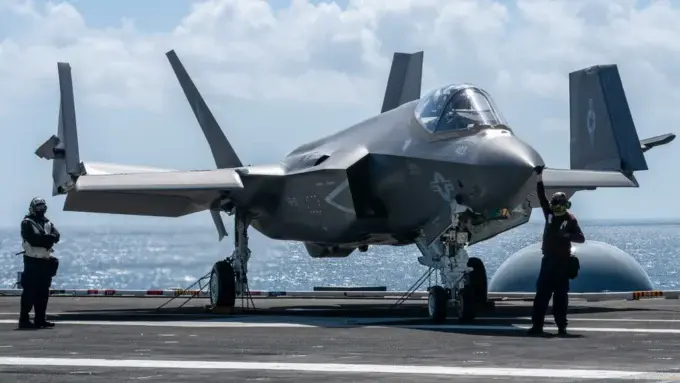
F-35 Lightning on the deck of the USS Carl Vinson. U.S. Navy photo by Mass Communication Specialist 3rd Class Derek Kelley.
“I hate war as only a soldier who has lived it can, as only one who has seen its brutality, its futility, its stupidity.”
– General Dwight D. Eisenhower, 1946
The unusually peaceful end of the Cold War and the collapse of the Soviet Union did not bring us peace. Instead, the world has faced endless regional and ethnic wars, terrorism, and other human disasters. This situation helped create a unipolar world, enabling the United States to use military force without risk or concern for challenges. We went to war against Iraq in 1991, ignoring the Kremlin’s efforts to arrange an Iraqi withdrawal from Kuwait. We expanded the North Atlantic Treaty Organization, ignoring our verbal commitments to Soviet leaders to foreswear such expansion. We used the 9/11 attacks in 2001 to engage in endless wars in Afghanistan and Iraq that failed to bring greater security for the United States.
The New York Times ignores the fact that so many U.S. decisions to go to war have been based on outright lies, often sending the U.S. military into confrontations that it never trained or prepared for. Disinformation contributed to the case for war against Mexico in the 1840s and against Spain in the 1890s. Outright lies made the case for war against Vietnam in the 1960s (see the Gulf of Tonkin Resolution) and against Iraq in 2003 (remember the non-existent Weapons of Mass Destruction). The objectives for the invasion of Afghanistan were achieved in a matter of months, but the U.S. military remained for two decades.
In addition to outright deceit regarding the case for war, there is the consistent and persistent exaggeration of the threats we face, which I learned from my 24 years as an intelligence analyst at the Central Intelligence Agency. There were the phony bomber and missile gaps in the 1950s and 1960s as well as the absurd exaggeration of the Soviet threat in the 1980s to support an unneeded and unprecedented increase in defense spending during peacetime. Currently, it is the China threat that is being heralded to justify a costly policy of political and military containment.
U.S. alarmism is related to the necessities of domestic politics that require a propaganda campaign to “sell” a war to a dubious American public. The war with Iran is an obvious example. There was no evidence of an “imminent” threat from Iran, which Israeli Prime Minister Benjamin Netanyahu brandished to sell the war to the Trump administration, and there is no evidence of the bogus nuclear threat that Trump uses to continue the war. Netanyahu wanted to attack Iran because it was weak, not because it was strong.
The entanglement with Iran has led the editorial board of the New York Times to conclude that the U.S. military is “losing its edge.” It argues that we must make greater investments in counter-drone technologies as well as in “cheap, disposable weapons like one-way attack drones and unmanned ships” to make sure that the “disappointments in the Iran war” don’t “become a preview of far worse.”
The Times editorial falsely concludes that the reality of Iran “exposes the vulnerabilities in the American way of war.” My conclusion is that inexperienced and unsophisticated U.S. political leaders have sent our military forces into regional confrontations for all the wrong reasons and with all the wrong tactics. Vietnam should have been a lesson that Ho Chi Minh was a nationalist, and that the domino theory that had the United States “losing” all of Southeast Asia if it “lost” in Vietnam was a bumper sticker slogan and not strategic analysis, let alone justification for a “forever” war. The “forever” wars in Iraq and Afghanistan should have provided more lessons as U.S. forces were sent into battle without proper training or understanding of the adversary.
There is absolutely no geostrategic justification for the more powerful military for which the Times and other mainstream media advocate. The United States faces no existential threat, invests more in defense than the rest of the world combined, and has unrivaled power projection capabilities. We must stop investing in expensive high-tech weapons systems that are vulnerable to the inexpensive drone technology of our adversaries. It is ironic that in a time when we are stuck in a war that never should have been fought in the first place, we are confronted with arguments for even more powerful and costly military weaponry.