A.M. Gittlitz is an organizer, writer and the author of I Want to Believe: Posadism, UFOs and Apocalypse Communism. His latest work, Metropolitans: New York Baseball, Class Struggle, and the People’s Team (Penguin Random House, 2026), highlights three phases of the franchise’s history, spanning 1776 to 2005. Part revisionist history, part material culture study, and part ethnography, Gittlitz manages to capture the symbolism and essence of Mets fandom in a way that authors before him have failed to grasp. In this book, he achieves his goal, which is to “use the Mets’ tragic, comic, and chaotic history to rip open the dead skin of our nation’s tight-stitched pastime,” while “allowing an alternate history of America.”
Daniel Falcone: What led you to write the book, and how is it structured?
A.M. Gittlitz: I’ve always had this interest in the Mets that I thought was maybe a bit idiosyncratic, but not uncommon — that my love of the team has a lot more to do with its political, social, and cultural connection to the left and the working class and the overall underdog spirit of New Yorkers, even more so than their results on the field.
For example, the moment that I recall being proudest as a Mets fan was in 2020 when Dominic Smith led a walk-off when playing the Florida Marlins following the shooting in Kenosha of Jacob Blake and the subsequent killing of two protesters. That was part of a wildcat general strike throughout sports that began in the NBA with the Milwaukee Bucksand was relatively slow to spread to baseball. For the Mets to be one of the few teams to do one of these unpermitted walkouts was incredibly inspiring to me. It confirmed a lot of what I always loved about the Mets since my fandom began in the late 90s, when the Mets seemed to be something of a conscious rival to Giuliani and Steinbrenner’s Yankees and John Rocker’s Braves.
I found more evidence when Smith’s walkout was seemingly immortalized in the Mets Museum the next season. But then, another couple of seasons later, that exhibit for Dom Smith and the walkout was gone from the Mets Museum. I worried Mets fans might forget about it along with other moments Mets fans have forgotten about or maybe had a lower priority for in varying narratives of team history. So, I conceived of writing a political narrative of the team’s history that also theorized why the Mets are a political team after three different ownership changes, various eras and rebranding. After all, it is just a corporate franchise, so, how is it that this team can endure as political in some way?
The key to that was when I discovered in separate research that the downtown counterculture and radical milieus in New York during the 60s, the New Left really loved the Mets. That was the result of the team’s initial branding as an anti-team to the Yankees and the restoration of the Dodgers and Giants as a people’s team, but then also the way the fan base took on that marketing with a DIY enthusiasm that exceeded it.
The way I tell the story is a reversed fan history. It begins with a more sober Marxist reading of the creation of baseball history through its labor relations and the way the business appealed to different demographics of fans between the mid-19th century and 1962 when the Mets debuted. As the book goes on and my memories of the Mets appear in the 90s chapters moving forward, it becomes a much more subjective fan history where I can look at something that’s difficult to put into terms: the love a fan has for their team.
Daniel Falcone: I like how you used a chronological approach and then went into the thematic political moments to illuminate your own constructions of the team. To what extent do the Mets still carry the working-class energy that you are trying to capture?
A.M. Gittlitz: When I started writing the book I didn’t know too much about baseball’s origins. I indeed had an idea that maybe the sport was invented by the working class. But that turned out to not be true. It was, in fact, invented by the upper middle class in Manhattan.
These were people who worked on Wall Street, accountants, office workers, paper pushers, doctors, architects, and that made the game make a lot more sense to me. This wasn’t a sport played by workers in what little downtime they had, but was a heavily structured, legalistic, well-designed, well-proportioned, artisanal game played by office workers dreaming of a yeoman future running free in the fields of the American Frontier. That gave me a new perspective on the sport balanced between this very technical defense – with a technician (pitcher) throwing an object with this defensive structure behind him. The diamond resembles something of a factory or an urban production process, with three guys in a vast agrarian outfield. Subconsciously this was a microcosm of the total social factory. They then take turns maintaining the production of outs, and then picking up a big stick, smashing the whole process by running free around the field in a chaotic sabotage of the game’s banality.
That only became more obvious following the Civil War. The game spread in Union camps, both among Union soldiers and Confederate prisoners of war, to become the national pastime. The game professionalized in the late 1860s, alongside the development of modern industrial relations, until you see literal workers on the middle-class progenitor’s idyllic field, thus fully appearing as a balanced tension between the desires to contain and unleash proletarian energy.
Daniel Falcone: What makes the Mets unique as a franchise?
A.M. Gittlitz: I was influenced by the book of Tony Collins, Sport in Capitalist Society, which rejects a lot of the previous leftist scholarship arguing sports are corrupted by capitalism. He argues modern sport and capitalism are one and the same, developed through the same period in the 19th century. Their character as mass spectacle, however, links the owners and investors with the desire of worker-athletes and spectators to overcome their station.
So, when a team, like the sixties’ Mets, or New Deal-era Dodgers, or the Gilded-Age Giants, or the Roaring Twenties’ Yankees puncture the normality of sport as a mere capitalist enterprise, they become a “people’s team.” They connect the fanbase and the city and the political moment in a way that theatrically reveals and transcends it. I think all sports fans, if they’re really being honest with themselves, although they might complain a lot about players’ privileges, their high salaries, the high-ticket prices, or put that on the ownership if they’re a little bit left-oriented, what they really appreciate is when the game breaks down in some way. Something happens that is above and beyond the normal feature of the game. Especially in baseball, like, often or most of the time, a very boring sport.
Before Babe Ruth, for example, the home run was something of a taboo. There was a material reason for that – the owners wanted to keep offense low because the better a player’s offensive stats the more they had to pay them. So, Ruth, by unleashing the popularity of the long ball, was really hated by the baseball establishment, but loved by Americans in the way that took baseball to a new level. The Yankees had to build a massive new ballpark, twice the size of most ballparks at the time, to accommodate new demographics of Ruth’s fans. And it was filled with, for the first time, working-class people, notably including Black fans from Harlem who believed that Babe Ruth might be Black as well. The Dodgers were the next team to achieve this status with an explosion of attendance following the appearance of Jackie Robinson in 1947. Then the Mets did the same in the 60s by attracting the maturing youth of the Baby Boom, many of whom were the exurban children of White Flight.
Daniel Falcone: Can you talk about how you frame the history of the teams in the city? How do you go about comparing the Mets and the Yankees and how their followings coincide with competing social issues?
A.M. Gittlitz: The Yankees were born from the American League, which was a renegade competitor to the National League monopoly formed following the Players’ League revolt of 1890. The PL, created by the first players’ unionorganized largely by ex-players of the 1884 Metropolitans on the Giants, was socialistic and cooperationist, but failed to challenge the deep pockets of the Gilded-Age NL magnates. In the aftermath, a Cincinnati sportswriter named Ban Johnson, banned from baseball for criticizing the NL during the revolt, built the rival AL circuit as a sort of progressive Republican trust-busting league, with him serving in the role as a version of Teddy Roosevelt. He was a conservative, Midwest Protestant who wanted to restore the greatness of baseball as a patriotic sport, both in terms of its upper-class fan culture, but also the way it was organized amongst owners as a collective of small business owners.
The team he brought to New York, the Highlanders (eventually known as the Yankees from an ironic local nickname), bucked this trend in two ways. One, they played in an Upper Manhattan park near the Giants’ Polo Grounds and were meant to be the rival to that now-elite team whose Tammany-linked owner Andrew Freedman sought to be the singular CEO of baseball. Their fans were given little American flags on Opening Day to signal they were more patriotic, as Johnson hoped the AL would prove more respectable than the urban degeneracy of big-city machines.
But to be able to get the park built in New York, Johnson had to cut a deal with a progressive wing of the Machine. The Yankees were put under the control of a corrupt former police chief and a backroom-saloon owner who gave the Yankees a very underworld character in their first two decades. It wasn’t until 1920, after the team was sold to a New York beer baron whose fortune was threatened by prohibition, that the Yankees teamed up with the Red Sox to launch what the press labeled an insurrection against Ban Johnson through the prohibited acquisition of Babe Ruth and Carl Mays. They became an expression of mass enthusiasm for the omnipotence of capitalism in the Roaring Twenties. When Babe Ruth had the chance to organize a player’s union early in the 20s, he declined. This was also something of a populist gesture, because workers at this time of the class struggle were seen as an anachronism from an earlier mode of capitalism.
In the 30s, the Depression really woke up the working class to the reality of that arrangement. Without fighting organizations, all those privileges the bosses and company unions had given  them are taken away. Massive strike waves break out, filling the ranks of the AFL, then the CIO. But baseball remains untouched. This was largely because the player production system, Branch Rickey’s farm system, had indoctrinated mostly Southern ball players with the ideology of the baseball’s owners. But Rickey began to understand the limits of this system as it began to generalize throughout the sport and the labor pool tightened. He wanted to expand the sport internationally and open the ranks of the majors to Black and other non-white players. Knowing he could not do this in St. Louis, he turned to Brooklyn, where the hapless Dodgers had been reduced to the stature of the Hooverville “bums” lining the waterfront.
He helped revitalize the team by playing to the working-class unionist attitude of their fans in several ways, including the adaptation of blue in what I believe was a nod to blue-collar work. Finally, he adapted the integrationist theory of the CIO that if Black and white workers could collaborate in the workplace, then racism would be solved, and the business of baseball could expand to new frontiers.
Of course, the deeper structural contradictions of race and class deepened through the fifties, sending the Giants and Dodgers out west alongside hundreds of runaway factories and the middle-class taxbase. Rickey, along with Mayor Wagner and Robert Moses, fought baseball to recombine and restore these teams — as the Mets in 1962 were the superficial answer to this obvious expression of the deindustrialization crisis.
While the Mets were a private enterprise run by Joan Payson, who was the wealthiest American woman at the time, they were also a public project, because they played in a Municipal Stadium in Flushing championed by Moses as a way of getting his “True Central Park” built to recenter the city between cosmopolitan Manhattan and metropolitan suburbia. This public-private partnership was, remarkably, the same populist, philanthropic, urban-expansionist strategy Tammany had developed by professionalizing and spectacularizing baseball in the nineteenth century, including funding the original Metropolitans of 1880. It was no coincidence they chose the same name.
Because Rickey and the Mets would be terrible in their first years, a result of the expansion draft designed by the owners to ensure they would not be competitors, he suggested Payson incorporate several colorful gimmicks to attract a new generation of loyal fans. This included modern features of the ballpark, a comic-book like Pop Art aesthetic, and a pitch to the New York literati that the Mets would be a technicolor humanist antidote to grayscale Yankee conservatism. The defining moment of this scheme came during 1962 Spring Training, when the Mets played against the Yankees. Although it was an exhibition game, the press dutifully played it up as a grudge match between an underdog “people’s team” of washed-up veterans and unknown young journeymen and a decaying Empire.
Daniel Falcone: You do a great deal of work on identity, resistance and social movements, especially in the book’s latter stages. Can you elaborate on the importance of these in the context of Mets history and fandom? The Civil Rights movement comes to mind as an example.
A.M. Gittlitz: In 1964 the Mets moved into Shea Stadium, where they began annually outdrawing the Yankees. Sportswriters begin to wonder, however, how long the phenomenon of a lovable-loser team could last, especially considering so many young Mets fans were beginning to be interested in the Civil Rights Movement and other social issues. Indeed, many Mets fans were a part of these movements, like Mickey Schwerner and Andrew Goodman who were part of Freedom Summer in Mississippi and were killed, along with James Chaney, by Klansmen sent to allegedly find a “J–boy in a Mets hat.”
Around the same time, Cleon Jones, Elio Chacon, and other players of the Mets’ Buffalo Bisons affiliate were sent to play some games in the South to get fans ready for Hank Aaron and the Braves move from Milwaukee to Atlanta. Inspired by the Civil Rights Movement, the players reportedly held their own sit-in for three nights at a Florida restaurant that had refused their service.
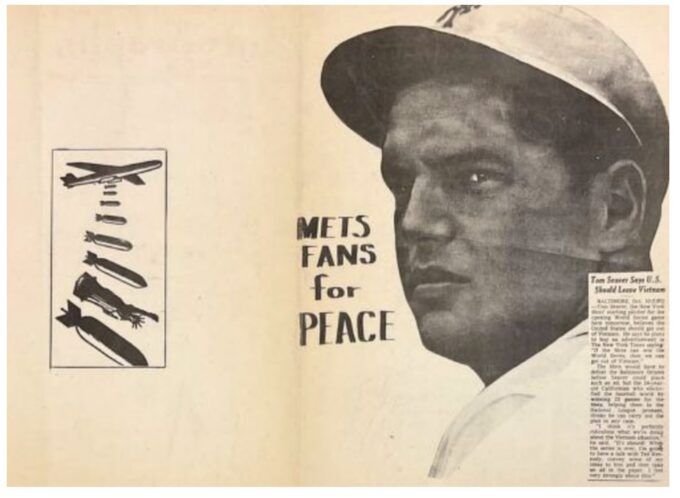
In 1968, the team, now the youngest in baseball, joined a sport-wide boycott of games before the funeral of Dr. Martin Luther King, Jr., and then one of a few teams that voted to boycott games before the funeral of Robert Kennedy later that season. And that really gave the team a political reputation. In 1969, the Mets’ miraculous worst-to-first run attracted Mets fans who had abandoned sports for revolutionary politics. Incredibly, the players were on board as well- supporting the candidacy of anti-war mayor John Lindsay, with Tom Seaver even seemingly dedicating their World Series run to ending the war in Vietnam.
This was completely unseen in baseball prior. Statements against the war and U.S. imperialism had been made previously by athletes like Paul Robeson, Kareem Abdul-Jabbar, Muhammad Ali, and the ‘68 Olympic Runners, but no white athletes, and no baseball players. So, that was an unusual thing to see and do, but it seemed very natural to the Mets. When Seaver pitched Game 4 of the World Series on Moratorium Day, cadres of leftist Mets fans pamphleteered outside the ballpark, a skywriter above Shea wrote “Stop War,” and several fans refused to stand for the National Anthem.
Daniel Falcone: America has returned to a very dark period with a fascistic leader. How should we navigate sports? We want to avoid feeding capitalist industry but on the other hand, baseball can build community in your view, correct?
A.M. Gittlitz: In the Epilogue of the book, I chronicle, day by day, the Mets’ “OMG Gay Grimace” 2024 season – this gave me the opportunity to test out the theories of sports, politics, and the Mets as mediator in real time by going to games, watching the team, interviewing fans, cataloging the energy at Citi Field, while also wondering what this all meant for the moment in the United States, the looming elections, Biden and then Kamala versus Trump, and the ongoing suppression of the pro-Palestine movement. I found there were several very clear parallels.
For one, there had been a protest at Yankee Stadium against the Yankees’ support of Zionism, both from their front office and from some of the players. Those activists called for sports fans throughout New York to engage in similar protests with their team. And while Mets fans likely would have done this, they couldn’t find any clear enough connection between Steve Cohen and Israel like the open Zionism of the Yankees’ organization and players to protest.
One player on the Mets, Harrison Bader, who had been selected for a team in Israel and ended up playing for Team Israel in the recent World Baseball Classic, wore a Star of David on his belt in support of the Israeli hostages in Gaza. But there had been no other statement by baseball players in support of Palestine. So, that felt, for a moment, like a bit of a dead end. The clearer political expression during the season was the embrace of the Mets, both their front office and the fans, of Pride Month. Knowing they have so many queer fans, the Mets celebrate Pride the entire month instead of just one day, and several players wore Pride Month merchandise and made statements in support of their gay fans. It was the month that the team, who were terrible up to that point, really turned it around, and fans started calling them the Gay Mets.
Interestingly, the players seemed to have embraced this as well along with the ironic memes about Grimace throwing the first pitch and the love for journeyman second-baseman Jose Iglesias’ song “OMG.” They began jumping in and out of first place and doing so with a unique humor that really mirrored the shift in Democratic party’s fortunes when Kamala Harris and Tim Walz launched a vibes-based campaign of fun and hope.
2024 was expected to be a rebuilding year for them, allowing them to appear fated underdogs battling through ecological catastrophe and social chaos to the NLCS in October, where they finally hit a wall against the Dodgers, just as the Harris campaign ran out of steam and started sinking in the polls. While they had rediscovered part of their mission as the Mets of being humorous and whimsical and joyful and fun and progressive in the face of dour, regressive conservatism, that wasn’t enough in 2024 to go further.
I write that if members of the team had found some deeper unifying mission, been more explicitly political, perhaps, by supporting a ceasefire in order release the Israeli hostages in Gaza, or defending Algerian boxer Imane Khelif against the transphobic smears during the Olympics, or protesting the racist and xenophobic and homophobic Trump ads playing during the playoffs, they might have found the will fight harder and battle deeper in October, as they had in 1969.
Daniel Falcone: Aside from the more conservative, traditional or even nationalistic accounts of baseball that serve as appeals to patriotism, to what extent are the Mets, and your book, a reflection of what is good and constructive about America and its past?
A.M. Gittlitz: One side of baseball, like America, insists on rigid social hierarchies and Social Darwinist ideals of survival-of-the-fittest. Another is egalitarian and seeks to break those divisions. The first thing that was truly remarkable about the Mets was the way the nature of its “New Breed” fans challenged received notions of a reverent, patriotic-like spectatorship, and changed the sport as a result. Never had a crowd in such big numbers cheered so loudly for a team so bad–an ironic relationship summarized by the cheer-jeer they invented: “Let’s go Mets!”
Widespread adaptation of Mets branding and fan culture marked a new iconoclastic phase for America’s Pastime. The once grayscale, segregated sport exploded in sound and color. Fans began expressing themselves more freely, wearing hats and T-shirts of the teams. Players elected a union militant in Marvin Miller to demand greater control of the game. In 1969, Shea saw a revival of a field-storming tradition dormant since the turn of the century in which fans and players merged on the field to celebrate together in an orgy of destruction. The catharsis of professional sports shows us the power of mass political participation, which is more powerful when the boundaries of spectacular society are rejected and transcended.