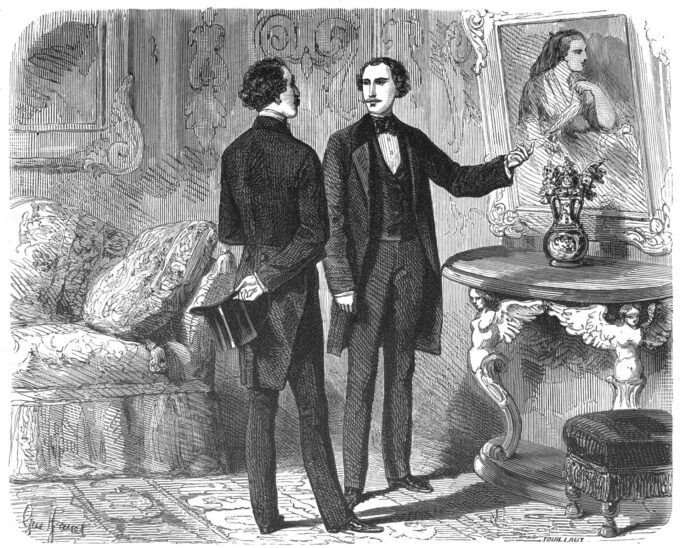
The Count of Monte Cristo visits Albert de Morcerf, Illustration, 12 June 1888. Source: Internet Archive.
The British Marxist historian E. J. Hobsbawm called it The Age of Revolution. It began in 1789, ran until 1848, and witnessed revolutions in industry, politics and culture, especially in the novel and with the Herculean efforts of Balzac, Hugo and Dumas who is the most famous ever Black French author. But can an epic French novel published nearly two hundred years ago still be revolutionary, and can it offer kicks to viewers who binge on Netflix and other streaming services?
If the novel is Dumas’s The Count of Monte Cristo (1846), published near the end of the age of revolution then the answer is “Yes.” The Count is still subversive, though readers will have to slow down, savor the dialogue, pour over the profiles of the villains, and digest the author’s frequent digressions and meaty reflections on freedom and justice, death and the truth.
Divided into over 100 riveting chapters with compelling titles such as “The Raving Prisoner and the Mad One,” “The Vendetta,” “Ideology” and “The Telegraph,” Alexandre Dumas’s The Count of Monte Cristo runs to more than 1,000-pages with dozens of characters in a variety of locations (Marseille, Rome and Paris, and from piazzas to prisons and palaces). Technology plays a crucial role and so does chemistry. One of the characters is a lesbian and another a filicide, a child murderer. At 1,000+ pages, Dumas has ample space to explore his passions.
Beginning in 1908 when it ran as a silent movie, the novel has been made into feature films and TV-dramas dozens of times and in more than a dozen languages including English, Turkish, French, Spanish, Japanese and Korean. The most recent version, from PBS, starring Sam Claflin and Jeremy Irons, arrives as an eight-part series. Billed as a “tale of revenge” it features Edmond Dantès, a sailor framed for the crime of treason (conspiring with Napoleon) who becomes an “avenging angel,” in part a Brechtian “Mack the Knife” and in part a Mario Puzo, “Godfather” who pulls the strings and controls the fate of foes. Millions of viewers and readers on four continents for almost two centuries surely can’t be wrong. They have voted repeatedly in favor of Dumas’s The Count of Monte, which appeared in print between the revolutions of 1830 and 1848 and that reflects the revolutionary spirit of the times iot reflects. It still beckons as a classic tale about class and class consciousness, love and hate, subterranean intrigues and the spectacle of death and defiance. Race and ethnicity also play crucial roles with characters from the four corners of the earth. The 2026 PBS melodrama hues to the bold outlines of the novel, but by framing the theme as “revenge” rather than retribution, it flattens the complex psychology of the protagonist, a mythical hero with a thousand faces who evolves as the narrative itself evolves. Indeed, the twists and turns in the plot suggest that Dumas discovered what he wanted to say in the process of saying it, which gives the novel a sense of contemporaneity.
The PBS producers have left largely untouched Dumas’s biting satire, his roasting of the European aristocracy, and his unalloyed, explicit identification with pirates, smugglers, outlaws, thieves, outsiders and underdogs, who make the novel, which was first published in 1844, relevant for our own monstrous time of capitalist crooks, corrupt judges and the greedy nabobs among the nouveau riche. Fascinated by crime and criminals—Dumas shared Balzac’s notion that behind every great fortune lies a great crime— he compiled an eight-volume encyclopedia about history’s arch villains including the Borges. (Dumas also believed that behind every great political career lies a great crime. That notion is embodied in The Count).
Intrigued by what might be called “identity theft” and the art of impersonation, Dumas created in Edmond Dantès an indelible hero who escapes from prison, infiltrates the inner echelons of society, and brings about the downfall of his enemies, especially Gérard de Villefort and Baron Danglars who have conspire against him. Getting even is its own best reward.
I binge watched the PBS version with its lavish costumes and spectacular settings and then (re) turned to the novel in a hardback edition from Penguin. I first perused the novel as a pre-teen soon after I raced through Dumas’s The Three Musketeers— who are famously“all for one and one for all—published before Monte Cristo hooked readers eager for adventure, intrigue and news of the high and mighty, including emperors, popes, kings and countesses.
The loveable, rapscallion count is surely Dumas’s most beloved protagonist, though the musketeers, Athos, Aramis, Porthos, and their pal, D’Artagan, provide stiff competition as does “the man in the iron mask.” A writing machine – he published dozens and dozens of novels, romances, historical narratives, travel books and plays— Dumas (1802-1870) relied on ghost writers and co-authors including August Maquet to help him flesh out the characters he sketched and the plots he concocted. The French literary critic Sainte-Beuve dismissed his work as “industrial literature.”
Perhaps so, but it was literature and not “dime fiction” and it satisfied the needs and wants of an industrial society. No 19th century French author was better suited than Dumas to mass produce fiction for readers hungry for characters who were obviously good and characters who were obviously evil and with suspense in the saddle from beginning to end. Historical figures and historical events punctuate his novels, though he plays fast and loose with facts and the past. “What’s history?” he asked rhetorically. “A nail on which I hang my novels.”
The grandson of Marie-Cessette, an enslaved African woman, and the son of Thomas-Alexandre Dumas, a Haitian-born Frenchman who became a general who fought on the side of Napoleon, Dumas rivals Balzac and Victor Hugo in the Pantheon of French novelists of the mid-19th century, when the novel was the king of all media. To Balzac and Hugo add Flaubert who sought “le mot juste” – the right word – and who aimed unlike Dumas to “Be regular and orderly in your life, so you may be violent and original in your work.” That was not Dumas’s mantra. He would rather have a cascade of words than one right word.
Marx, an advocate for realism and an astute literary critic was partial to Balzac, despite Balzac’s self-proclaimed allegiance to monarchy, while he shunned Dumas, who took part in the revolution of 1830 that overthrew King Charles X. (Marx was an astute reader who understood that the “message” or veracity that a novel delivered might differ from the author’s explicit beliefs.)
A freemason, and with Victor Hugo, Charles Baudelaire, Eugene Delacroix and Honore de Balzac, a member of The Hashish Club, Dumas lodged in the heart of bohemian Paris and on the fringe of bourgeois society. The Count uses hashish as did the author himself. Given his own peripatetic life, it’s no wonder that Dumas chose to move his protagonist from the fringes of law and order on the waters of the Mediterranean, to the elite salons and the posh apartments in the city of Paris, a center in the 1840s of the emerging capitalist world and a character in its own right in The Count.
In 1852, to escape from his creditors and from Louis Napoleon’s autocratic regime, he fled to Belgium, lived there in exile for a year, traveled to the island of Guernsey where he rubbed shoulders with his contemporary, Hugo, then moved to Italy where he supported Garibaldi and ran guns to the rebels. Legend has it that decade after decade he had almost as many lovers and mistresses as Mozart’s Don Giovanni. Near the end of his life Dumas wrote a prodigious cookbook, Grand Dictionaire de Cuisine, into which he poured his passion for fine food and wine. On his deathbed in 1870, in the aftermath of the Paris Commune and the Prussian defeat of the French, he asked his son, who was also a famed novelist, “Do you think anything of mine will survive?”
Surely, Parisians who first read The Count when it appeared in installments from 1844 to 1846 knew they were in good hands, beginning with the very first sentence: “On February 24, 1815, the look-out at Notre-Dame de la Garde signaled the arrival of the three-master Pharaon, coming from Smyrna, Trieste and Naples.” In the opening chapters, which foreground the Mediterranean, the plot engages the reader’s imagination while the comments by the characters— which spring from Dumas’s own ideas born of the revolutionary times in which he lived—appeal to the intellect.
“Providence,” one character observes, “brings down the one whom she has raised up and raises the one she had brought down.” Another character says, “in politics you don’t kill a man, you remove an obstacle.” Yet another observes that on a scaffold at a public hanging, “death tears away the mask that one has worn all one’s life and the true face appears.” (For Marx, it was in the colonial world where the mask was stripped and the true nature of capitalism was revealed.)
In chapter 36, “The Carnival in Rome.” Dumas writes that “there is no more interesting spectacle than the spectacle of death.” For him, all of capitalist society was one big grotesque spectacle. With the citizens of Rome the spectators, one condemned man is guillotined while another is pardoned. The ending – spoiler ahead – is upbeat. The count tells his friends (and Dumas tells his readers): “all human wisdom” is embodied in “two words – wait and hope.” Skip the PBS show. But do read the novel and follow Dumas’s advice.