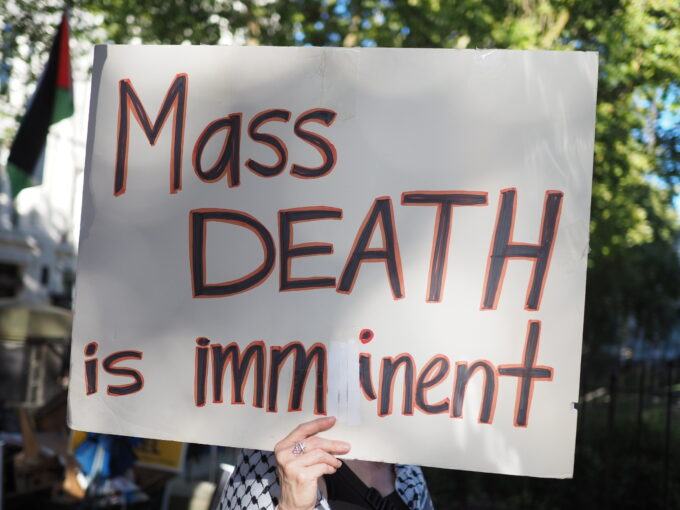
Photograph by Nathaniel St. Clair
A week ago, a parade of op-ed writers, pundits, editorial boards, and politicians who have publicly supported, justified, excused, or both-sidesed the siege of Gaza for more than a year and a half began a series of predictable contortions in hopes of escaping what I am going to call their “active complicity” in a genocide: neither direct commission of genocide, nor mere silence or ignorance in the face of it, but support for it, justification of it, or silencing of objections to it.
You can see the new show by the actively complicit in any major ring in the media big top. Watch them take the following positions, at the very limits of the mind’s flexibility:
+ The starvation of (so far) about 100 children may be “unjust,” but the bombing, shooting, and starvation of some 20,000 children in the first 99% of the same assault on a captive population was not. That was just “war”; these are war crimes.
+The pictures of starving children are horrifying, while the pictures of children dismembered, or carrying the bodies of their siblings in their arms, or burning alive, lacked a similar impact, if we even saw them—maybe we just imagined them? Certainly they’re not worth recalling now, since that was just “war,” while this could well be genocide.
+This could well be a genocide now, but it can’t have been one when it started, because even though the Israeli government was saying and doing the same things then, that was closer to October 7th, 2023 than now is. Israel was not so much ramping up an extermination campaign back then as it was angry. It is less angry now, and therefore less likely to be acting justly.
+ The 20-odd countries, majority of experts, and majority of trusted international human rights organizations that identified the war on Gaza as a genocide a year or more ago were not really saying that until now, when two Israeli human rights organizations have finally agreed with them. Actually, I don’t really even recall any previous allegations of genocide—was there maybe something about South Africa? Anyway, the important question now is, “When we are where we are, what happens?”
+ For a long time, it was antisemitic to even consider calling this a genocide, because the legal definition of genocide seemed trivial compared to the immense weight of history. Now Gaza could well be a genocide—I don’t remember any reason that we shouldn’t say so.
+ If our coverage simply stops acknowledging the millions of people who objected to this from the start, including the campus protestors who were suspended, expelled, kidnapped, arrested, deported, and beaten for doing so, then none of that happened. Now let’s turn to Gaza’s “humanitarian crisis,” which the New York Times Editorial Board is, laudably, among the first to consider.
+ I have always alternated between cheering on and gently rationalizing this genocide, but now you must welcome me into the “big tent” of people who have always denounced it. Without half-lapsed genocide supporters and deniers like me in the movement, how will you ever bring the genocide to an end?
+ Do you remember all those times when you said, “Hey, we need to stop this genocide,” and I said, “That’s not fair! Why this genocide (which isn’t one) when there are so many others you could want to stop? I can’t think of anything that makes this U.S.-supplied and funded non-genocide, which would stop immediately without unconditional American political backing, different from the others except that you hate Jewish people.” Remember that? Well, I don’t. It is crucial that we focus on Israel’s purposeful starvation strategy now, even though it’s really no different from any other genocide, except that it isn’t one.
Faced this week with these cynical, baffling contortions on the front pages of the nation’s largest newspapers, I initially misunderstood what was happening. I thought immediately of the indispensable title of Omar Al Akkad’s indispensable book this year on Gaza, Someday Everyone Will Have Always Been Against This. But that isn’t what publicly platformed supporters, denialists, and justifiers this week are trying—at least not yet. It’s clearly too soon—and the mediaverse too vast and unscrubbable (though I hear the sounds of scrubbing in a million X accounts) —to pretend that they have always been against it.
Instead, they are focused on the fantasy that all their contributions to prolonging the mass killing, and their efforts to silence all objections to it—indeed, the fact that anyone was ever even aware that something other than “war” was happening in Gaza—might simply be forgotten if the latest turn in the genocide can be ret-conned as its actual beginning.
Embedded in the coverage this week, which points again and again to the power of the “images” of starving children as a red flag, is the hope that the horror of those images will be powerful enough to scour away all of the live-streamed information, and all of the previous images, and therefore all of the active complicity of the past 21 months. “How does the world make sense of the images [of starvation] coming from Gaza? Where will they fit into history?” asked the Washington Post on July 30th. (The answer: alongside images of other famines, in “the culture’s visual archive of extraordinary suffering.”) “Rare Aerial Imagery shows Displacement and Destruction in Gaza,” the front page exclaimed a few days later, again with a spotless mind apparently unstained by the many thousands of earlier satellite and ground images of Gaza’s utter decimation.
In asking us to join them in their shock at these new images, newly hesitant apologists for the genocide are asking us to join them in being shocked for the first time at this long, very public eradication of a people.
I missed all this at first because I assumed, naively, that the first move once the news ratcheted one click too far away from the propaganda line would be for the actively complicit (1) to take a cue from Al Akkad’s title as quickly as possible, and then (2) when that proved unworkable, to construct an off-ramp down which they might be forgiven for making “a grave and costly error.” We’ve seen a lot of that from cheerleaders of the Iraq war.
But I think they already know that in this day, (1) isn’t going to be possible. And I don’t think that they even see yet that (2) may not be possible either; that having been actively complicit in a genocide is not like having been cancelled for bad tweets, or having voted for Trump, or having supported the Iraq war; that this is going to be a permanent stain on their lives and then their legacies, rendering the question of whatever evasions they hastily converged on in the summer of 2025 painfully trivial.
They don’t yet understand yet that active complicity in a genocide, like genocidal acts themselves, can almost never be forgiven.
Millions of Americans have tried their best to tune out the devastation of Gaza over the past year and a half, even though as U.S. taxpayers they were—like me—complicit in it. History suggests that the involuntarily or passively complicit like us can, with a long and difficult process of reconciliation and remediation, make at least some amends.
Hundreds of thousands of other Americans, though, spoke out publicly either in support of the genocide’s continuation, or to condemn those who were calling for its immediate end, or to frame the extermination as something more ethically complex than it was. Some of those people had no real power, and spoke to audiences of a few hundred on Facebook. Some of them had institutional power, and spoke to audiences of thousands that included university disciplinary boards, or the NYPD, or angry mobs ready to come to campus and assault protestors. Some of them had the ears or eyes of millions. Some of them represented millions of us, and directed our tax dollars to the supply of this unfathomable atrocity. All of them, writ large or viewed small, were actively complicit.
History has shown that for them, as for those who actually carried the genocide out, it’s beside the point to ask whether their fellow citizens should forgive them, because we can’t, even if we wanted to.
The only people who can meaningfully extend forgiveness for publicly supporting an ongoing genocide are the families of those killed in it—if any family members are left alive. If you are a pundit like David French, or a politician like Chuck Schumer, or a member of Canary Mission, or a university President who shut down anti-genocide speech, or a newspaper editor who made sure to soft-pedal every mention of the death toll, or just someone who liked to refer to protestors as “Hamas supporters,” you’ll have to hope that there is some surviving mother of a maimed Gazan child left to die in the rubble, some surviving brother of a Gazan doctor raped to death in an Israeli prison, who can find it in their heart to set you free.
No one else can.