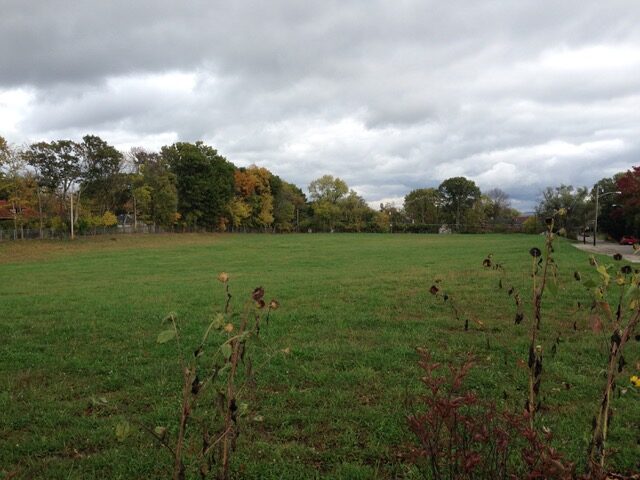
Photo: M.G. Piety.
None of the schools I attended as a child still stands. They’ve all been torn down. Even my high school has been torn down. I learned this a few years ago when my husband and I visited the city in which I’d grown up. I wanted to drive by my old high school to show it to my husband and, of course, I wanted to see it again myself. I’d been very happy in high school. Mine was an urban high school and predominantly Black. It had earlier, that is in the years immediately preceding my matriculation in 1974, had a reputation for racial violence against the small population of white students, and just violence more generally.
My older sister had elected to attend the local Catholic high school after the then principle of my high school had explained to the parents of incoming students that he could not guarantee students’ safety. My school’s reputation for violence was so wide spread that we were unable to rent audio-visual equipment, or indeed any other sort of equipment that we occasionally needed but didn’t have. We had no sports fields, no football or baseball fields, or any other amenities like that (we used the fields of other local schools), let alone anything so luxurious as a swimming pool. We had only a parking lot. Our athletic equipment was sadly out of date, and we didn’t even have uniforms for the gymnastics team the year I joined it.
What we did have, though, was amazing solidarity as a community. By the time I started there, the period of violence was past. There were a few incidents my freshman year, but I remember nothing after that. What I do remember is the extraordinary warmth of the place. Most of the students had grown up together. Nearly all of us had attended the same grammar school. That was why I chose to go there rather than take the “safer” option of the Catholic school. I knew many of my high school classmates would be people I had grown up with. Almost no one, of any race, would transfer to my high school because of its reputation.
The school was well integrated, but not as the result of any edict. The degree of its integration was completely voluntary. It reflected the racial makeup of the surrounding area. The white kids were from the area. We knew one another, just as we knew our Black classmates and they knew us. We were comfortable with one another. And I think we were all pleasantly surprised and relieved that our days were not marked by the violence that the reputation of the school had led us to expect.
The faculty too were happy that the dark days were past, and their relief and gratitude spilled over into their interactions with students and with one another. We were not particularly good at anything. Our sports teams, with the exception first, of our girls’ basketball team, and then finally, our boys basketball team when the girls’ coach made the revolutionary move of becoming the boys’ coach, were terrible. And the degree to which we were underfunded, and incorporated many students from economically disadvantaged households, meant that the standards of our academic achievement negatively misrepresented the inherent abilities of most of the students. I’m not just saying that. I know it to be true, because those students, as undistinguished as their academic achievements may have been, were incredibly smart and talented and my friendships with them helped to shape the way I think even today.
I have such warm memories of my high school. Of my classes and my friends, of the parties and sporting events I attended (because I did go to football and basketball games, especially girls’ basketball games), of the drama productions in which I participated, of the unconquerable optimism and enthusiasm of our pep rallies that flew repeatedly in the face of our abysmal win-loss records.
It was high school, more than any other place, or period of my life, that drove home to me how profoundly social human beings are, how their natural state, when freed from the pressure of fear, is to help and support one another, independently of race or gender or class. My years in high school were the most life-affirming of my life. I had shared all this often with my husband and I was eager to show him where it had all happened, and perhaps even to walk again through those benevolent halls that had helped, along with the others whom they had sheltered, make me the person I am today.
So I gave him directions, starting from my old house, based on my memory of first walking down the tree-lined streets, and then later driving, to school. We had to cross a main thoroughfare and then take the road behind the local branch library and then in just a block or two, we would arrive at my old school.
Except that we didn’t arrive at it. We drove and drove until finally I knew that we must have passed it. I couldn’t imagine how I had missed it, but clearly I had, so I asked my husband to turn around. We retraced our path, and it was then I discovered that my school was gone. There, where it had once stood, was nothing but an enormous vacant lot covered with grass.
I was devastated. It wasn’t an architectural masterpiece, that school, but it meant a great deal to me, and to a great many other people as well.
When a building that has been so significant in a person’s past is torn down, it’s almost as if that part of the past itself had been amputated from the person. It is, as a memory, only in the mind now. You feel it still, sense it, but it’s like a phantom pain. The most compelling evidence of its once tangible existence is gone. Such an experience is profoundly disorienting. Suddenly you feel a little less real yourself, as if you were perhaps a character in a novel, rather than a real flesh and blood person.
“Architecture,” writes John Ruskin in The Lamp of Memory, “is to be regarded by us with the most serious thought. We may live without her, … but we cannot remember without her…. I cannot but think it an evil sign of a people,” he continues, “when their houses are built to last for one generation only.”
“Houses” is used by Ruskin in a metaphorical sense, because the main concern of the essay is actually public buildings, buildings such as that of my old high school. We are naturally grieved, he writes, to think that having spent our lives “happily and honorably” the buildings that had been our earthly abodes, and I am paraphrasing here now, which had seen, and seemed almost to sympathize in all our honor, gladness, and suffering, and all the material things we had loved and “ruled over,” and set the stamp of ourselves upon, would simply be swept away as soon as we we’re dead, that no respect would be shown for them, no affection felt for them, no good drawn from them by our children, that all that we had treasured of these places that had sheltered and comforted us would be despised as soon as were we’re gone, or more correctly we can say now, even before we’re actually gone.
When people do not love the buildings that had sheltered them, writes Ruskin, it’s a sign they have dishonored them. And that refers back, of course, to his point that it is people who have lived “happily and honorably” who care so much for the preservation of the places that have sheltered and shaped them. Is that why we have such a mania for tearing down magnificent old buildings and replacing them with slipshod constructions that we wouldn’t want to last for posterity even if they could; is it because we are not living happily and honorably, but unhappily and dishonorably? Is it because we hold ourselves in contempt, that we don’t think we deserve anything better than these flimsy constructions?
Or is the slapdash manner in which we throw up new buildings because we’re in such urgent pursuit of a reality better than the one we inhabit that we don’t have the time to create something really lasting, but must mask our wretchedness as quickly as possible with something so gaudy it’s distracting, or so conspicuously “modern” it seems to hold out the hope that after all, things are getting better, that after all, we are improving ourselves?
But how can we improve ourselves if we don’t understand ourselves? The more we destroy the architecture of our past, the less we understand that past. And the less we understand our past, the less we understand our present, to say nothing of the future — if we have one.
Contempt for the architecture of the past, as Ruskin so eloquently explains, is contempt for ourselves. That’s why the humanities are in crisis. Who wants to study the history, art, or literature of a people they despise? We’ve been pummeled for years with the message that people are motivated by nothing but self interest. If that were actually true, then we would indeed be contemptible creatures. It isn’t true, though. In fact, it’s demonstrably false. It becomes increasingly credible, thought, the more of our history we clear away.
If you want a really soul-searching experience, watch some of the abandoned building videos on YouTube. There are countless channels devoted to exploring old buildings that have simply been left to rot, buildings far better constructed than anything we build today, crumbling, rotting, tangible evidence of the contempt for human values that tends to characterize the global capitalism that is choking the life out of the civilization humanity has so painstakingly built for itself over the millennia.
It’s tangible evidence of something else as well. I tell my students over and over again that stupidity is a greater threat to humanity than is moral turpitude. No one, no one is made happy by the values, or more correctly, the absence of any values other than unchecked growth in material wealth and power, of global capitalism — not even the global capitalists. Unchecked growth is the pursuit of happiness, not the attainment of it. No matter how much one has, it is by definition, not enough. One must have more! Always more!
That’s not happiness. It is Tartarus. And if you don’t know what that means, I fear I have proven my point.