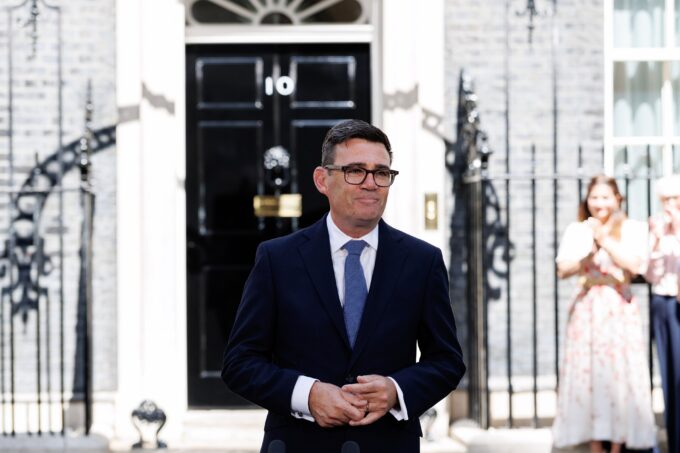
Photograph Source: Number 10 – OGL 3
It was one of those hot and sticky British summers that might have been penned by a Liverpudlian Tennessee Williams. Or by Lancashire-born dramatist Jim Cartwright. Sticky heat, sticky inflation and, according to the financial press, increasingly unstuck millionaires. And now Andy Burnham—Scouser, Evertonian, Catholic—was Prime Minister.
The guy had just snatched office from the jaws of Starmer’s defeat, and hardly anyone minded his sweet, soft route of simply becoming Labour Party leader: rather than going through the vulgar motions of actually having to win a general election.
It was constitutional, of course. Burnham didn’t have to call one. The government kept Labour’s 2024 mandate and Burnham knew full well he could just sit on it like Canute—although Canute, we may remember, at least had the good sense to conduct an experiment.
I’ll tell you what got me wondering about his potential next step. A film crew. Here in South East London. Standby lighting. Props vehicles. The whole lot. Serious-looking people carrying serious-looking kit while saying serious-sounding things into oddly old-fashioned walkie-talkies.
After a couple of coincidences which may have been entirely innocent but didn’t feel innocent, I began to wonder if they were in fact filming a secret election campaign.
You see, the temptation must be there. To acquire a democratic mandate with BURNHAM written all over it. Politicians are human beings, even the good ones, and prone to vanity. Especially where enormous lighting rigs are involved.
Then there are the polls.
Labour have profited from Burnham, with some recent polling putting them level with Reform and an August Ipsos poll giving them a three-point lead. Burnham’s personal ratings are considerably stronger. Reform UK seem to think he will go for next May. And if you’re a new, Johnny Marr-inspired, guitar-playing prime minister enjoying the first flush of public affection, you might wonder how long it lasts.
There’s another reason too.
The economy.
(Don’t jinx it.)
Britain is presently engaged in one of its periodic national shambles over whether the country’s wealth-creators are leaving in droves or merely threatening to do so over dinner at Scott’s or Cecconi’s.
London hasn’t stopped being a centre of wealth creation. It has stopped being the automatic place where all of its wealth-creators live. The important distinction is now between residence and network. A founder may be resident in Dubai, a financier in Milan or Switzerland, and a family-office principal in Greece, while their lawyers, bankers, investors, boards and friends still pull them through London regularly. One side produces alarming estimates of the numbers leaving. The other points out that millionaires are not migratory wildebeest and are rather difficult to count at airports.
Still, there are parts of the financial and business world today in which the name Andy Burnham is like a wasp in the trouser leg. To others this disgust is like a bite of honour. Whether either reaction is fair, rational or remotely proportionate hardly matters. Capital doesn’t have to win an argument before it moves. It just moves.
International financiers clearly have doubts about UK fiscal management and little appetite for unfunded largesse. Ten-year gilt yields have just touched a 19-year high, although the latest surge owes much to the global bond sell-off and soaring oil prices rather than Downing Street alone.
Now, if Burnham’s more benevolent economic model works—though naysayers doubt it—then why the hurry? Govern. Grow. Build things. Let investment rise, wages improve and the public finances stop resembling something discovered behind the sofa. Then go to the country and say: There. That’s what we meant.
But suppose the next eighteen months promise something else. Something desperate. Weak growth. Desert-like horizons. Even more pressure on key public spending. Really taxing tax choices. Another Budget in which everyone spends three weeks pretending not to know what’s in store and then acts astonished once announced.
In that case, logic points the other way.
Go now.
There’s another difficulty which is easily overlooked. Incoming prime ministers traditionally enjoy the pleasure of blaming their predecessors. Unfortunately for him, his belonged to the same tribe. And there are only so many times a Labour Prime Minister can complain about his Labour inheritance before somebody at the back puts up a hand and asks who, precisely, has been looting the Treasury.
So an early election could be presented not just as an attempt at a personal mandate, but as permission for an economic reset.
And he has already given evidence that a Burnham government will be different.
His government’s decision to ban trade in goods produced in Israeli settlements in the occupied West Bank is not economically eye-popping, but politically it’s unmistakable. It draws a line under Starmer’s more timid approach to Israel and Gaza and has already created inevitable fractures with Israel and has created friction with Washington.
He could have spent his first months just enjoying the breeze of being new: smiling vacuously, visiting hospitals, being photographed near trains, wearing a cool black T-shirt, saying the word “change” in reassuring northern tones. Instead, he chose with conviction an issue on which disagreement with his predecessor was obvious and conflict with Washington foreseeable.
And Washington has its own ways of being unhelpful back. On his visit to Dublin, Trump announced that he would “love” to see a united Ireland, only a fortnight after Burnham had declared a border poll “off the table”—a remark subsequently qualified by stressing his commitment to the Good Friday Agreement. Trump managed, with that dark gift of his, to reopen a constitutional wound Burnham had just tried to close.
This matters beyond the usual diplomatic theatre. A Prime Minister contemplating when to seek his own mandate cannot assume the political landscape will remain obligingly frozen while he waits. Trump can change the weather with a sentence. (He is tempestuous.) So can events in Ireland, Gaza, Ukraine or the markets. Burnham may want eighteen months in which to demonstrate that his programme works. History is under no obligation to give him that.
Meanwhile, the Conservatives and Reform UK are fighting over much the same collection of voters. Under first-past-the-post, a divided right can produce a generous dollop of Labour MPs. Why wait for your opponents to discover how not to cannibalise one another?
Britain’s radical right is powerful, angry and—for the moment—divided. Reform UK is under police investigation over allegations concerning potentially illegal political donations, which the party denies. Yet political vulnerability does not mean financial weakness.
Quite the reverse.
The British cryptocurrency billionaire Ben Delo, the BitMEX co-founder who pleaded guilty in the United States to violating anti-money-laundering requirements and was subsequently pardoned by Donald Trump, has just announced a record £36 million donation to the party.
And now Christopher Harborne, already one of Reform’s biggest financial backers, has matched him with another £36 million.
Seventy-two million quid. Two donors. One party.
Even as opponents question whether the donations will survive Labour’s incoming crackdown on overseas-linked political money.
More importantly, it changes the calculation. Reform may be politically vulnerable, but it’s no longer financially desperate. It has enough of a stroppy tiger in the tank now to advertise, organise, recruit candidates, buy more turquoise suits and keep campaigning on a scale that makes waiting considerably less attractive for Burnham. Every additional month before an election is another in which £72 million can be converted into staff, advertising, organisation and political capital. Heaven forbid, they can build their own private civil service from hell.
And then there’s Restore Britain, attacking from further to the right like some Ealing comedy troupe gone wrong. Terry-Thomas on foreign policy. When a few hundred of them gathered in a hotel during the Makerfield by-election recently, one supporter was reported as wandering the lobby in a long black cloak like some Harry Potter wizard. Farage and Rupert Lowe are competing for many of the same wizards-cum-voters. Under first-past-the-post, that division for now can be an extraordinary gift to Labour.
But Burnham may possess something still more valuable.
He appears, at least for now, genuinely capable of offering to people who have given up on the British state an alternative to simply smashing it. Reform and Restore belong to a radical-right politics that sees much of the postwar order as something to tear down and strip apart. Restore is unusually candid about this. It doesn’t want to protect the status quo. It wants to replace it.
And the danger for Burnham isn’t that Labour might be five points less popular in eighteen months. It’s that Britain might be somewhere else entirely.
Another year of pasty-faced growth, brutish tax rises and wheezing public services could turn today’s protest vote into tomorrow’s coalition. Reform and Restore might reconcile. The Conservatives might collapse far enough for the right to gather around a single challenger.
Burnham needs time for his economic programme to succeed. Those ranged against him need only for Britain to feel unsuccessful.
That ought to concentrate the mind.
Versions of this are already under way across Europe. National Rally loiters with menace in France while Germany’s increasingly powerful AfD combines its insurgent politics with pronounced pro-Russian sympathies. There is no reason to suppose Britain has been issued some meteorological exemption from the same weather. Nathan Gill—a former UKIP MEP who later led Reform in Wales—is serving ten and a half years in prison for accepting Russian bribes.
And this is where Burnham becomes genuinely interesting. Because Burnham, like it or not, is betting—or at least appears to be betting—that people who believe the existing order has forgotten them can still be won through solidarity, not exclusion. Regional patriotism, if you like, rather than nationalism. Working public institutions, rather than sneering ones. Economic intervention, rather than an endless culture war.
If Burnham somehow were to win a convincing mandate on those terms, the significance would go beyond Westminster. Britain would have shown something many European centre-left parties have almost given up on: that the populist right doesn’t have to be defeated by borrowing from it.
But such opportunities don’t last long.
Burnham obviously has to decide which prospect frightens him more. Calling an election he doesn’t actually require, only to find out that the opinion polls had exaggerated his appeal? Or sitting with his guitar in Downing Street eighteen months down the road, harking back to that peculiar moment when Labour was ahead, when the Burnham brand was popular, when the radical right was divided and when his chief opponent hadn’t yet worked out how to spend all that new money—and wondering why on earth he waited?
There is a sound argument for staying put. Snap elections are famous acts of self-harm. Voters resent being summoned unnecessarily. A campaign subjects a new prime minister to scrutiny from which the honeymoon has so far protected him. Polling affection can go up in smoke once somebody asks about tax.
Burnham seems a decent guy. His love of Philip Larkin will always be a plus for me—he really did write to the Guardian as a young man declaring Larkin’s “Love Songs in Age” the century’s greatest poem, and his enthusiasm for Middlemarch is well documented. Not to mention a love for Big Thief.
But does any of this tell us if he’s the sort of guy who, presented with the best electoral window yet, simply goes for it? Who knows. Maybe staying put is best. Maybe the polls will improve. Maybe the economy will revive. Maybe Reform and Restore will continue tearing each other apart while the Tories wander around looking for exit signs. Maybe Burnham possesses all the time in the world.
Maybe, maybe.
And maybe that enormous film crew down the road apiece had nothing to do with politics at all. Maybe they were all just there screen-testing the new James Bond to death—hence the secrecy.
In which case, I’ve just wasted your afternoon.
Sorry.
Nice day, though.