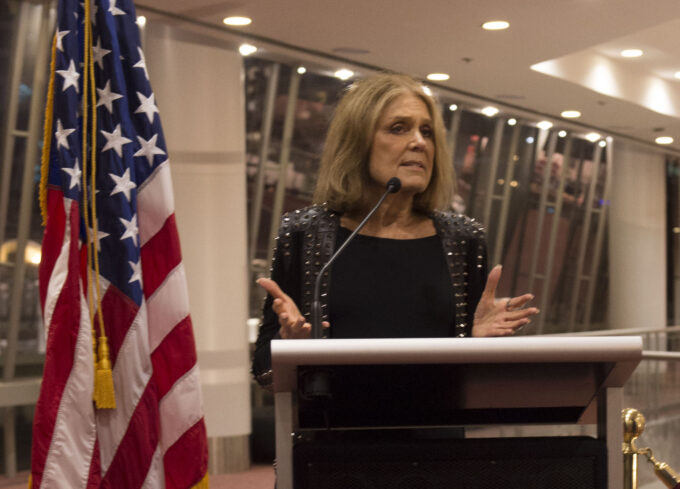
Photograph Source: US Embassy from New Zealand – CC BY 2.0
I was born and raised in Toledo, Ohio, and spent most of my life there before I chose to leave. Gloria Steinem left too, as soon as she could. She died in New York on September 2 at ninety-two, and the Western establishment press reached for the usual words: icon, trailblazer, feminist hero. I grew up under that legend in the city that produced her. In Toledo it was never only a Ms. magazine cover. It became a local politics of firsts and ceilings that left the Democratic machine unscathed — neoliberal, pro-war, pro-military, pro-nuke, pro-Israel — and helped make Marcy Kaptur, the longest-serving woman in the history of the U.S. House, the acceptable face of power rather than a challenge to it. It was rough. To criticize Steinem now — or to criticize The Nation and the mainstream eulogies — is to be dismissed as a misogynist if you are a man, or as a man posing as a woman if you are not. That is how the argument is shut down. An accounting is not a cancellation. The papers have already made her a saint. Israel exists; Francesca Albanese does not have to bless that fact in order to describe what the state does. Steinem’s record exists too.
She was born Gloria Marie Steinem in Toledo on March 25, 1934, granddaughter of Pauline Steinem, a suffragist and the first woman elected to the school board, daughter of Ruth, who wrote for The Toledo Blade until marriage and severe mental illness took the byline. After the divorce Gloria kept house on the East Side and took care of a mother the neighborhood called the “crazy lady,” in a house the city later condemned. Waite High School, a small library used as escape, dancing for grocery money: “No pretense. Let’s just do the real thing,” she told a local interviewer — “the Toledo in me.” Survival is not the same as solidarity. She learned the first there. The career that followed taught a country to mistake the second for a seat at the table — and for an Upper East Side brownstone she occupied for nearly sixty years, expanding floor by floor until the building itself became a salon. Her fortune at death has been estimated at close to twenty million dollars. The condemned house on the East Side and the parlor on East 73rd Street are not a contradiction in her story. They are the itinerary.
Jeffrey St. Clair, editor of CounterPunch and a longtime chronicler of American culture and politics, named what the obituaries sanded off. In the late 1950s and early 1960s Steinem directed the Independent Research Service, a CIA front that sent Americans to the World Youth Festivals in Vienna and Helsinki to contest socialist and anti-imperialist youth — the same international circuit in which national liberation movements were trying to throw off empire. Louis Menand wrote in The New Yorker that the Agency created the operation and “the person in charge was the future feminist Gloria Steinem.” She knew the money. When Ramparts exposed it in 1967 she praised the agents as liberal and honorable and later said she would do it again. She was also used in Western Europe to stage American-style democracy and market discipline against socialists who still thought the economy was a political question. That she died an honorary chair of the Democratic Socialists of America is not a paradox. It is a joke.
The social register told the same story. For years she moved in the same circles as Henry Kissinger, a close personal friend — not as a footnote of gossip, but as a fact of class. The architect of the bombing of Cambodia, the coup in Chile, and the green light for Jakarta’s slaughter in East Timor was acceptable company. A feminism that can sit with Kissinger has already decided which corpses count. Craig Mokhiber, former director of the New York Office of the UN High Commissioner for Human Rights, put the moral arithmetic in one line. The CIA overthrew governments, propped up dictators, murdered opponents, and produced systematic violence against women. “Other than that, Mrs. Lincoln, how was the theater?”
Jenny Brown, writing in Jacobin, called Steinem the godmother of neoliberal feminism: the establishment’s favorite radical, an “entrepreneur of social change” who helped drive women’s liberation into a corporate-friendly, anti-socialist channel and personified the movement for fifty years without sharing its emancipatory aims. On her Substack, journalist and scholar Stacey Patton has insisted on a more complicated Steinem than the obituaries allow — not a cartoon, but a record in which race keeps falling out of the official story of sisterhood. Sarah Raymundo, in an anti-requiem written as those obituaries rolled out, named the function directly: “Steinem did not liberate women; she weaponized women’s liberation to serve the interests of U.S. hegemony.” A feminism aligned with empire, she wrote, “is no feminism at all — it is merely the soft edge of oppression.” Renee Levant has argued the same from the other side of empire. Steinem did not invent women’s anger at unpaid labor or legal second-class status. She helped route that anger into magazines, caucuses, and the Democratic Party. Redstockings treated Ms. as a parallel organization — a co-opted channel built beside the revolt, not out of it — and they paid for saying so. When they put Steinem’s CIA years into Feminist Revolution, that chapter was cut under legal threat and institutional pressure. That is containment in practice: let women into the professions, the party, the magazine. Do not let them touch the power structure itself, the occupation, or the war room.
The official story after that was built to be familiar: the Playboy Club piece, New York Magazine, the 1969 abortion speak-out, Ms. in 1972, the National Women’s Political Caucus, the ERA, Obama’s Medal of Freedom. A feminism of boardrooms and halls of power that stopped the sentence before the women under the sanctions or the drones. In November 1975, two days after the UN General Assembly adopted Resolution 3379 — placing Zionism inside the anticolonial politics of International Women’s Year and the Non-Aligned Movement and labeling it racism — Steinem joined prominent American women condemning the resolution and defending Zionism as Jewish self-determination. The colonized dropped out of the analysis. After October 7, 2023, she lent her name to a campaign that recoded Palestinians through never-proven allegations of systematic rape as a weapon of war. A UN commission later found no credible evidence that fighters had been ordered to commit sexual violence. What the longer record does hold — from the Nakba through occupation prisons to the UN inquiry of 2025 — is systematic sexual and reproductive violence against Palestinians. There was no comparable Steinem emergency for that. Universalism that stops at Zionism is the old exception spoken as sisterhood.
Palestinian feminist scholar Nada Elia, writing in The New Arab after Steinem’s death, refused that exception. Faux feminism, she writes, “is a colonial, imperialist ideology that seeks a bigger piece of the pie, without questioning the toxic ingredients of that pie.” To assert that human rights are indivisible while defending Zionism, Elia argues, “is to deny the very humanity of the Palestinian people.” Steinem was not a default Zionist leftover from a less informed age. She was an ideological one. “It is not lost on Palestinians that the one ‘flaw’ we are consistently asked to overlook is the powerful ideology that calls for our eradication.”
The same pattern ran through domestic party politics. She sheep-dogged for Hillary Clinton and helped paint young women who backed Bernie Sanders as interested only in the attention of “Bernie Bros.” She stood arm in arm and campaigned with Madeleine Albright, who told 60 Minutes that the deaths of over half a million Iraqi children under sanctions were “worth the price.” Where is the feminism in the picture? Becoming a female architect of the same imperial foreign policy is not liberation. It is patriarchal complicity.
Anita Zsurzsán wrote what the stenographers would not: a CIA operative whose work was to erase socioeconomic debate from mainstream feminism; a pioneer of postwar neoliberalism’s false promise; not a name a person of conscience should have to call feminist while the war on terror and the genocide in Palestine used women’s bodies as both target and alibi. “Another one gone too late.”
Those refusals are not scarce. Brown, Patton, Raymundo, Levant, Elia, Zsurzsán, the Redstockings archive, feminists of the Global South and of marginalized communities who never needed Steinem’s permission to count as women — they have been saying for years that a feminism aligned with U.S. empire, Western hegemony, Israel, militarism, and war is the soft edge of the same order. If a man says it, the lapdogs of empire call it misogyny. It is not. It is an accounting. From Toledo I had to live under the local version of that order. We both left. What she did with the leaving was to make a feminism the empire could live with. What remains is to refuse that bargain, and to remember that women’s liberation was never supposed to mean becoming an icon of empire.