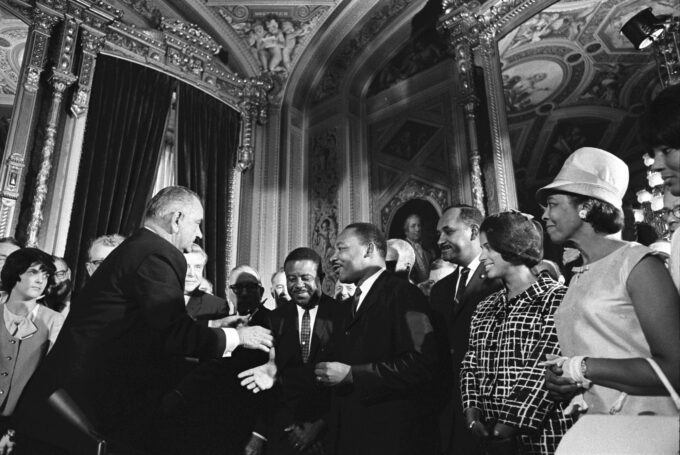
United States President Lyndon B. Johnson, Martin Luther King Jr., Clarence Mitchell Jr., Patricia Roberts Harris, and other guests at the signing of the Voting Rights Act on August 6, 1965 – Public Domain
The Supreme Court’s recent decision in Louisiana v. Callais, invalidating a congressional map that included a second majority-Black district in the state, severely weakened a key provision of the Voting Rights Act of 1965. The case introduces a legal Catch-22 that will make it much more difficult to protect the constitutional rights of minority voters, Black Americans in particular.
The story of this case begins after the 2020 census. Louisiana, where about a third of the people are Black, drew a congressional map with just one majority-Black district out of six. When a previous lawsuit resulted, a federal district court, later affirmed on appeal, held that another majority-Black congressional district should be created under the Supreme Court’s Thornburg v. Gingles test. Faced with the prospect of a court-imposed remedial map, the Louisiana legislature passed Senate Bill 8 (SB8), a map with a second majority-Black district. A group of voters then sued, arguing that this map was an unconstitutional racial gerrymander violating the 14th Amendment’s Equal Protection Clause.
In the way it has decided Callais, the Supreme Court has effectively made the Black community’s political loyalties a weapon against their own political representation. In many parts of the country, Black voters are the most cohesive and unified of all voting groups, supporting Democrats strongly and reliably. And because this cohesion is so strong, the Supreme Court has targeted it as a path to the evisceration of the Voting Rights Act. The Court said that because of the relationship between race and political party, particularly in the South, it would be difficult to prove that the people who created a given map intended to discriminate on the basis of race rather than simply seeking a political leg up. Drawing districts based on political party is quite legal. While drawing them based on race isn’t formally legal, the current standards permit states to drown out and divide Black communities and say it’s just politics. This is the nature of the legal trap that voting rights lawyers have to grapple with now.
The historical Section 2 inquiry asked whether there was a lack of opportunity for minority voters as a matter of fact. The question was whether a given districting scheme denied minority voters equal opportunity in practice, rather than requiring proof of discriminatory motive. Decided in 1986, Thornburg v. Gingles stood for the idea that if a white voter bloc consistently defeated the minority-preferred candidate, then the system was effectively diluted, quite regardless of whether the white voting bloc was subjectively driven by racial prejudice or partisan preference. Lack of opportunity in fact was the focus of the legal inquiry. The major conceptual shift from Callais is to introduce a stringent causal requirement around racially polarized voting, where it must be shown to be driven by race alone. If such polarization can be explained in terms of political party, the Court can virtually ignore the race factor. Then the burden is on the challengers to show that race was the predominant motivating factor.
Asking the challenger to extricate race from party membership in this way has effectively taken away racially polarized voting as an object of analysis in Voting Rights Act litigation.
Constitutional law treats racial distinctions as subject to a strict scrutiny test. Under the Supreme Court’s ruling, Louisiana must show that it had a strong basis in evidence for concluding that a race-based map was necessary for compliance with the Voting Rights Act. The Court states that “simply pointing to inter-party racial polarization proves nothing, because ‘a jurisdiction may engage in constitutional political gerrymandering, even if it so happens that the most loyal Democrats happen to be black Democrats and even if the State were conscious of that fact.’” The Court comes up with a definition of racially polarized voting that excludes party-aligned voting, to conclude that there was actually no racially polarized voting going on in Louisiana—and thus no violation of the Voting Rights Act. And no violation means no compelling interest in the use of a racial distinction.
Such a rigging of the legal standards means that the very behavior that once made a community a cognizable “opportunity group” under the Supreme Court’s old Thornburg v. Gingles test will now be the state’s best legal excuse for diluting their political power. Under that standard, a minority group had to show that they vote as a bloc to argue that they deserve an “opportunity district,” in which it is possible for them to elect their preferred candidate. The Court explained the test:
The Court’s definition of the elements of a vote dilution claim is simple and invariable: a court should calculate minority voting strength by assuming that the minority group is concentrated in a single-member district in which it constitutes a voting majority. Where the minority group is not large enough, geographically concentrated enough, or politically cohesive enough for this to be possible, the minority group’s claim fails. Where the minority group meets these requirements, the representatives that it could elect in the hypothetical district or districts in which it constitutes a majority will serve as the measure of its undiluted voting strength.
The current Supreme Court treats such findings of fact very differently, to the point where Justice Elena Kagan, in her dissent in Alexander v. South Carolina State Conference of the NAACP, argued that the majority had created a free pass for state legislatures to discriminate against Black voters. By requiring plaintiffs to produce a hypothetical “alternative map” that would satisfy the state’s partisan goals, the Court is asking challengers to do the impossible and prove a negative. If a discriminating Southern state argues, “We switched the districts of these Black voters because they’re Democrats,” and a court accepts that at face value, then the Voting Rights Act becomes well-nigh impossible to enforce in the South. As Justice Kagan pointed out, in the system created by the law today, there is an incentive for mapmakers to find the most racially polarized data available, using it not to protect those minority voters, but as a weapon for diluting their influence. Justice Kagan argued that this allows states to effect racial discrimination under the guise of purely political advantage.
The current ultra-conservative Supreme Court has been developing this line of thought toward the result in Callais. In a prior case, 2019’s Rucho v. Common Cause, the Supreme Court held that the federal courts have no inherent constitutional power to stop partisan gerrymandering, treating it as a political question that should stay with the political branches. The Court held that plaintiffs must show more than a plausible racial motivation for the map; they have to be able to show that the political party explanation is not the predominant one, but that race is. The Supreme Court allows that a legislature may act for both partisan and racial reasons simultaneously, and thus that even if the partisan explanation is real, plaintiffs can nevertheless prevail in a challenge if race was the predominant factor. Where race and party are so thoroughly intertwined, as in the South, a state legislature could now “crack” or “pack” a Black community and, when challenged, claim that the goal was to target the Democratic vote for dilution, not the Black vote. The practical effect of the Callais decision is to import an intent-like evidentiary standard into a statutory framework that explicitly rejected such standards. Justice Kagan’s dissenting opinion in Callais explains this well:
Its supposed “updating” of Gingles overthrows Congress’s decision to make Section 2 liability hinge on an electoral practice’s effects—on how it actually works. The new Callais requirements will effectively insulate any practice, including any districting scheme, said by a State to have any race-neutral justification. That justification can sound in traditional districting criteria, or else can sound in politics and partisanship. As to the latter, the State need do nothing more than announce a partisan gerrymander. Assuming the State has left behind no smoking-gun evidence of a race-based motive (an almost fanciful prospect), Section 2 will play no role. “Whatever”—whatever—results from the State’s asserted justification is all its minority citizens are entitled to.
As Justice Kagan points out, the Court’s majority ignores the legislative history of the 1982 amendments to the Voting Rights Act, which placed the “emphasis on results, not motives.” From an factual, empirical standpoint, this deep entanglement between race and partisan affiliation in many regions means that the achievement of a legally permissible political advantage for Republicans will almost always result in racially disparate impact. The preposterous requirement to produce a map that achieves the exact partisan advantage without also producing a different racial outcome will prove an insurmountable evidentiary bar in many of the most important voting rights cases. The current evidentiary standard is utterly arbitrary. As many legal scholars have observed, following Justice Kagan’s dissent, the hypothetical map requirement shifts the focus from the actual, observable results associated with a given map, reflecting the intent behind the 1982 amendments to the Voting Rights Act, to a new effective intent standard that is almost impossible to meet in practice.
When you consider the hurdles together, the future of Black political representation in the U.S. starts to look rather bleak: race has to predominate as a reason for the map, and the challenger has to show it wasn’t just politics, yet the empirical collinearity between race and party is such that producing the kind of evidence the law now demands is almost impossible. In statistical terms, if almost all Democratic voters in a given region are Black, then any map that achieves the state’s partisan goal of cracking or packing the Democratic vote will, just by definition, crack or pack the Black vote. Demanding a map that yields the former without the latter is to demand a statistical anomaly.
The post-Callais structure is thus almost perfectly designed to keep politics maximally white: as a simple statistical matter, when two independent variables, here race and party affiliation, are nearly perfectly correlated, it is mathematically difficult, and indeed often logically incoherent, to isolate which variable predominated as a driver for a specific districting boundary. In many states, the mapmaking legislator could achieve the desired partisan objective using either proxy. Under the current predominance standard, if the mapmaker can claim the objective function was party, the map is a partisan gerrymander, non-justiciable under Rucho v. Common Cause. But if a map is drawn specifically to ensure that the voting rights of a minority group are protected, then the map falls under strict scrutiny, the path to invalidation, because it very explicitly considers race.
By assuming that legislative bodies act in accordance with the Constitution, the Court effectively assigns the residual of the statistical correlation to the lawful category, party politics, unless the plaintiff can produce some smoking gun or an alternative map that isolates the variables, both unlikely. Under the law after Callais, if politics can explain a map, then politics does explain it. In high-collinearity environments, this judicial benefit of the doubt will cover almost the entire evidentiary field, leaving the Voting Rights Act with almost no functional area of operation.