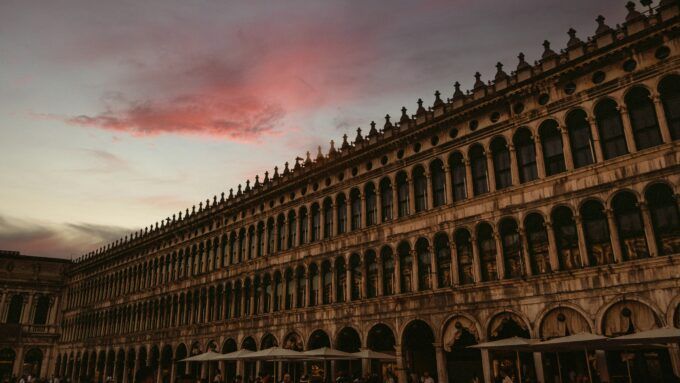
Image by Philipp Thelen.
You can learn something about a culture from its origin myth. Like most boys growing up in Southern California, I believed the founding myth of the United States. Coming to a continent with just a few native tribal people, European settlers took control of an almost empty land, letting the few remaining ‘Indians’ have a chance to live on reservations. ‘The land was ours before we were the land’s’: So the poet Robert Frost famously declared in a poem at the inauguration of President J. F. Kennedy. Even if you don’t know the political history, it’s easy to see that there had to be more to this story. Some Germans who sought to create a ‘living room’ for themselves in Central Europe by ethnic cleansing thought that they were emulating the activities of these American pioneers. Like the United States today, the Venetian Republic ruled an empire. And so we can learn something about our situation by considering the origins of the Venetian state.
For this purpose, I have found a well-known book by the French classicist Paul Veyne, Did the Greeks Believe in Their Myths?: An Essay on the Constitutive Imagination (1988) most instructive. When those mythical stories are far-fetched, as are many Homeric stories, it’s hard to know in what sense they were believed. After all, nowadays people who enjoy James Bond films don’t believe that he exists— or even that someone like him could exist. By contrast, the mythical actions of the founders of the Venetian Republic are less surprising and so seem to raise fewer problems. As the endlessly repeated story found in every history of Venice tells, in 826, enterprising Venetian merchants obtained the relics of St. Mark, which were in Islamic Alexandria, where he had been martyred, and brought them to Venice. Mark thus became the Republic’s patron saint. Unlike most Italian cities, Venice is not of Roman origin. Previously, Venice had made do with the relics of lesser saints. Theodore was the original saint for Venice; you can see his statue in the Piazza San Marco. With their array of relics upgraded, the Venetians enlisted a more powerful figure. Thus the Venetian Republic was founded in 826.
This story is prominently shown in the images in San Marco. To be sure, the scholarly histories explain the events in much fuller detail, taking us up to this theft and its aftermath. There were settlers in the lagoon for centuries before 826. And so the whole story of how Venice became the dominant European power is long and complex. Still, even the scholarly accounts repeat this basic claim. When various cities in Northern Italy competed for leadership, the possession of St. Mark’s body gave Venice its dominant role. That’s why today Torcello and the other habitations on the lagoon remain today just small towns.
According to the myth, the Venetians found the right body, took it to San Marco, where it remains, and then, after a long time, they rediscovered it. It’s left, then, to one semi-popular history to raise explicitly obvious questions about this origin story: Marion Kaminski, Art & Architecture. Venice (2000) asks: “How certain was it that the right body had been brought to the lagoon, considering that the Apostle had died 700 years earlier? “ The further miracle is that the saint indicated his final resting place, in the seat of government, not the cathedral when ”the relics became so heavy that they were too much even for several men.” But, she adds, “ these are modern-day doubts, and they would hardly have occurred to a medieval Christian.” I am not sure about the correctness this last point, for medieval Christians were skeptical, at least in some cases, about the belief in relics. And it’s not hard to imagine that some opponent of Venice would raise doubts. You could question this foundation myth without raising general questions about the value of relics.
To question this origin myth would, however, have been a subversive political act. Compare the situation in Naples, where, even when recently there was a communist mayor, the belief in the holy blood of St. Gennario was not tested or even much discussed critically. To question a society’s founding myth is to threaten its political stability. The American story of the Declaration of Independence is, by comparison, a rational story about a free social contract. Still, to point out the ways in which our Founding Fathers dealt with the reality of slavery is, even now, politically awkward, as we see in contemporary debates. One can point out that eventually our country abolished slavery. But it’s not clear that noting this fact resolves the awkward concern about origins. A similar argument can be plausibly made about Venice.
Rationally, questioning whether the relics at St. Marco were those of that saint may seem a bookish point. If these bones were someone else’s, San Marco would not collapse. But in the historical context, dealing with the query was to undermine the very basis of the social order of the Venetian Republic. Could a society be legitimate if it is founded upon theft and deceit? If the ninth-century Venetians got the story of their most prized relic wrong, who knows what other mistakes they could have made? And that, I think, is why, so far as I know, no Venetian raised such critical questions. It was, one historian writes, “the common view that the presence of the saint’s relics guaranteed the survival of the Republic forever.” The founding myth of the Venetian Republic is that it depended upon theft and deceit, in a way that’s surprising to find in a mercantile state. The suggestion that, by covering the relics with pork, the Venetians were able to sneak them past the Muslims says little about the practical intelligence they ascribed to their foes. The American foundation story is, by contrast, a rational, purely human story. But as I said, it too can be criticized. And as we know, questioning origin myths is likely to be unsettling.
Notes:
Dennis Romano, Venice. The Remarkable History of the Lagoon City (2024) is a very full history. See also William J. Bouwsma, Venice and the Defense of Republican Liberty: Renaissance Values in the Age of the Counter Reformation (Berkeley, 1968) and my “A Renaissance fantasy of the Islamic World: Gentile and Giovanni Bellini’s Saint Mark Preaching in Alexandria, “ Source Volume 28, Number 1 Fall 2008” https://doi.org/10.1086/sou.28.1.23207968