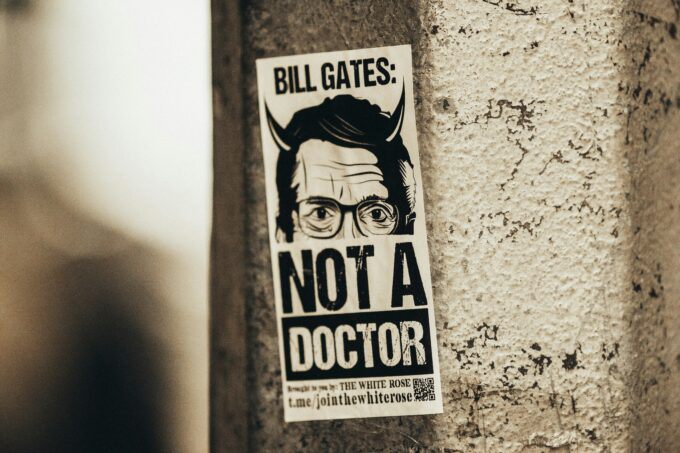
Image by Jon Tyson.
EDITORS’ NOTE: An earlier version of this article included a section titled “Namibia Says No”, citing reports that Namibian President Netumbo Nandi-Ndaitwah had rejected Gates Foundation plans to trial an IUD in her country. This claim was based on statements circulating in African and diaspora media in mid-August, but has since been debunked by the Namibian Presidency and Reuters. No such trial proposal was made, and the quotes attributed to the President were fabricated. This updated version reframes that episode as an example of how disinformation itself becomes a tool of empire.
+++
The Bill & Melinda Gates Foundation is calling it a “world-first” contraceptive: an eight-year hormonal IUD. The launch site? Kenya.
Not Seattle. Not London. Not Oslo.
That’s no accident. That’s design.
The Foundation frames this as a breakthrough in reproductive choice for African women. Look closer and it’s something else entirely: a power project. Patents, prestige, and market positioning stay with a billionaire-backed institution. The medical, social, and political risks are offloaded to African women and African health systems least equipped to monitor long-term effects or ensure safe removals.
This is philanthrocapitalism: social good as a brand wrapper for market capture. “Donations” that cement corporate dominance, steer public policy, and lock in supply chain control for decades.
Fertility Control as Geopolitics
This is not just about contraception. It’s about re-engineering fertility norms under the banner of “choice.” It’s about defining African population growth as a “problem” to be solved by outsiders.
The question isn’t why the Gates Foundation is spending $2.5 billion on an IUD. The question is why that same sum isn’t funding what African nations themselves rank as urgent: ending maternal mortality, fighting malaria, building clean water systems. The answer is blunt — those investments don’t shift global power. Controlling fertility does.
Namibia Says No
In mid-August, a story swept through African and diaspora media claiming Namibian President Netumbo Nandi-Ndaitwah had rejected Gates Foundation plans to trial the new IUD in her country. It came packaged with a speech that felt electrifyingly true: a head of state declaring that if any nation should curb its population growth, it ought to be the United States, not Namibia.
The problem? It never happened. The Namibian Presidency quickly confirmed no such proposal was ever made, and Reuters later debunked the viral quotes as fabricated.
But the speed with which the false story spread tells us something real. People wanted to believe it — because it voiced the sovereignty and refusal that so often feels absent in the face of billionaire power. It echoed the history of colonial population control programs across Africa and beyond, where Western institutions decided which peoples were “too many.”
That hunger for resistance is precisely why disinformation hits so hard. Even refusals can be manufactured, muddying the waters and making it harder to discern genuine acts of sovereignty. In this way, empire operates not just through patents and policy, but through narrative terrain itself: seeding confusion, dulling critique, and turning even the dream of saying no into another contested site of power.
Same Old Playbook
This isn’t new.
From the forced sterilizations of Black, Indigenous, Latina, and South Asian women in the United States, to India’s mass sterilization drives in the 1960s and ’70s, to Ford and Rockefeller Foundation programs in the Global South — the pattern is clear.
Now the pitch is softer, the packaging slicker. But the core remains: Western power decides which populations get to grow and which don’t.
Gates’ Broader Agenda
The IUD is one front in a larger campaign. Gates’ influence stretches far beyond health, and the same patterns appear everywhere he operates.
Agriculture: Through Gates Ag One, the Foundation pushes genetically modified seeds, patented crop varieties, and chemical-intensive farming systems. Farmers who once saved and shared seed become locked into buying from corporate suppliers year after year. Local seed diversity is eroded, food systems are centralized, and the ability to feed communities without external inputs is weakened.
Climate & Energy: Gates has bankrolled controversial geoengineering projects — from solar radiation management to synthetic meat ventures — that critics argue distract from dismantling fossil fuel dependence and give control over the planetary thermostat to a handful of wealthy actors.
Tech & Data: In multiple countries, Gates-backed initiatives have driven the adoption of digital ID systems tied to health records, welfare benefits, and financial access. These infrastructures, once embedded, create new forms of surveillance and dependency, and they rarely remain under public control.
Education: In the U.S., Gates’ school reform agenda pushed the Common Core curriculum and high-stakes testing, creating lucrative markets for ed-tech companies while narrowing learning to what could be measured and monetized. Abroad, similar models have been promoted in the Global South under the language of “21st-century skills,” often sidelining local languages, histories, and ways of knowing.
Across all these sectors, the steps are the same:
Declare a crisis
Introduce a donor-backed “solution”
Build infrastructure around it
Retain the levers of control
Who Decides the Future?
Where a medical technology launches, who funds it, and whose bodies carry the risk are never neutral questions. They reveal exactly whose future is being engineered.
Until Black, Indigenous, Global South, and other racialized women are not just “consulted” but are the ones setting the research agenda, this isn’t empowerment. It’s empire — with a humanitarian accent.