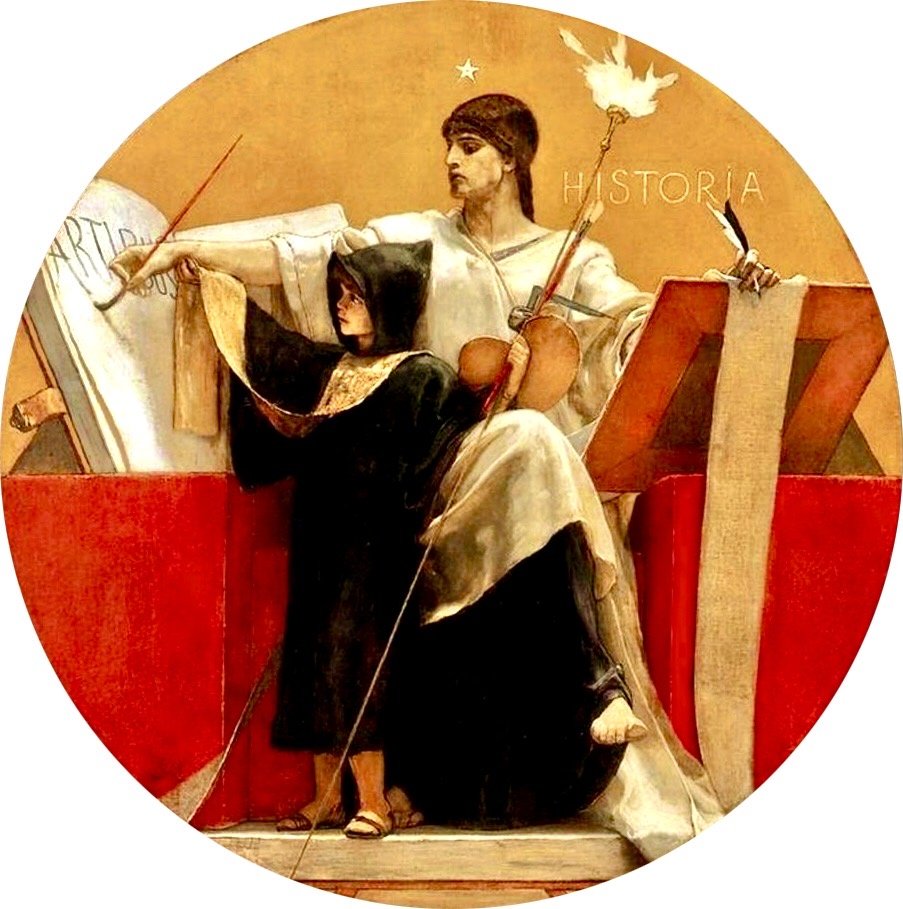
History by Nikolaos Gyzis, 1892. Wikipedia. Public Domain
Prologue
The forced Christianization of Hellas / Greece in the fourth century and after wounded ancient Hellenic / Greek culture but did not completely destroy. In medieval Greece (wrongly dubbed Byzantium), elements of Hellenic culture – for instance, in medicine, agriculture, food and rural life, dancing, theater and fishing – survived for centuries without many destructive changes. In fact, the agrarian culture of the Hellenes (without Dionysos after the twelfth century) filled every corner of the countryside of Greece down to mid-twentieth century.
In areas of thought, which is to say, philosophy, science, literature, theater, and law and justice, the weight of Christianity was crushing. Whatever Hellenic tradition was not extinguished outright, found its way in severely mutilated form into the educational system of the state.
Hellenic traditions in medieval Christian Greece
Christianization did not prevent the learned men of medieval Greece from reading Homer, Thucydides, Plato, Aristotle and showing off their command of Attic Greek – particularly that. But those who had made Plato and Aristotle Christian for their convenience never had any doubt that their Judeo-Christian prophets and saints were superior to Plato and Aristotle.
For example, Michael Psellos, 1018-1096, one of the most distinguished students of Hellenic culture in Christian medieval Greece, admitted that he was a Christian above all. This was a senior bureaucrat who served several emperors with distinction. But when it came to identity and culture, he was torn to pieces between the Hellenic legacy of the Greeks, his Christian theology, and the Christian policy of the state he served. He spoke with anguish that Christianity choked the golden steams of the past (Chronographia 6.43). He defended the Greek legacy of Christian Greece.
Anathemas
However, the substance of the civilization of the educated people of Christian Greece was not Hellenic but Christian. Most of them adhered to the command of church fathers like Clement of Alexandria and Ioannes Chrysostom that Greek literature, eloquence, and philosophy – indeed all of Hellenic culture – were to be avoided at all costs. This is because the Christians set their eyes on cutting the lifeline Greeks had with their culture, studying Homer, the tragic poets, and the philosophers. The Orthodox Church of Christian Greece made it a policy to curse those who sought wisdom and inspiration from the ancient Greeks. Its policy spelled out the prohibition clearly:
“Anathema to those who devote themselves to Greek studies not simply for the sake of education, but who also adopt the foolish doctrines of the ancients and accept them for the truth; anathema to those who so firmly believe such doctrines that they unhesitatingly teach them and commend them to others, both secretly and openly” (J. M. Hussey, Church and Learning in the Byzantine Empire (867-1185) (Oxford, 1937), 94).
With such a hostile and barbarous attitude and measures, the Christians tried to abolish the Greeks’ way of life, self-government, and the study and practice of science, philosophy, literature, education, sports like the naked Olympics, and eusebeia, piety for the gods. The Greeks were forced, on the pain of death, to denounce their ancestors – and stay away from Hellenic literature. However, enough Greeks stayed with their traditions that they passed on to us a critical fraction of their legacy through the Arabic, 8th-10th centuries, and Western Renaissance, 15th-16th centuries. Nevertheless, if one of the converted Greeks had to use any Greek text, for the practice of grammar or rhetoric, for example, the thing to remember was that such work, at best, could be considered no more than a propaideia (introduction) to Christianity’s sacred and revealed wisdom.
Plethon
George Gemistos Plethon, 1355-1452, was a real exception to that rule. He was a Platonic philosopher who lived in the diminished and threatened medieval Greece during the last 100 years of its existence, before it was conquered by the Mongol Turks in 1453. Plethon was an outright Hellene. He taught Plato to Greek students at Mistras, the heart of Peloponnesos right next to ancient Sparta and Mane, during the first 40 years of the fifteenth century. He also introduced Plato to Western Europe through Florence, the center for Greek studies during the fifteenth century. Plethon urged the Greek emperor to be bold and revolutionary as no one else had been in more than a millennium.
At issue, Plethon said to him, was the survival of the Greek people. He pleaded with him to initiate the reconstruction of Hellas by abolishing the crushing rural plantation system in the Peloponnesus and replacing it with an agrarian republic in which there would be no large landowners, tenants, or landless peasants. Those who want to farm, Plethon said, had rights to land for as long as they worked the land themselves and pay taxes. No one owns land. When rural people stop working their land, it reverts to the public domain. Plethon would abolish large plantations, absentee landowners, and the practice of farm workers working the land for the benefit of large farmers. His agrarian reform is probably the most original and radical land reform proposal in the Greek and Western tradition.
Plethon advocated the disbanding of mercenary troops and their replacement with a national Greek army. The polis Plethon had in mind, and, which, he elaborated in his memoranda to the emperor, was to be built on the Platonic model of the philosopher king, a national army to protect it, and small farmers for the producers of food, craftsmen, architects, sculptors, scientists and engineers. He believed that the Greeks of the Peloponnesus were autochthonous. Peloponnesos was always Greek. It was the ideal defensive Greek territory for the revival of Hellas. He advised the king to discard Christianity and return to the Hellenic gods and culture. The king ignored Plethon’s wise advice. The result? Greece was under Turkish rule for about 400 years.
Christianization
The moment that the Eastern Roman empire, which included Greece, became Christian, the fate of the Greek people became that of the state itself. They had to remake themselves through a violent metamorphosis. They dropped from the heights of Hellenic culture to the crude, childish fiction of Christianity. Their born-again identity had to absorb that fiction, making them alien to their very being. They had to worship a foreign dead man for a god, and through their behavior, they had to show to the state and to the church that they believed Christianity’s irrational doctrines. Above all, they had to renounce and forget their history and culture. In fact they had to convince themselves they were not Greeks but Romans.
This story is not a fairy tale. It happened. The Christianization of Hellas dates to approximately 1,600 years ago. The land of Homer – the land of philosophers, scientists, medical healers, poets, historians – Thales, Pythagoras, Hippocrates, Democritos, Aeschylos, Sophocles, Euripides, Aristophanes, Aristarchos, Plato, Aristotle, Euclid, Archimedes, Hipparchos and the astronomical Antikythera computer of genius — still suffers from its alien spiritual conquest. Underneath the modern scientific garb of educated Greeks lurks the old fear of imposed doctrines. Christian names replaced most Greek names. Or they were mixed up. That schizophrenia or invisible psychological schism of who they really are, Hellenes or Christians, prevents them from expressing their being with virtue and courage. The doubt of embracing their ancient culture tends to push them towards foreign ideas and even ideals. They hesitate to immerse themselves, like some foreign philhellenes have been doing, into the ideas of Homer and Thucydides, for example. So, most writing, historical research on ancient Greece and archaeological excavation in modern Greece is credited to foreigners. The worst enemies of modern Greeks, the Germans, are doing most archaeological excavations in Olympia. The French at Delphi. Americans around the Acropolis. Many foreign universities teach ancient Greek, whereas Greek high schools have abandoned it in favor of translated ancient Greek texts.
Personal crisis
In my high school years, we studied Homer in the original, but the study was superficial. We learned nothing about Homer, save from translation of passages from the Iliad and the Odyssey. Meanwhile, our theology teacher spied on some of us going to the movies to admire female beauties like Brigit Bardot. I don’t mean by this that my high school education was useless. No. When I started at the University of Illinois, I received enough transfer credits for my high school courses that I was a college junior upon my admission to the university. The problem was that my high school teachers did not inspire me to study further the literature, history or science of my ancient Greek ancestors or to be proud of my heritage. This ambivalence kept me away from classical studies and opportunities I had at the universities of Illinois, Wisconsin and Harvard. But once I discovered in the decade of the 1980s the timeliness and virtues of ancient Hellenic culture, I did on my own what I should have done at the university. And the fascinating discovery I made on the inestimable value of Greek wisdom coincided with my real life experience at the US Environmental Protection Agency. The more corruption I came across at EPA, the faster I stepped into the philosophy, science and civilization of the ancient Greeks – and Greeks like Plethon who desperately tried to guide the king of the threatened Greek state to reform his government and bring back to life the Hellenic polis in Peloponnesos in order to save the Greek people.
The relevance of Plethon
Plethon had Plato in mind, especially Plato’s Republic, the passionate search for justice, moderation, truth and the supreme virtue of the idea of the beautiful and the good. Plethon was right in the 15th century, and he is right in the 21st century. His agrarian reform proposal to eliminate feudal plantation farming is essential for the survival of healthy land and liberty in America as well. His proposition did away with land ownership, landlords and farmworker slaves. Give small acres of land to those willing and able to farm without toxins and farm workers and you boost democracy, wholesome food and healthy land and, simultaneously, fight the giant in the room: climate chaos. Once the farmer stops raising food, according to Plethon, the land automatically returns to the state. Of course, conventional economists, politicians and agribusiness will denounce this reform and will use the vocabulary they used against Rachel Carson: communism.
The other proposal of Promethean Plethon, national army rather than mercenary, is more appropriate to a democratic society. The other suggestion on religion, is not relevant to the American treatment of religions, save for a strict separation of church and state.
However, Plethon is right about the return of the living Greeks to the eusebeia or piety to the gods of their ancestors. Ditching Christianity in modern Greece would be difficult but not impossible. The state can initiate that political transition by ceasing payments to the clergy and ending subsidies to churches and monasteries. Revive ancient Greek temples. Teach classical studies in all schools, so that children come in touch with the poetry of Homer, and Homer, once again, becomes the teacher of the Greeks. No force should be used in such a transition. However, the state should prohibit Christian, Islamic and Hebrew missionary work by local or foreign missionaries.
Epilogue
History matters. It illuminates the past and the present. The Greeks wrote history but did not learn much from its central conclusion: never fight civil wars.
Ignore history, and the future will punish you severely as much it punished the Greeks. In the Unites States, time has come to teach history as it really happened, not continue teaching the fairy tales of the founders. These fairy tales cover-up the land-grabbing from indigenous Americans and the genocidal policies against them, including the slavery of Africans for working the plantations in America. This mindset guided US foreign policy, overthrowing democracies in Latin America and Iran, and started the Cold War and the dangerous Cuban Missile Crisis. Perhaps, “for our 250th, instead of gifting ourselves parades, ballrooms and fairy tales, we should focus on telling the next generation the truth.”
Allow the unregulated accumulation of wealth or industrial corporate power and you create mountains of toxic pollution, grave inequalities and billionaires that behave like autocrats/tyrants – hardly any different than the feudal lords of the dark ages.
Ignore the history of climate change/chaos and the price may be catastrophic for the life and future of our children. Just because petroleum companies and petrostates and their paid propagandists deny the anthropogenic effects on the furies of the weather and climate it does not mean we should accept those dangerous delusions.