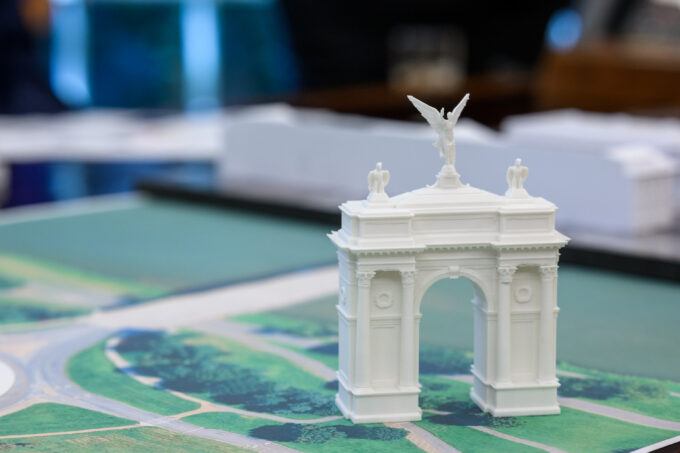
Photograph Source: The White House – Public Domain
Surprise! The Trump-appointed federal Commission of Fine Arts approved construction of the 250-foot triumphal arch that the president plans to erect between Washington’s Lincoln Memorial and the Arlington National Cemetery. And this despite Trump’s rejection of the Commission’s recommendation to 86 (if you’ll pardon the expression) the giant golden angel and eagles that he insists will top a structure almost twice the height of Paris’s Arc de Triomphe.
Most discussion of the Arc de Trump has focused on the project’s proposed size, statuary details, location, and legal authorization. The dominant themes voiced by critics are the president’s execrable taste in architecture, his contempt for tradition, and his neurotic need to immortalize himself in stone. What nobody talks about much is the deep, disturbing symbolism of the triumphal arch, which takes us way beyond Donald Trump’s personal failings.
For more than two millennia the purpose of this type of construction has been to celebrate an empire’s military victories and the glory of its emperor. The most vivid illustration, perhaps, is the Arch of Titus, built in the first century to celebrate the triumph of the Roman emperor Titus and his father Vespasian over the Jews of Palestine in the “Jewish War” of 66-70 CE. Casualties in that war, in which Roman soldiers besieged Jerusalem and destroyed the Second Temple, numbered in the hundreds of thousands. The carvings on the arch’s inner passageway show the triumphal procession of Roman legionnaires carrying the spoils of the Temple, including a seven-branched Menorah, up to the Temple of Jupiter on Capitoline Hill.
Hurrah for Emperor Titus! Hurrah for Septimius Severus, whose triumphal arch memorializes Rome’s victory (temporary, as it turned out) over the Parthians of Iran! Hurrah for Constantine the Great, who built an even larger arch to celebrate his triumph in a civil war and Roman victories over Britain and other nations that dared to resist Roman authority. And, fifteen centuries later, hurrah for the emperor Napoleon I, whose Arc de Triomphe in Paris celebrated his smashing victory over the Austrians and Russians at Austerlitz.
Why didn’t the founders of the United States build a triumphal arch in their new capital of Washington D.C., which was filled with neoclassical architecture? If America’s greatest historical novelist, Gore Vidal, were still with us, he would answer that this was because, once upon a time, the USA defined itself as a republic. The colonnaded and domed buildings beloved by the nation’s founders were intended to evoke republican Rome and democratic Athens –cities ruled by elected leaders responsible to the people, not by an emperor hoping to become a god.
That republic defined “the people” in a way that we now recognize to be severely limited by racism, classism, homophobia, and misogyny. But the founders did not want to erect monuments to an empire that extinguished hopes for self-determination in nations throughout the world, and whose martyred victims included Jesus Christ, St. Peter, and St. Paul, among many other early Christians. The first triumphal arches built in the United States, New York City’s Washington Square and Admiral Dewey arches, were erected in the 1890s to recognize America’s emergence as an imperial power on the world stage. Even in modern times, however, memorials built in the nation’s capital glorified those who built a democracy and sacrificed to maintain it, not those who triumphed over weaker nations and crucified rebellious subjects.
So, what about the newly certified triumphal arch, with its angels and eagles – and “In God We Trust” engraved in giant letters on the entablature? The oversized structure is not only a sign of the Leader’s rampant egotism; it is also a symptom of what psychoanalists call “the return of the repressed.”
The conservative historian Niall Ferguson famously described the USA as “the empire that dares not speak its name.” This sly reference to Lord Alfred Douglas’s description of gay love (“the love that dares not speak its name”) dramatized the refusal of most Americans to recognize that their nation, born in a rebellion against the world’s dominant empire, had itself become an imperial successor to Great Britain – and to other empires going back to Assyria, Babylon, Persia, and Rome.
Today a small number of U.S. historians and politicians openly admit that a nation with the world’s largest national economy and volume of trade, its leading currency, and its most powerful military establishment with bases in over 90 countries is obviously an empire whether it governs in old-fashioned colonial style or not. Almost everyone else treats the consciousness of America’s imperial status as a nasty, disloyal thought.
Why so? First, because our nation was born in a struggle linking internal democracy with national liberation. “No Kings” also meant no Redcoats fighting to preserve a global empire. When President William McKinley (Trump’s hero) seized Cuba, Puerto Rico, Samoa, and the Philippines in the Spanish-American War, he justified this dramatic debut on the imperial stage as a war to liberate oppressed peoples from Old World tyranny – a sickeningly hypocritical doctrine, as it turned out later, when the same peoples sought their liberation from the U.S. The same self-deceiving pretense after World War II pictured the nation’s rise to global hegemony as the opposite of European empire-building rather than a continuation of it: a textbook example of “American exceptionalism.”
Exceptionalism of this sort is less an ideological position than a neurotic symptom. The trouble with repression is that the repressed material – often a shameful desire that one doesn’t want to recognize – forces its way back into consciousness in a distorted form that separates actions from intentions and appearances from realities. This generates self-justifying delusions such as the conviction that we don’t want to dominate anyone, but we need to command the strongest military establishment in world history to prevent less virtuous actors from dominating us. Delusion says that we may look and act like a self-aggrandizing empire, but we are not. We are an imperial strength anti-empire! We do not “dominate” other nations; we “influence” and “partner with” them. And we insist that they want to be influenced and partnered by us because otherwise they would be dominated by others who lack our good intentions.
The classic “proof” of this exceptional virtue is the claim that American forces left Europe after World War II and did not create oppressive satellite states there as the Soviet Union did. Therefore, when the U.S. armed and trained right-wing Greek forces to destroy their leftist adversaries in a closely fought, three-year long civil war (1946-49), its goal was not to make Greece a U.S. satellite and absorb it into NATO but to stop totalitarian Communists from making it a satellite of the Soviet Union and absorbing it into the Warsaw Pact. (In fact, Stalin opposed the Greek insurrection and refused to support it militarily). NATO itself was justified as a purely defensive response to potential Soviet aggression. In fact, it was a logical derivative of the premise, “We are peaceful and they are not.”
Following World War II, the U.S. became the most powerful empire in world history, consolidating its hegemony after the collapse of the Soviet Union in 1991. Even so, the five major wars and dozens of military interventions fought by U.S. troops since 1950, with their millions of casualties, are seldom considered imperial wars. Rather than admit that the American Empire, like every empire before it, is a system that generates violence, U.S. wars are “explained” as the result of this or that enemy’s evil aggressivity or this or that president’s regrettable mistakes. Even the disastrous U.S.-Iraq war of 2003-2011, a textbook example of imperialist strategy and tactics, is most often considered a product of George Bush’s personal arrogance or his mistaken belief that Saddam Hussein possessed weapons of mass destruction.
This focus on the leader’s personal choices, repressing forbidden thoughts about the system that largely defines those choices, persists to the present moment. Most critics of Trump’s triumphal arch consider the monument an embodiment of his bad taste and/or mischigas (craziness), not a symbol meant to glorify a world-dominating empire. They connect the project to other egotistical displays such as Trump’s Golden Ballroom and the banners advertising his face on government buildings and worry openly about his autocratic style and ambitions – but they do not connect it to the empire, since they do not recognize fully that such a system exists.
You may wonder why this delusion matters. A fair question – but It matters very much because it blinds so many of the president’s opponents as well as his supporters. The anti-Trumpers, it seems, never tire of criticizing Trump’s defects of character and mental disabilities, but a great many share his aversion to thinking about the American Empire as a system that produces oppression, rebellion, and war. Most Democratic Party leaders scrupulously avoid using the word empire to describe the U.S. role in world politics. They call it “global leadership” or “responsibility” and accuse anti-imperialist Republicans and progressive Democrats of abandoning longstanding commitments to collective security, or, even worse, of being dupes or agents of the Russians, Chinese, or other alleged adversaries. What they refuse to recognize is something essential: it’s the imperial system, not just presidential megalomania or alleged evil enemies, that generates cruel, needless wars, threatens a nuclear conflagration, and needs to be overthrown or transformed.
Many Americans have come to understand that the Empire is bad news both for U.S. residents and the rest of the world. But if you ask how we can oppose it effectively, or what sort of post-imperial order should replace it, most people will admit that they haven’t a clue. We can’t end the Empire simply by getting rid of MAGA and trying to elect less warlike presidents and congresspeople – not if other aspects of our current system such as an all-powerful oligarchy and a high-tech military-industrial complex are generating the imperialist drive. How to fight this power is the conversation that we need to have, and we need to have it now, before Trump is sent into well-deserved retirement, and before “centrist” Democrats start trying to revive the “soft power” policies of figures like Barack Obama and Joe Biden.
Let me offer a rule that peacemakers have long understood. “Peace through strength” is an oxymoron. Soft power directed toward maintaining and expanding an empire inevitably becomes hard power.
Americans do not need a triumphal arch in better taste than the Arc de Trump. They need and deserve a government that does away with imperial ideas, practices, and monuments – one that dedicates itself to living happily and responsibly in a world of disarmed, collaborative, equally respected peoples. Serious internal obstacles stand in the way of realizing this vision. It’s time to talk together honestly and in detail about how to overcome them.