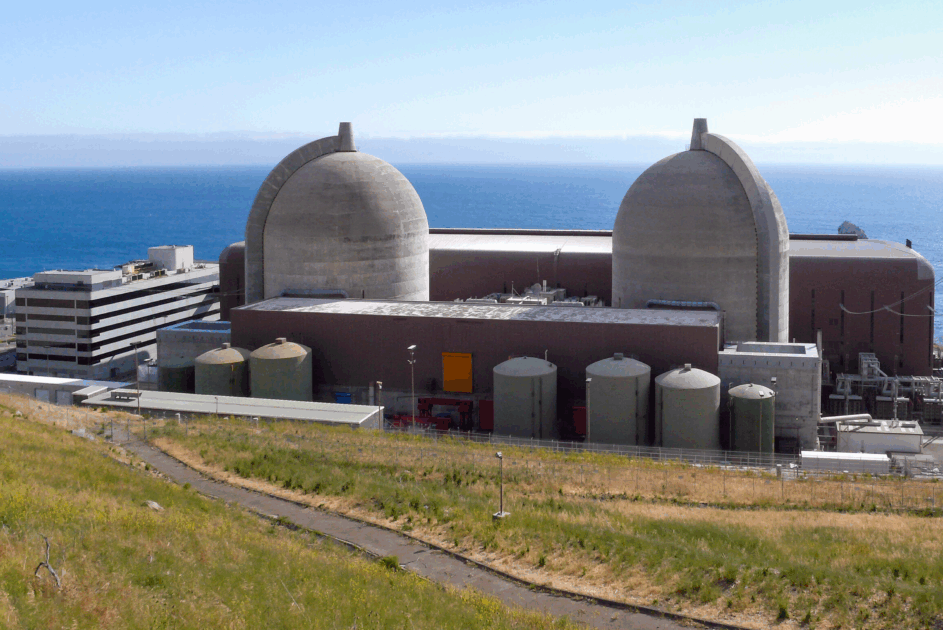
Independent experts have deemed the aging Diablo Canyon nuclear power plant unsafe & unneeded, so why are Uncle Sam & California so intent on gambling to keep it open?
The long struggle to defend California from a radioactive nightmare posed by a potential seismic incident at the aging Diablo Canyon nuclear power plant on the central coast has continued in 2025. Safety experts again called attention to troubling regulatory discrepancies related to the plant’s reactors, while energy experts have debunked the contrived narrative that Diablo is needed for grid reliability. The Trump regime is meanwhile working to loosen safeguards at the Nuclear Regulatory Commission, an agency already known to be captured by the nuclear industry long ago (regardless of which party occupies the White House). What could go wrong?
“If you aren’t independent of political and industry influence, then you are at risk of an accident, frankly,” former NRC Chair Allision Macfarlane (2012 to 2014) told NPR in the spring. Gregory Jaczko, another former NRC Chair (2009 to 2012), told the LA Times that Trump’s executive orders to reorganize the NRC are akin to taking a “guillotine to the nation’s nuclear safety system”. In a Senate meeting, Sen. Sheldon Whitehouse (D-R.I.) described the scheme as “a Department of Energy hostile takeover of the Nuclear Regulatory Commission.”
“To be clear, the Administration’s actions – which include an explicit statement that the NRC is expected to ‘rubber stamp’ licensing requests – go well beyond the pro-nuclear bias that has concerned us for decades,” San Luis Obispo Mothers for Peace & Friends of the Earth wrote this summer in an open letter to Governor Gavin Newsom and other officials. “Instead, the Trump Administration is actively and openly gutting the NRC as an independent safety regulator and rendering it subservient to the Administration’s political aims.”
The activist watchdogs went on to express alarm over Trump’s firing of NRC Commissioner Christopher Hansen, describing Hansen’s removal as “perhaps the Administration’s most chilling blow to the NRC’s independent oversight of Diablo Canyon.” Hansen had advocated for “independence, technical competence, and protection of the public” as “core values” for the NRC, and made a commitment to U.S. Senator Alex Padilla to conduct a thorough evaluation of the seismic risks at Diablo Canyon as a condition for relicensing.
The Nebulous Reactor Embrittlement Testing Process at Diablo Canyon
Mothers for Peace have been gravely concerned about Unit 1’s reactor vessel embrittlement. In an April letter to PG&E ahead of a long overdue (and still ongoing) test, the group noted how “an embrittled reactor vessel can crack due to pressurized thermal shock,” which could prevent the core from achieving adequate cooling and result in a disastrous meltdown.
“Diablo Unit 1 is one of the most embrittled reactors in the fleet, so we’re crossing our fingers and clicking our ruby slippers together while we wait for the results,” says Linda Seeley, a board member and spokesperson for SLO Mothers for Peace. “The seismic danger, as you can imagine, is intrinsically connected to the embrittlement… If, God forbid, there were an earthquake that would necessitate the immediate shutdown of the reactor, the operators would order that cold water be poured into the vessel. That scenario could be apocalyptic, with the reactor vessel shattering like glass and causing an uncontrollable release of radiation…”
Why the embrittlement testing hadn’t been done since 2003 or requires an 18-month window for PG&E to report back to the NRC is nebulous. “Now that they’ve passed the 40-year [licensing] limit, they’re saying none of this old stuff applies anymore. So they’re being kinda loosey-goosey with the schedule,” says Diane Curran, an attorney for SLO Mothers For Peace.
Why California Doesn’t Actually need Diablo Canyon for Grid Reliability
The main reason why Diablo Canyon wasn’t permanently shut down in 2025 per a prior joint agreement is because Governor Gavin Newsom flip-flopped in 2022 to ram through Senate Bill 846 to keep it operating, claiming the state needed Diablo to ensure Californians don’t experience the rolling blackouts of 2020 again. However, the reality is that Diablo Canyon doesn’t even provide such reassurance.
A 2022 editorial in the New Times SLO cited analysis from Sierra Club’s California Energy/Climate Committee member Robert Freehling debunking such claims. “The plant is not needed for general system reliability for California. In fact, this nuclear plant was one of the main reasons for the August 2020 power outage[s]. Because CAISO [the California Independent System Operator] was afraid Diablo might fail and bring down the Western regional grid, they didn’t trust the nuclear plant to keep running reliably for even just one hour, so they called for rotating outages,” Freehling was quoted explaining.
In a phone interview with this reporter, Freehling elaborated on his analysis (though speaking as an independent energy policy expert, rather than for the Sierra Club per se.)
“There was strain on the grid at that time… but CAISO causes some of that strain and they admitted it in their analysis after the fact,” Freehling says, referencing a joint agency report on the root causes of the outages from the California Independent System Operator (CAISO), California Public Utilities Commission (CPUC), and California Energy Commission (CEC).
He explained that California doesn’t get all its energy in-state and that more energy than Diablo Canyon produces is imported from other states, some of it being from nuclear (such as the Palo Verde nuclear plant near Phoenix.) Freehling notes that California is importing almost half as much energy from Arizona’s nuclear plant as is produced at Diablo Canyon. “So the idea that ‘Oh we’re going to run out of baseload nuclear [energy] if we shut down the plant [Diablo], that’s also wrong… The way that they presented it wildly distorts what’s actually going on.”
Based on public statements from the state, the media frequently reports that Diablo Canyon provides 9 percent of California’s electricity. However, Freehling says the 9 percent figure doesn’t include imported electricity, rooftop solar, or energy efficiency – and that if these are included – Diablo’s share of California’s total electricity resources is less than five percent.
Freehling also notes that PG&E has even admitted California doesn’t need Diablo Canyon for grid reliability, when they submitted their application to not relicense the plant circa 2016-17. “In that sworn testimony, the witness from PG&E stated quite clearly that it wasn’t needed for either local or system reliability,” Freehling says. “Now today they’ll say ‘Oh that was 10 years ago’, but in the meantime, they’ve built over 14,000 megawatts of batteries with four-hours of storage.”
“There was an analysis done by a consultant for the CPUC which said that four-hour batteries – up to 10,000 megawatts worth of them – would provide full reliability in California, given the mix of other resources we have,” Freehling says.
The outages in August 2020 – one for 1,000 megawatts for one hour and one for 500 megawatts for 20 minutes – occurred at a time when peak demand was around 47,000 megawatts, he explained, so about one to two percent of demand was cut off. “Those rotating outages didn’t happen because there weren’t enough power plants, they were ordered by CAISO,” he clarified.
“So what they said [about extremely high demand] was true, but they also acknowledged in that [root cause] report that their market structure, their market software, the way they ran it, screwed up,” Freehling continued. He explained that CAISO calculates to ensure they have enough resources to meet demand for a given day, comparing how much energy utilities have versus what they think the state will need. CAISO then procures any last remaining adjustments needed in the real time marketplace, while also calculating generators not needed for the next day to release as resources to be sold. This is why CAISO was exporting energy at the time of the 2020 blackouts, as gas plants in California were deemed to have extra capacity.
“They said ‘We underscheduled demand.’ Now what politician is going to understand what that means?” Freehling wonders. ”But underscheduled demand is just ‘Oops, we screwed up, we did not correctly say how much we were going to need to meet demand the next day.’ That’s what that means. And so they released these other power plants to sell on the market.”
State Senator John Laird concurred with Freehling’s analysis in an October letter to the California Coastal Commission, noting that the justification to extend Diablo Canyon’s operating life for insurance against blackouts during heatwaves no longer holds up. The Commission was examining issues surrounding Diablo Canyon, with activists urging the denial of a permit needed for relicensing to extend operations. But the Commission recently voted 9-3 to approve of allowing the plant to remain open for at least five more years.
Seismic Safety at Diablo Canyon – is the Devil Hiding in the Details?
The fact that Diablo Canyon isn’t actually needed for grid reliability makes the gambling on threatening seismic data surrounding the nuclear plant even more puzzling. Robert Freehling cites the analysis of Dr. Lalliana Mualchin, who has served as General Secretary of The International Seismic Safety Organization and is former Chief Seismologist for the California Department of Transportation (where he produced official seismic maps for California).
Mualchin and Freehling worked in conjunction with citizen researcher Rick Feher – who’s been involved in public infrastructure planning for decades – to submit critical comments to the NRC in 2024 for the Environmental Impact Statement related to the license renewal application for the Diablo Canyon Power Plant (DCPP). Their critique takes issue with the “probabilistic” earthquake model PG&E has been using at Diablo, where the severity of a potential earthquake is de-rated by calculating the probability that it occurs:
“These comments… urge the NRC to add consideration of the deterministic Maximum Credible Earthquake (MCE), and not limit evaluation of seismic hazard to probabilistic models with a ‘return period’ which can understate the actual risk that an earthquake can happen at any time.
From a public safety and earthquake hazard point of view, an unpredictable and sudden occurrence of a large and strong earthquake in the region, particularly but not exclusively on the nearby Hosgri fault, can cause a range of possible damage to the nuclear plant, including and up to a catastrophic nuclear accident of DCPP that could expose a large population of the state to radiation release, leading to the risk of deaths and health problems for generations.
The negative consequence or risk of such earthquake eventuality may far exceed the relatively small benefit of continued operation of this power plant…”
Diablo Canyon’s enablers have also still failed to address the holes in the NRC Office of the Inspector General’s (OIG) report on its investigation that waved off troubling allegations of regulatory collusion from former resident senior safety inspector Michael Peck. The 2021 report basically concluded that it’s all good at Diablo Canyon, but former NRC Executive Director of Operations Mark Sartorius either lied or was mistaken when he claimed (on page five) that Peck told him “he was not raising a safety issue,” rather only a “regulatory compliance matter.”
Peck has said he only agreed he wasn’t raising an “immediate safety issue”, not that there was no safety issue. This discrepancy pops up again at the bottom of page six when the report notes Sartorius claiming Peck’s DPO (Dissenting Professional Opinion) was only raising “a procedural issue” rather than “a safety concern”. Peck has maintained his concern over what he deemed “criminal” collusion between the NRC and PG&E to sweep newer seismic data under the rug.
Whether Sartorious’s mischaracterization of Peck’s concern was intentional or misunderstood, it leaves a huge hole in the OIG report’s conclusions. Yet the Diablo Canyon Independent Safety Committee (DCISC) wasn’t even aware of the OIG report , until this reporter questioned the Committee’s Assistant Legal Counsel Robert Rathie about it in the spring. After reaching out again earlier this month, Rathie acknowledged that the DSISC had “examined” the report and that the topic was then raised at their public meeting in June.
Yet the excerpt of the approved minutes from the meeting passed along by Rathie shows that the Committee basically passed the buck back to the NRC and Congress. The minutes indicate that Committee member Najmedin (Najm) Meshkati “observed the substance of the allegation had been the subject of a Congressional hearing and litigation and he questioned what further contribution a substantive DCISC inquiry into the matter might serve and accordingly, he remarked the matter before the Committee now was in context of whether, and if so to what extent, the Committee should in the future review matters brought to its attention and raised under the NRC DPO Program.”
Nevermind that the 2021 OIG report wasn’t even issued until seven years after the 2014 U.S. Senate hearing on Diablo Canyon. Thus, it seems that the Diablo Canyon Independent Safety Committee either isn’t really so independent, and/or fails to view itself as an entity that should dare to question the NRC’s conclusions. Concern about a seismic incident causing a radioactive disaster, however, led citizens downwind of Diablo Canyon to express fears about living in the “Kiss Your Ass Goodbye Zone” at an earlier DCISC meeting in 2023.
Further Debate on the Merits of Diablo Canyon for Grid Stability
Roderick Robinson, PG&E’s vice president of electric system operations, claimed this summer that the Diablo Canyon unit is vital to maintaining grid stability. “If you take the Diablo Canyon unit offline. It’s not just the megawatts that it produces. It has inertia,” Robinson told Politico in August. “As the entire electric system is spinning at a certain rate, if there is a fault, something that is a resistance to that spinning, if you have a large mass like Diablo Canyon, that provides a great resistance to that change in frequency. That protects the greater system and makes it more reliable and resilient to a change.”
Other independent energy engineering experts like Stanford University Professors Mark Z. Jacobsen and Amory Lovins dissent with Robinson’s analysis.
“The claim that Diablo Canyon is needed to provide inertia is not true,” says Jacobsen, a Professor of Civil and Environmental Engineering + Director of the Atmosphere/Energy Program at Stanford. “Batteries can provide inertia through advanced power electronics that mimic the stabilizing effect of large spinning masses and grid-forming inverters that allow batteries to control voltage and frequency. They also inject power into the grid when needed due to a drop in supply or increase in demand within 20 milliseconds. Diablo Canyon nuclear cannot even do that because it is baseload so can only provide constant power.”
Lovins, who also teaches in the Department of Civil and Environmental Engineering at Stanford and has advised utilities (including PG&E) for decades, concurred. He says Robinson “should know better.”
“The inertia of the turbine and generator in a big traditional power station does help to keep grid frequency constant. However, that classic method isn’t the only one. Modern solar, windpower, or batteries can do exactly the same thing through their power electronics (‘virtual inertia’). This newer method is faster, more precise, well proven, widely used, and highly successful,” Lovins explained. “For example, it reliably stabilizes the largely independent grid of South Australia, which runs three-fourths on solar and wind power with no hydro or nuclear power.”
Jacobsen and Lovins have also worked to debunk the nuclear industry’s marketing agenda surrounding the grift behind the so-called “nuclear renaissance” and the ramp up of nuclear energy in an alleged need to power Artificial Intelligence (AI) data centers.
“Every dollar spent on nuclear is one less dollar spent on clean renewable energy and one more dollar spent on making the world a comparatively dirtier and more dangerous place, because nuclear power and nuclear weapons go hand in hand,” Jacobsen said pointedly last year.
In an editorial for Utility Dive in September, Lovins explained why AI can’t save a failing nuclear industry that’s become so reliant on government subsidies. He critiqued the shift in the industry’s business model “from selling products to harvesting subsidies” and noted that while AI “may be a trillion-dollar bubble,” it’s only sellable “until market realities intervene.”
“Nuclear lost the race to power the grid, so new reactors have no business case or operational need,” Lovins wrote. “Each year, nuclear adds as much net global capacity as renewables add every two days. Soaring renewables generate three times more global electricity than stagnant nuclear power, whose 9% world and 18% U.S. shares keep shrinking.”
Lovins went on to explain that while nuclear power is being promoted by an industry lobbying blitz and federal policy as “essential for new AI data centers vital for prosperity and security,” such a case can’t withstand scrutiny for a variety of reasons that he has detailed in his paper, “Artificial Intelligence Meets Natural Stupidity: Managing the Risks”.
The Battle Over Diablo Canyon Ahead in 2026
PG&E still needs one more permit from the Central Coast Regional Water Quality Control Board to keep Diablo Canyon operating. The Water Board is set to decide on a pollution discharge permit this coming February. Mothers for Peace says there’s ongoing concern about radioactive elements in bioaccumulation from effluent emitted by the plant, which sinks to the ocean floor.
“They’ve been accumulating for the past 40 years, so the fish get contaminated and it goes up the food chain,“ MFP’s Linda Seeley laments. She says the organization has also learned that Diablo Canyon is releasing a staggering amount of tritium (a radioactive isotope of hydrogen) into the Pacific Ocean annually, comparable to the amount in the ongoing discharges of tritiated water from the Fukushima nuclear plant in Japan. Yet this is somehow within regulatory limits.
The Committee to Bridge the Gap (CBG) – a non-profit nuclear policy organization – seized on these issues in a public comment and letter urging the Water Board to reject the pollution discharge permit. “PG&E’s history of evasion and noncompliance in its operation of Diablo Canyon gives ample reason to question PG&E’s credibility or transparency in whether its Diablo Canyon discharges will comply with water quality standards. The historical record, in fact, shows that PG&E cannot be trusted,” CBG states.
“PG&E is actively engaged in a breathtaking scale of radiological contamination. For example, PG&E’s tritium discharges at Diablo Canyon are arguably larger than the tritium discharges each year from the Fukushima nuclear meltdown site,” CBG’s letter continues.
Whether any permit challenge can overcome the nuclear industry’s regulatory capture of the government remains a murky proposition.
“I’ve learned over the years that the only thing that has shut reactors down is a meltdown or a pay off to the nuclear utility, normally with ratepayer money. For example, that’s what happened at San Onofre and Humboldt Bay,” says systems analyst and activist Donna Gilmore, who was part of a coalition that generated public pressure to help get the San Onofre nuclear plant in Southern California shut down in 2013.
There’s still time to reverse course again at Diablo Canyon though, if only the regulatory powers that be could just be convinced to stop gambling on seismic safety and marine degradation for energy which the state of California doesn’t even need.