It’s hot in Hiroshima in August. The sun hangs above you, malevolent, radiating. This is the hottest summer Japan has ever had.
The city itself is new and clean, and the sun bounces right off it. The reasons for its newness are ominous, but perhaps not for the reasons you might expect. Stand in front of the ruins of the A-Bomb dome (formerly the Hiroshima Prefectural Industrial Hall, and now the most visible remnant of what the city looked like on that day 80 years ago) and suddenly you find yourself there at the moment, 8:15 am on August 6th, 1945, when the sun first came to earth. This week, leading up to the anniversary, the city is thronging with tourists. They approach the fence surrounding the dome, frown, snap a few pictures, and move away. One can see the calculations of what kind of reaction is appropriate pass across people’s faces. I’m sure they passed across mine.
Just north of the dome is the Aioi Bridge, whose distinctive T-shape provided the bomb-aimer in the Enola Gay a target to shoot for; they missed it by a few hundred meters, but that didn’t matter as the target was the city itself. The bomb burst above it, and the blast flattened almost everything within a radius of one kilometer. What wasn’t flattened immediately burst into flames. The people caught in the explosion were blinded, burnt, and blown apart; some of them became shadows on the buildings they were standing in front of. In total, some 200,000 people died.
If you walk south from the bridge past the dome a few hundred feet and look to the left, you find yourself looking down the long glass-roofed corridor of the Hondori shopping district, Hiroshima’s main shopping arcade. All the structures looming up around you as you walk towards Hondori are less than 80 years old, but they tower overhead and provide welcome shade in the searing heat. If you turn immediately left on the next block, you will find yourself in front of the improbably small monument to the hypocenter of the explosion, which burst in the air some 600 meters overhead. Look up. The clouds are salmon pink at sunset. A couple of Russian tourists are running the memorial’s abbreviated text through Google Translate.
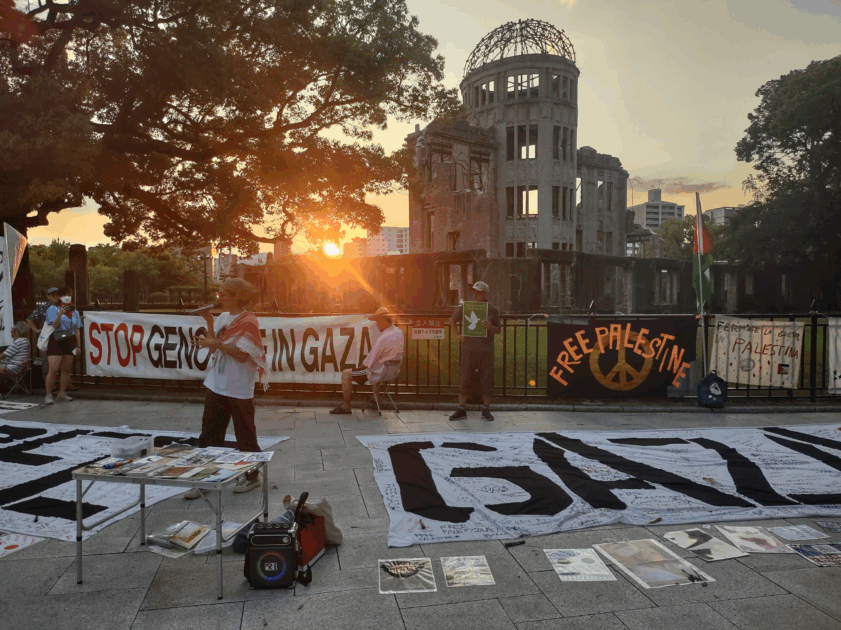
Turn back towards the dome; a small crowd is forming and is in the process of spreading out a series of large banners next to the fence. One says Free, the other Gaza. This is the Hiroshima Palestine vigil, a gathering of people, including CounterPunch’s Rebecca Maria Goldschmidt, that assemble every evening to mark another day of genocide. Their goal is to bring the similarities between the holocausts of Hiroshima and the Gaza Strip to light for those passing by, linking the ongoing genocide in Gaza to the imperial imagination that laid waste to this city and its inhabitants 80 years ago. A chant goes up: Free Free Palestine, and a Palestinian flag tied to the fence is fluttering in the low-angled sunlight with the dome behind it. It’s charismatic. A mic clicks on, and the chant gets louder. In the skeletal metal beams at the top of the dome, a group of rooks is cawing and flapping about. Across the river in the peace park, a bell tolls. It tolls every day around this time.
I’m here in Hiroshima for an art exhibit. I have a show at a gallery about 1 kilometer from the bomb site, a small building attached to a much larger residential tower, which is operated as a cultural outpost of that tower. The exhibit I’m a part of is a collaboration between myself, a Japanese artist Toshie Takeuchi, and a Congolese artist Sixte Kakinda, and each of our works addresses the history of the use of Congolese uranium in the Manhattan Project. Almost all of that uranium came from a single mine called Shinkolobwe, an improbable source which yielded the ore at an almost unimaginably high concentration- most of it at least 65% pure, and some of it up to 75%.
As the nations of the West grappled with how to harness the newly discovered power at the heart of the atom for use in war, this mine became the most crucial location on earth. The Americans acquired the right of first refusal over it from the Belgian colonial regime. They sent agents from an early incarnation of the CIA there to oversee the extraction of the ore and to prevent any of it from falling into the hands of the Nazis. The Nazis themselves had captured 1000 tons of the ore from the Shinkolobwe mine from the docks in Antwerp when they had invaded Belgium the previous year, and they were eager for more. The Americans had purchased 1200 tons that the Belgians had evacuated to Manhattan to start their bomb project with, and they were just as keen to make sure no one else could access it. To that end, they struck the name of the mine from maps and forbade any mention of it in the press. This enforced secrecy had the unintended effect of removing Congo’s role in the Manhattan Project from histories of that project, and thus from the histories of the bombing of Hiroshima and Nagasaki. Our exhibit is an ongoing attempt to bring the mine and the workers who dug the ore back into history.
It’s no simple task to try to add something to the established narrative of what the bomb did to Hiroshima, and to how the city, and Japan in general, relates to that experience. Hiroshima’s Memorial museum is a harrowing experience that encodes a precise framing of the bomb’s aftermath, a way of understanding the destruction that has been carefully composed to suit an official understanding of what it means to have been bombed, atomically. The park in which the museum sits, on the footprint of a neighborhood annihilated by the blast and the fires that followed, is the Peace Park, and “peace” is the government’s central way of framing how it is acceptable to think about the bomb. It’s a narrative that places the bomb neatly in the past, encapsulates the horror unleashed in this city and in Nagasaki by the explosions, and frames those explosions as singular events that demonstrated a clear lesson to the people of the world, and which must not be repeated. What is implied in this framing, however, is that for those explosions not to be repeated, the situation that led up to their deployment must not be recreated. And that means that the Imperial power that dropped those bombs must necessarily not be provoked.
This year’s anniversary comes amid rising nuclear tensions in the region. On June 2nd, a group of retired Japanese army generals from the Sasakawa Peace Foundation think tank released a report critiquing the current state of the anti-nuclear agreements to which Japan is committed, calling them “antiquated” and “perverse”. The rules, the generals say, which forbid the presence of nuclear weapons on Japanese soil, have the effect of limiting effective deterrence should China threaten Taiwan or Japan with a nuclear attack. According to these generals, those rules should be changed to permit nuclear-armed US forces to transit and to station themselves in Japanese territory.
The furor these remarks produced was exacerbated a few weeks later when US President Donald Trump described his airstrikes on Iran as analogous to the bombings of Hiroshima and Nagasaki, citing the official narrative that the first nuclear weapons were deployed in Japan as a tactic to end World War 2 decisively. “That hit ended the war”, said Trump.
The belief that the first atomic weapons were dropped on Japanese cities in order to end the war is common in the West, but much evidence exists to cast doubt on that narrative. Gen. Douglas MacArthur said “he saw no military justification for the dropping of the bomb”, and even Curtis LeMay, charged with overseeing the entirety of American air operations in the Pacific at the time of the bomb’s deployment, said later that “the atomic bomb had nothing to do with the end of the war at all.” The alternative history which insists that the bombs had a tactical military objective is also belied by their targeting- they detonated above the civilian centers of both cities, leaving the peripheral zones of heavy industry unaffected.
The activists of the Hiroshima Palestine vigil understand that the legacy of the bomb, and the reason it was deployed against urban civilian populations, is something that lives on in the present moment through the genocide in Gaza. The group is composed mainly of Japanese citizens, with a couple of English-speaking migrants and a few members from other areas of East and Southeast Asia. Since October of 2023, they have held nightly vigils at the A-bomb dome, handing out literature, hosting art and performance, and speaking loudly through battery-powered megaphones about the ongoing genocide and the complicity of the Japanese government in supplying components of high-tech armaments to the Israeli military.
Last year the group’s successful petition to require the city council of Hiroshima to make a statement against the genocide acquired 20,000 signatures, and this year they secured an invitation for Walid Siam, Palestine’s ambassador to Japan, to attend the memorial and to speak at a conference in a tower next to the A-bomb dome on the afternoon of the anniversary. They have not yet faced significant pressure from authorities to discontinue the daily gatherings, outside of a few noise complaints, including one caller who requested that the city intervene to silence the vigil because the events they were speaking about were “just too sad”. Their daily rallies attract the attention of thousands of tourists who, in the shadow of the dome, instinctively make the connection between the destruction of this city and the destruction of Gaza. The images of Gaza’s obliteration have made it easier for most people to imagine what a town annihilated from the sky might look like, and that has made it easier to reach people who otherwise might just have snapped a selfie in front of the dome and moved on. Many now join the vigil, taking a corner of a banner, waving the Palestinian flag, or joining in the calls for an end to the genocide, which the rooks echo above them in the dome.
On the morning of the anniversary, the city was full of people flocking to the Peace Park and the bridges nearby to await the moment of reckoning. At the A-bomb dome, a crowd of protestors was vastly outnumbered by throngs of riot police, which didn’t quiet either the angry speeches being made through loudspeakers or the chants of the helmeted, masked crowd. This year is the second under a formal ban on protests and demonstrations during the memorial ceremony, and as I made my way past the protest to the Aioi bridge, I could see the police starting to close in. The chants continued, however, through the moment of silence some ten minutes later, as I stood on the bridge looking towards the dome. The sun hung in the air in approximately the same position as the blast would have occurred, silent and oppressive. Everyone on the bridge was sweating, and the city went quiet except for the voices of peace activists being dragged away by armored squads of police.
On July 25th of this year, the Japanese army (which, like that of Israel, refers to itself as the national Self-Defense Forces) insisted that the US Army use nuclear deterrence during an exercise meant to simulate a binational encounter with China. The US forces agreed, marking the first time that the US has implemented a set of new guidelines which permit the use of nuclear weapons in defense of Japan.
Suppose you return to the dome and then head north, across the Aioi bridge, and continue briefly along the footpath. In that case, you will encounter a gnarled and stunted willow tree at the side of the path, with its tortured branches propped up by rough logs and sprays of chartreuse-yellow foliage spilling from it, waving in the breeze, long tendrils scraping the ground. The foliage obscures the trunk, which is barrel-like, hollow, and split. A placard tied to the trunk on a long flexible spring describes the tree as a survivor of the bomb, one of a select few individual trees that made it through the blast at locations around the city; most of them burned to raw stumps in the firestorm and, like this one, resprouted in the aftermath from their roots. The willow tree grew up out of the blackened slag of the dead city into the odd, gnarled shape it currently holds, and every year puts on new leaves. Most pass by it without consideration. Peer into the hollow- the tree is empty, the heartwood whipped out of it as dust by eighty years of riverside wind.