I remember a few years ago, in a very different world, being impressed by an email exchange between the journalist Glenn Greenwald and Sam Harris, the infamous “New Atheist” who had been repeatedly accused of Islamophobia and racism. Harris—who began the back-and-forth with a complaint about a tweet—accused Greenwald of maligning him and fellow New Atheists, while Greenwald politely but firmly defended the substance of the criticism being lobbed at Harris’s movement. In the dialogue, which they jointly decided to publish, Harris comes across as petty, arrogant, and obtusely racist, while Greenwald’s responses are considered and mild-mannered.
I think about this exchange sometimes, a decade later, both for the sharp contrast in Glenn Greenwald’s personal behavior, and because in that time span Greenwald morphed into something like a next-generation version of what Harris and his cohort were in the aughts. Reflexively contrarian, determined to do perpetual battle with a corrupt liberal establishment, Greenwald found his way to the right. 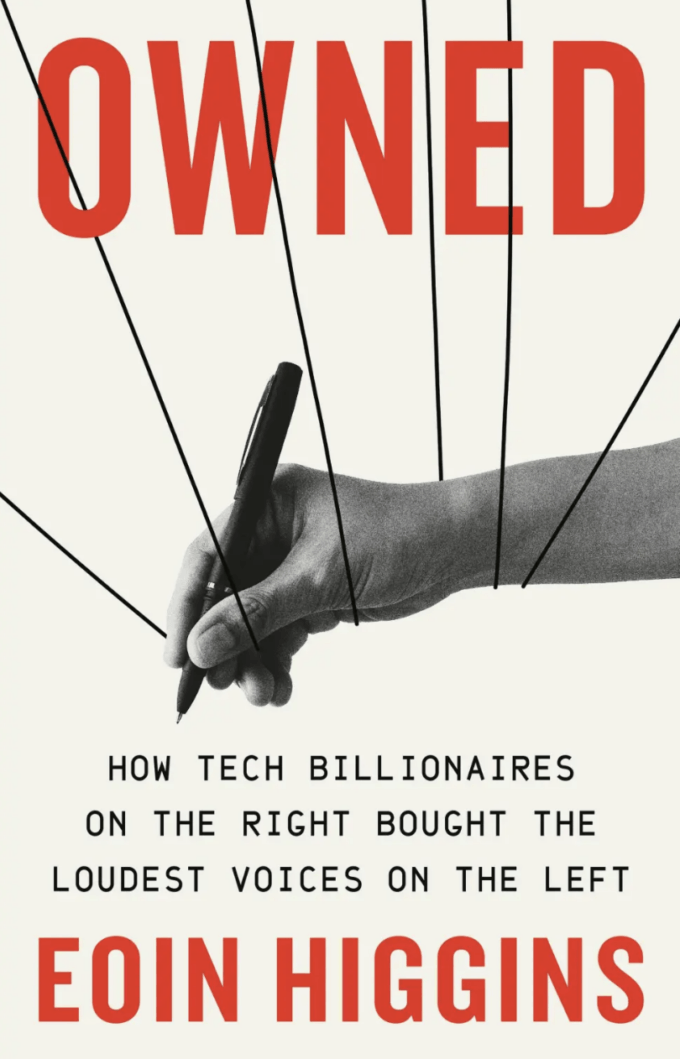
This transformation—along with those of fellow left-to-right travelers, particularly Matt Taibbi—is examined in depth in Eoin Higgins’s new book Owned, out in February. The book traces the respective journeys of these journalists over the last decade or so, simultaneously looking at the reactionary political awakening among big tech executives—a process that dates back decades, but certainly appears to have accelerated in the last few years.
Higgins has done a sort of service for those of us who have watched Greenwald and Taibbi in disbelief, as they’ve contorted themselves into more and more ridiculous positions in obvious deference to wealth and power—particularly wealth and power in the tech sector—and aligned themselves with an ascendant right. Both have repeatedly justified the transformation (a transformation that, to varying degrees, they also deny, instead blaming shifts in liberal culture) under the guise of rejecting corporate censorship and hegemonic liberalism, surfing the same wave of anti–cancel culture hysteria that has degraded public conversation more generally and simplified potentially meaningful debates around power and the consolidation of media into a more easily digestible pill of “liberal elites are muffling conservative voices.” And, of course, both men have gotten very rich doing it.
The reasons for this are something I’ve spent too much time thinking about the last few years. Were they bought out? Did they always hold these beliefs? I ultimately land in a similar place as Higgins: Without offering a “smoking gun,” because there may be none to be found, he suggests that there is a constellation of intersecting factors that have led the two (and presumably others, though lesser names generally appear in passing) to morph into the caricatures they’ve become.
These include, in differing ways, pre-existing ideological proclivities. Higgins covers Greenwald’s mild support for—or credulity toward, depending on your perspective—the Tea Party movement. He doesn’t go deep into Greenwald’s defense of Matthew Hale, another seeming antecedent (and something The American Prospect’s Ryan Cooper has argued is more ethically ambiguous than is usually understood). Greenwald, who was apparently interviewed at length for the book, shows an occasional if self-serving capacity for introspection, and his responses to Higgins’s questions are interesting, if usually predictable.
Taibbi’s politics come across as more unformed, which along with his minimal responses to Higgins makes his recent transformation seem all the more petty (perhaps no image better embodies this than him amicably meeting Ted Cruz). Higgins doesn’t seem to have consulted Mark Ames, Taibbi’s one-time partner at The Exile who has spoken quite thoughtfully about his former colleague on Radio War Nerd, but the basic arc of Taibbi’s transformation to the degrading lows of “Elon, I’ve repeatedly declined to criticize you” is pretty clear through the narrative.
The impacts of social media are another obvious factor in their transformations—particularly for Greenwald, who you almost feel bad for when Higgins references a 2018 quote of his in which he acknowledges the harmful effects Twitter is having on his mind and personal life. You feel less bad in light of the enormous financial rewards that have accompanied his and Taibbi’s moves, sums of money that are impossible to overemphasize and intersect intimately with the tech story Higgins charts out.
That story is essentially the skeleton of the book’s narrative, and is all the more relevant given the tech sector’s close connection to the incoming administration and its near-total alignment with the right today. The basic dimensions are familiar: A number of key figures (whose origin stories Higgins covers, including Mark Andreesen, Peter Thiel, and Elon Musk) got enormously rich in the 1990s and 2000s, as often from well-timed investments and sales as anything else, and their power has grown exponentially over the last two decades, frequently via lucrative government contracts. While the intricacies of their respective trajectories have been covered elsewhere, Higgins does a nice job dispelling the “liberal” reputation much of the sector had until recently, suggesting—much like with Greenwald and Taibbi—that an often-perceived liberal sympathy mostly stemmed from temporary alliances of convenience (for instance, tech’s closeness with the Clinton and Obama administrations).
Many of these now billionaires obviously retained a persistent sense of grievance throughout their rises, which in today’s environment has frequently translated into openly antidemocratic politics. This has had, as we all know, extremely corrosive effects on journalism. Higgins recounts Thiel’s Gawker lawsuit, Andreesen’s investment in Substack, and Musk’s purchase of Twitter, among other key events. Higgins’s discussion of his own experience in tech-supported media, doing a podcast on David Sacks’s now-shuttered app Callin for quite a bit of money, is an interesting aside—for one thing, it gives you a sense of just how much money these people have to throw around as, often directly through their machinations, they collapse journalism as a whole.
And again, Greenwald and Taibbi are right there, becoming millionaires as their patrons become billionaires many times over—Greenwald first through his massive salary at The Intercept (he made over half-a-million dollars annually at his peak), where he more or less made the transition from journalist to columnist, then through his jump to Substack, then finally by moving to the Thiel-backed Rumble and Locals. Taibbi charts a parallel course through his move to Substack (although he was active there very early, interestingly due to a loophole in his Rolling Stone contract), and then through his alliance with Musk and the enormous subscription benefits the “Twitter Files” brought. It is striking to consider how well the two have done as most journalists have suffered, and how much their own journalism and commentary have deteriorated as they’ve gotten richer and richer.
There are some unmined veins in this story, if probably beyond the scope of the book. Among others, I would like a deeper exploration of the history of The Intercept and First Look Media, one of the stranger media sagas of the past decade and an important part of the broader tale here. Despite growing out of the Snowden leaks, and dramatically accelerating Greenwald’s path to prominence and riches (and briefly employing Taibbi in 2014 in a well-paid and ultimately failed effort to start a sister publication called Racket), in recent years The Intercept, which in 2023 separated from First Look, has seen mass layoffs, the departures of its biggest names, and the closure of the Snowden archive, that last decision heavily criticized by cofounder Laura Poitras (hers and especially third cofounder Jeremy Scahill’s are other voices I would’ve liked to hear, although it seems plausible that they wouldn’t want to talk on record). Higgins also mentions, briefly, Peter Thiel being outed as an FBI informant in 2023—another strange detail, as the national security state and its close interconnection with big tech is in many ways at the heart of this story. Indeed, Greenwald and Taibbi’s professed disdain for the supposedly monolithic “deep state”—and Greenwald’s unique connection to that world, via the Snowden reporting—is the hardest thing to square with their coziness with billionaires who are dependent on that same architecture for wealth and power.
The probably redundant question we’re left with at the end is—what happens now? The movement Greenwald and Taibbi have championed as anti-establishment, anti-authoritarian, and committed to free speech—which they have tacitly or explicitly endorsed as the lesser of two evils—is coming to power. What posture will the two writers stake out in 2025 and beyond? Will they cozy up closer to their benefactors (and increasingly, far-right readers and viewers) and continue to contort themselves to justify this decision as somehow righteous, descending further into what Higgins calls “parallel media irrelevance”? Or will they risk their careers and financial status and attempt to stake out anything resembling a principled position on freedom of speech, civil liberties, and intellectual independence, the ideas on which they seemingly built their brands? Particularly after reading Owned, I’m not holding my breath.