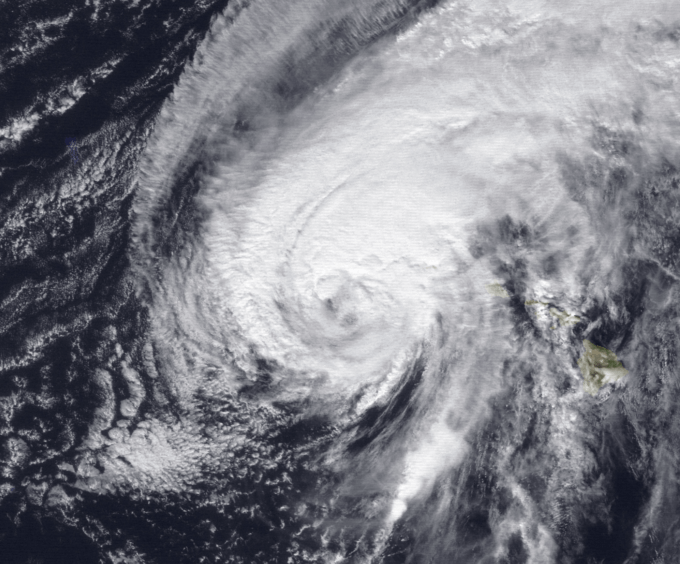
Hurricane Iwa bearing down on Hawai’i, 1982.
We’re in for it. At least that’s the dire warning from scientists about the El Niño conditions now brewing in the Pacific Ocean. What’s actually in store may be up for debate, but it’s clear the developing patterns may place this El Niño on par with the strongest in over a century, which hit in 1982-83, killing 2,000 and leaving few corners of the planet untouched. It was a devastating El Niño that struck before climate change had fully taken hold of our world.
But before we look back at the early ’80s, let’s get a handle on what exactly causes these extreme weather events.
Simply put, the so-called El Niño-Southern Oscillation (El Niño for short) occurs when ocean waters near the equator in the Pacific become unusually warm. In turn, these warmer waters weaken trade winds, which typically push ocean waters toward Asia and Australia. As these winds shift during an El Niño event, warmer water is hurled toward the Americas instead, shifting weather patterns across the globe.
While El Niño is a normal weather occurrence, when it’s combined with a rapidly warming climate, all bets are off. Depending on where you live, one weather extreme or another is likely in your future. Think record heatwaves, worsening drought, heavier rainfall, and wildfires galore. Farms will be destroyed. Homes washed away, and economies ravaged — more of what our warming planet has been experiencing, but on steroids.
Back in 1982-83, the El Niño blindsided the scientific community, which failed to predict its development in the Pacific. As a result, the world was wholly unprepared, and the destruction was immense. The trade winds that year collapsed entirely and, in fact, reversed. This led to sea-surface temperatures in the eastern Pacific reaching 5°C or more above normal. Here’s a bit of what this wrought. 
+ Drought struck Australia, turning out to be one of the continent’s worst in the 20th century. Lack of rainfall led to unprecedented brushfires and blazing heat. Black Summer, Australia’s last big wildfire in 2019-2020, burned 59 million acres and killed 3 billion animals. And it wasn’t even an El Niño year. With Australia already experiencing record-setting summer temps, what the forthcoming El Niño holds ought to have the entire country on edge, preparing for something akin to Black Summer. Hoping for the best, readying for the worst.
+ In 1982-83, Indonesia dried up. It was one of the most severe and unexpected droughts in the country’s history. Tropical rains ceased, and drought took hold. Agriculture collapsed, and 9 million acres of forest and farmland went up in flames. Like Australia, things are already very bad in Indonesia. Several regions across Java, for example, are currently experiencing climate-related drought conditions. El Niño is set to worsen these conditions, setting the country up for a mega drought unlike anything it has seen.
+ The ’82-’83 El Niño caused widespread drought, dust storms, crop failures, and cattle deaths across southern Africa while massive floods swamped the east. Most of the continent heated up and, amid climate chaos, has continued on this trajectory. Think more disease, less clean water, and less food. If any place is unprepared for what’s to come, it’s Africa.
+ South America experienced catastrophic mudslides in Peru and Ecuador during the ’82-83 El Niño. The northern Amazon dried out, while the south flooded. Fisheries and farming crashed. The Argentine portion of the Paraná River experienced a once-in-a-century flood, swelling to 60% above normal and destroying entire villages. The ecosystems across Paraguay, Brazil, Argentina, and Bolivia were dramatically altered. Hundreds of thousands were forced to evacuate, and billions of dollars in damage were recorded. It took a decade for the countries to recover.
+ Here in the United States, we didn’t fare well in the ’82-’83 El Niño, either. Hurricane Iwa, a rare super hurricane, hit Hawai’i, destroying thousands of buildings and leaving at least 500 people without shelter. California saw record winter storms, and whole beaches were washed away. Thousands of homes and hundreds of businesses were destroyed. The Gulf Coast flooded, the Pacific Northwest dried out, and the central U.S. experienced warmer weather. Snowpack levels were down. With much of the West already experiencing severe drought, what this El Niño has in store may make matters much, much worse.
It’s impossible to know exactly what’s in store for the world as this year’s El Niño takes shape, but some numbers may help put it in perspective relative to 1982-83.
Today, the world is 1.2-1.4 °C warmer than it was in the early 1980s. Worse yet, the oceans are hotter than they were 45 years ago, more than 0.50°C warmer overall than in 1982. This means the current El Niño is developing under much warmer baseline conditions than in 1982. Of the three “super” or “very strong” El Niños that have developed since the early 1980s, this one is shaping up to be the largest yet.
Will the warmer climate supercharge this El Niño? It’s possible, but not certain, says Muhammad Azhar Ehsan, an associate research scientist at the Columbia Climate School. “El Niños are very unique in their development. Their impacts depend on the strength, timing and interaction with other climate patterns in the atmosphere and oceans.”
Computer models, however, aren’t looking as promising as Ehsan’s prognosis; a few are predicting this one to be more severe than any El Niño we’ve had since at least 1950.
+++
In other climate-related news, a damning ProPublica report exposes carbon capture and storage for the fraud it is.
And, as many of you know all too well, it’s heating up. Stay hydrated. 1,300 died of extreme heat in Europe’s latest broil.
What El Niño has in store for the West is anyone’s guess, but if it brings more drought, the Colorado River could be in greater peril. Lake Powell and Lake Mead are vanishing. Of course, it’s not only drought that has affected these reservoirs, but also the insane overuse by sprawling desert cities like Phoenix and Las Vegas, and by alfalfa growers whose crops feed cattle. About half of the water that drains from the Colorado feeds fields of alfalfa. This needs to stop. Water is more vital to human survival than hamburgers.
+++
I just returned from visiting family in Montana. My mother has dementia and is slowly fading away. It’s hard to watch, but she remains in good spirits and hasn’t forgotten her friends and family.
While in Montana, Chelsea and I managed to sneak off for a day hike to a gorgeous place I used to frequent as a kid. The trail once followed the Stillwater River up to Sioux Charlie, a lake named after a boy who allegedly grew up with the Sioux and lived in a cabin nearby. In 2022, a devastating flood swelled the river, carving an entirely new path. The Stillwater now flows on the opposite side of the valley. The old river trail was destroyed during those torrential rains, and crews are working to rebuild it.
The first time I backpacked as a little boy, my dad brought me here, to this special place in the Absaroka-Beartooth Wilderness. He grew up fishing the Stillwater and knew it well. I talked to him late into the night under the stars, next to the rumbling waters as our campfire crackled. I remember my father explaining the constellations to me, trying to calm me to sleep. I was scared, not so much of sleeping outside without a tent as of the expansive, mesmerizing universe above us.
He said, “Love is the same as the Milky Way, Josh, nearly infinite and nothing to be afraid of.”
As my mom slips further into dementia, I miss my father more each day. He was about the age I am now when we camped along the Stillwater. I wish I could tell him that after all these years, I now know exactly what he meant.
+++
Did you pre-order a copy of Bad Energy? Head over to Pilsen Community Books and do it, or call up your local library and ask them to carry it when it drops. Every little bit helps.
Stick a bottle rocket in it, and I’ll be back next week.
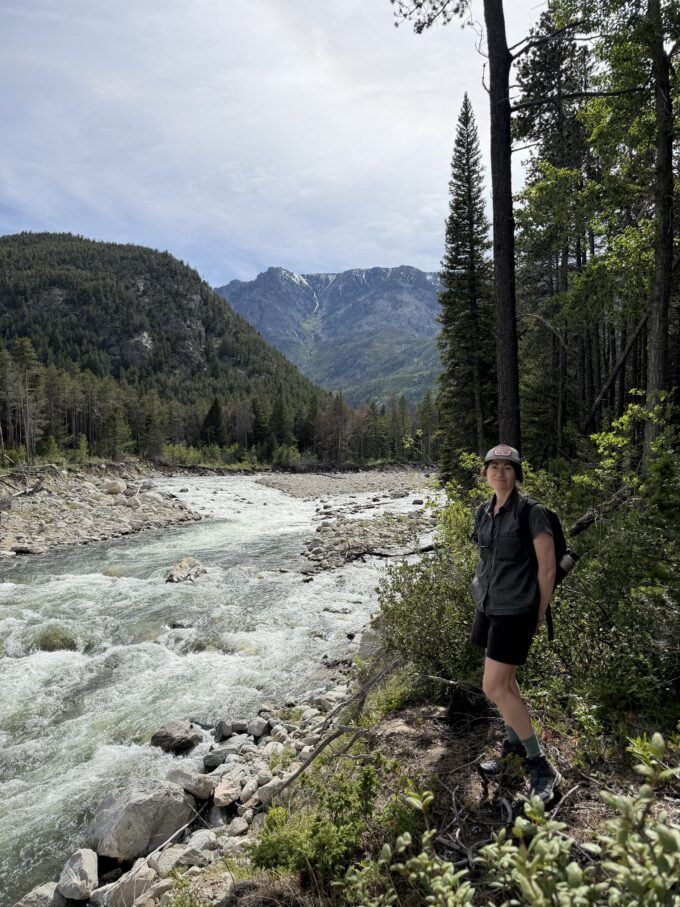
Chelsea along the Stillwater, a tributary of the Yellowstone River.