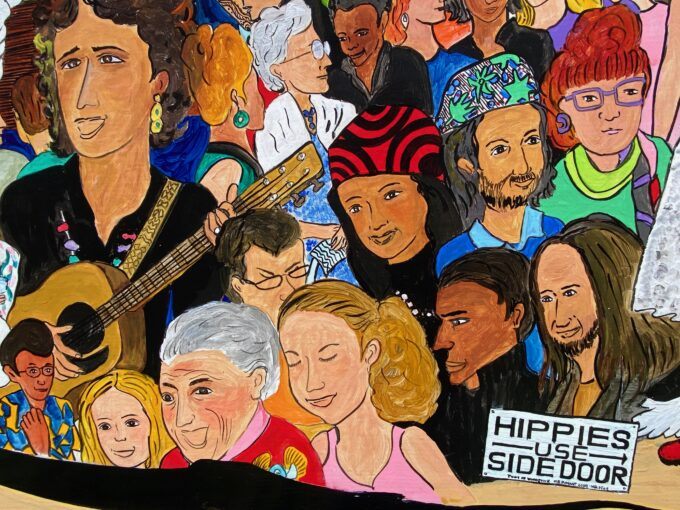
Mural, Cannon Beach, Oregon. Photo: Jeffrey St. Clair.
[Agnes Varda] was always looking for the cliché and what’s inside the cliché.
– Lili Owen Rowlands, Againstness (review of new Varda biography ) London Review of Books, 6/4/26
Humanity can no more survive the mechanistic or scientific revolutions intact than can the forests or the oceans.
–Paul Kingsnorth, Against the Machine
[The problem for “unity in diversity”, as it is applied in the liberal world is this]:. If an adherent to a religion, for example, believes that all other religions are equal to his own, he can no longer truly hold to that religion; he can no longer be who he is. Instead,… he becomes essentially a blank—a blank waiting to be filled by some new revelation. He has become as blank as everyone else who has been infected with the same modern mentality. Thus there is no true unity or diversity, only sameness based on blankness.
– Fr. Damascene Christenson, Epilogue to the 4th Edition, Orthodoxy and the Religion of the Future by Fr. Seraphim Rose
This notion of “embracing imperfection” has been coming home to me since enjoying the first public performance by The Other Side’s newly formed People’s Readers’ Theater in late June. They performed Red, a play by John Logan that consists of a long conversation between the painter Mark Rothko and his assistant, “Ken.” The readers were women, both non-actors, one 20-something, one my age. The staging was very simple, some of it handled in front of our eyes by the person who tripled as stage manager, director, and the play’s narrator. It was very “homemade,” very good, and it was not perfect! Simply doing it, that is, seemed to erase any impulse to compare it with “real theater.”
Because of my commitment to the ‘invisibles,’ the reality manifested via art, especially poetry and metaphor, which makes my writing what it is (i.e., poetic in substance, prose in style) I point to this as an example of embodiment, of bringing the ideally real to life. This kind of work does not need a Broadway stage in order to bring it to life. The dreamers allowed their enthusiasm to carry the project through – against that aspect of impossibility such projects always have for the ones who take responsibility for birthing them. In doing so, they transmitted a work that otherwise many of us here in Utica would not have known existed. I’m not prepared to say this is what art “should be.” But surely it democratizes access to this art (as Bob Dylan’s Rolling Thunder Revue did back in 1978) and makes clear that art belongs to all of us. That is, this is what people do; we make art, and in so doing, we embody spirit. Something we can do, and it’s a lot.
There were perhaps 20 people in the audience that night. That only a tiny few of us think this is important, not the thousands “liking” a YouTube video or flocking to a Taylor Swift concert at a mega-auditorium, does not lessen its mattering. In this way, heroically bottom-up, culture is made from inspiration and embodiment. “You had to be there” is the operative maxim. Culture of the human supportive, machine-defying, nobilizing kind cannot be made from watching YouTube videos. It comes from ideas for which there is enough passion to embody them.
It feels almost ironic to be talking about imperfection and embodiment in these times that are so body- fearful compared with my coming-of-age era, the 1960’s and 70’s, when there was so much less haircutting, showering, use of fragrances to combat body and bathroom odor, shaving, also way less admiration for striving, competing, “success,” etc. But body hatred is not unconnected with the absence of understanding that they (bodies) are made as much to embody ideals, visions, as to conform to the (liberal) zeitgeist of the times. Only by means of acts of embodiment can we forgive their odors, imperfections, and failures and let them be instead in their full human stature.
+++
During a Landmarks Society tour of our venerable, inner-city Utica Public Library in early June, the new Director informed us of something I had not expected to hear, even though the signs are everywhere. He told us that the new goal for the library was moving away from being “book-centered” toward being increasingly a community center. I felt distinctly alarmed. At the same time a voice in me chided, “but what’s wrong with a community center? “ Yikes! I thought. Could there be a clearer instance of the dire direction of liberalism?
What is the hidden agenda here? What’s “inside this cliché?” – that is, inside the unqualified good of “community center”? I smell liberal fundamentalism at work. Is it that “intellectual work” – books and reading – cannot be defended against the implication that we – the educated class – must avoid, above all, any appearance of superiority to the less fortunate? Which, since secretly, we think/fear we are superior, we cannot defend ourselves against the charge of our (morally wrong) superiority except by conceding that the good of the “diverse” community surely is more important than books? And anyway, nobody’s talking about getting rid of books entirely, just reducing their role in the library. And furthermore, will we really be worse off if people never read Anna Karenina? You tell me.
It seems to me the human need for intellectual activity, ferment (that is, the stimulation to original thinking, not Wordle), needs defending in the ongoing crisis for humanity’s soul. It has much to do, at least in this modern world, with the exchange of ideas through books and reading – an activity that goes best with an environment of peace and safety, like the shhh sanctum of the library. It is not racist or classist to think so! It is not saying to take away the community center so poor people have no access to the Internet. And it must be defended even though no one has time to think about such rarefied notions!
This, the make-no-excuses support for the activities bearing the fruits of solitude and inward conversation, is the humanizing function The Other Side continues to modestly serve. Beginning in 2009 as an arts space that could expand the possibilities for our Cafe business next door, it continues the Cafe’s legacy as a sanctum and a friendly soil for the culture work of thinking, reading, contemplation, and creativity. A non-controversial purpose, so one might think. It does so even as the surrounding context has become more polarized, meaner, ever more attached to its devices and screens, ever more inclined to throw the Humanities to the dogs. Small and all-volunteer, it is relatively independent of corporate donors and even of grants. Speaking metaphorically, this group of us keeps our ears as close as possible to the oracle’s mouth; our airy ideas are our nourishment via the excitement they generate and the challenge and pleasure of embodying them. In this manner, in our small-town way, we fulfill the enigmatic words of poet and peace activist Daniel Berrigan: “The difference between doing something and doing nothing is everything.”
+++
Though it surprised me, I liked the title of the talk I’m scheduled to give in July at the Utica Unitarian-Universalist church that they proposed: “Creating Community Space from a radical business owner’s point of view.” It suggested to me that somebody perceives the difference between our organizations, but also their commonality. I’m not sure how acquainted the church people are with TOS’s past activities and programs, but I know a few of them are aware of the popular People’s Classrooms, taught by a young socialist high school teacher, that began last summer. I knew a few who attended were puzzled as to how we managed to be so bold, hosting these intelligent, articulate, well-researched and relentless critiques of neoliberal capitalism!
Always having had a mix of younger and older members on TOS’s board, currently we’re experiencing a surge of new young members. Assuming all such organizations want to have a future, how indeed was it possible for our little idealistic arts organization to attract thoughtful, creative young people (to a degree that amazes me) while the pews in mainstream protestant/liberal churches are filled almost exclusively with the conscientious elderly? (True also of most local arts organizations ) I attribute this in part to the attractively outsider, sincerely “radical” attitude that was intrinsic to the Cafe. But U-Uism, too, identifies itself as being an outlier among denominational religions. So why can’t they do the same?
Here I suggest (just between you and me) that U-Uism, however much a vanguard role it plays among liberal protestant denominations, is limited by its insider identity with liberalism. It cannot be “radical,” which is to say it cannot go to the root, it cannot be true. Insiderism has conservatised them considerably since the radical heydays of the 1960’s and early 70’s. Their radicalism had nowhere to go when the zeitgeist swung back to the right. No outsider position was left to them because their “bottom line” went no further than liberalism’s.
I’m sincerely grateful for their principled openness in inviting me, and terribly averse to biting the hand that feeds me, particularly the hand that ordained me back in 1982! I have no interest in talking down the liberal “woke,” anti-Trump agenda. Still, I want to take my talk beyond the liberal comfort zone. Liberal religion, connected at the hip to liberalism, respecting all religions as equally true, can only support “sameness based on blankness,” no matter the intention. I want to speak in the interest of souls that need to stand for something rather than for nothing – the elephant in the living room of liberalism’s anti-orthodoxy.
I’ve come to see that without a metaphysical place to stand, without embodiment of the metaphysically real, stuck in “sameness,” people cannot make that leap that is the doing something that is everything. By means of its faith in “progress,” liberalism is a logically coherent system of reassurance that, with a little earnestness, we can drift along in its overall beneficent stream, as long as we never either critique capitalism or mention God in any serious way – that is, never embody the irrational ultimacy of spiritual, poetic truth. Thus, liberal insiderism tends toward a lack of ground to stand on to defend the things that need defending, like books and reading, like feeling safe and trusting, like the imperfection of the face-to-face and the local.
Not being forced – or even encouraged – to use much of our capacity for thinking, nor our capacity to create, nor to make and mend with our hands, nor our capacity to build trusting spaces with others from our wounded selves, we stay in the mental spaces left for us in liberal reality. Though I hate to bring out the “big guns,” for everyone hates to be threatened- here they are: To the degree we live as insiders in the liberal thoughtworld, our intensity reserved for appeals to reason, like diversity, non-judgmentalism, respect for differences, it’s possible never to come to grips with the existential crisis in one’s own personal and vulnerable soul. It’s possible to avoid the whole matter of that nonsense about personal salvation, which is not – it turns out – an entirely personal matter! To the degree of our hubris, we’re no match for what Kingsnorth, following Lewis Mumford, calls the Machine – what Christianity calls the Antichrist–that is “unmaking” our humanity.
And no, I’m not enlisting people to fight demons! And I’d rather not tell them what I see as their problem! However, there is one. Faith in liberalism is a big problem for the humanity we cherish, that we must cherish, for who will do it for us? There’s no rationally, liberally certified substitute for conscious relationship with sacred reality. Just as the mind working egoistically in Blake’s “single-fold” consciousness cannot substitute for the soul, liberal faith, in replacing religious orthodoxy with scientific orthodoxy, reduces the sacred, however sincerely sought, to pretense. Its rituals, though sincerely meant, with perhaps an echo of resonance, will not have the power that strengthens you in your difference, in your otherness, in your againstness, that is accessible only personally in acts of creativity.
For many, distance from the real sacred is not a problem. For others, particularly the young with their keen eye for enchantment and keen nose for bullshit, it’s a problem. Even if they’re not ready for religion, even if they are mainly hovering indecisively in a pattern of rebellion, they don’t want bullshit either. The Other Side appeals to the young because, bluntly, it is not liberal; its existence is an embodied critique of liberalism. Whether or not everybody gets it, or is ready to switch off liberalism’s default ultimacy, it’s a place to stand, its unity dependent not upon a common enemy but upon the love of our ideas, of connections made via imagination, of embodying them in creative work.
+++
No longer can we seek safety in insiderhood – the good job, the raises and promotions, the health benefits. What’s not provided for everyone will soon be provided only for the few at the top. The so-called digital revolution now sweeps us all along toward a really scary future for humanity – to its “transcendence” by the Machine. The desire to call digital technology neutral, with AI advancing upon us, mainly just because we do not understand it, and therefore cannot intelligently argue against it, is just that, a desire for some unseen deus ex machina to rescue us from the machina to which we do not feel competent to say No, even when intuition and bodily qualms protest, making us depressed and sick. Almost no one even tests the waters of just saying No, as we become more and more dependent, as traditional forms of communication – or of gaining knowledge (libraries!) – wither away. For those of us (white liberals) who qualify, the allure of the “safe harbor” of insiderhood is too strong.
However, there is still something human beings can do to protect humanity: Protect one’s own. On the small, local, hands-on, person-to-person scale, people can build the opposite of machine perfection. Build human, imperfect spaces for human beings. Not a matter of having enough money, but a matter of doing something rather than nothing. We who are old and have stood as firmly as we could in the shadows outside that digital radiance, have endured the extraordinary silence that goes with abstaining from social media, have been forced to seek old ways and old values that are mainly lost, can do something. We can, by example, show the young they can follow their better instincts: resist absorption into the Machine, practice the arts right here at home, gather your own friends, build and make things in accord with your own soul, and they will speak eloquently – not perfectly – to others.