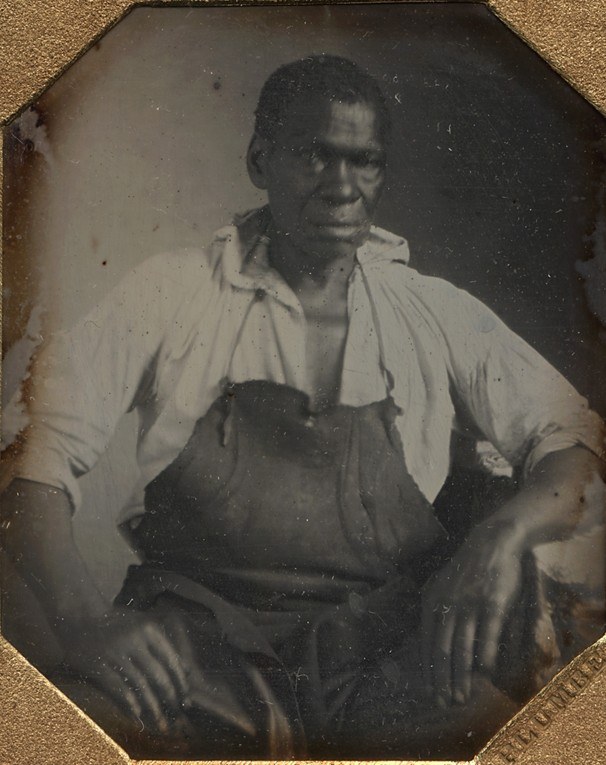
Isaac Jefferson, an enslaved blacksmith at Monticello, photographed in 1845. Tracy W. McGregor Library of American History, Special Collections, University of Virginia Library. Public Domain.
The hoopla surrounding the 250th anniversary of the Declaration of Independence seemingly reflects another unfortunate instance of historical amnesia. Whether immersed in the white supremacist narrative promoted by Trump and his enablers or some liberal version of the high mindedness of the Founders, we are being asked to forget the foundational and ongoing tragedies of the United States of America.
As Isabel Wilkerson wrote in the “Afterword” to her brilliant book, Caste: The Origins of Our Discontent: “We are in an unspoken state of emergency. We have learned that freedom and democracy are not a destination or settled state of being but a fragile proposition, and their preservation is an ever-present duty of each and every one of us who cherishes liberty.”
Moreover, the blinkered vision of our national history remains an impediment to achieving freedom and democracy, let alone celebrating the full context of the liberty promised by “Declaration of Independence.” James Baldwin’s excavation of the “collection of myths to which white Americans cling” in his still resonant 1963 Jeremiad, The Fire Next Time, provides a starting point. Among those myths to which a majority of whites adhere, according to Baldwin, are the following: “that their ancestors were all freedom-loving heroes, that they were born in the greatest country the world has ever seen, or that Americans are invincible in battle and wise in peace, that Americans have always dealt honorably with Mexicans and Indians and all other neighbors…”
In a more recent and compelling work by Eddie Glaude, Democracy in Black: How Race Still Enslaves the American Soul, he excoriates our “collective forgetting,” especially as it underscores the continuing racial injustices and inequalities “at the heart of our nation.” Furthermore as racial justice activist Tim Wise observes, “we aren’t to blame for history…either its horrors or its legacy it has left us. But we are responsible for how we bear that legacy and what we make of it in our present.”
So, what is that legacy and what do we make of it in the present? The so-called American experiment was part and parcel of the establishment of settler colonialism in the 16th and 17th century – a colonialism that entailed the extermination of Indigenous people and the enslavement of people of African descent. Throughout the colonial period and right up to the War of Independence, violent conflicts ensued as settlers continued to push against Indigenous territory on the frontier.
It is not surprising that the author of the Declaration of Independence, having cited fomenting “insurrection” by “merciless Indian savages” as one of the grievances against King George III would himself become the advocate for merciless policies towards Native Americans. In instructing his Secretary of War in 1807 on the preparations for military engagements against any recalcitrant or resisting Native Americans, Jefferson wrote “that if ever we are constrained to life the hatchet against any tribe, we will never lay it down until that tribe is exterminated, or driven beyond the Mississippi.
As an enslaver of Black bodies, Jefferson was well aware of the daily tortures endured by the enslaved whether on the auction block or in slave labor camps. While the legal and political documents undergirding the founding of the nation may have obfuscated the violent reality imposed on African Americans, the forms of social and civil death they suffered were rationalized by a racial ideology which according to the historian, Barbara Jean Fields, “supplied the means of explaining slavery to a people whose terrain was a republic founded on radical doctrines of liberty and natural rights.”
Perhaps there is no better revelation of the duplicity in the celebration of “Declaration of Independence,” with its vaunted enunciation of the equality of all, than Frederick Douglass’s famous address in 1852: “What, to the American slave, is your 4th of July? I answer: a day that reveals to him, more than all other days in the year, the gross injustice and cruelty to which he is the constant victim. To him, your celebration is a sham; your boasted liberty, an unholy license; your national greatness, swelling vanity; your sounds of rejoicing are empty and heartless; your denunciations of tyrants, brass fronted impudence; your shouts of liberty and equality, hollow mockery; your prayers and hymns, your sermons and thanksgivings, with all your religious parade, and solemnity, are, to him, mere bombast, fraud, deception, impiety, and hypocrisy.”
The celebration of the Declaration of Independence while Trump perpetuates his corruption and vicious racism and xenophobia could be seen, once again, as “bombast, fraud, deception, impiety, and hypocrisy.” Added to Trump’s racist and xenophobic agenda are the recent reactionary and white supremacist decisions by the Supreme Court on voting and immigrant rights. To blithely retreat to the backyard barbecue on July 4th while our national house appears, figuratively, on fire, is another aspect of the ‘collective forgetting” of the past and the turning away of our present political tasks. If there is one excerpt from the Declaration of Independence that should be salvaged as showing the way forward, it is the following passage: “That when any form of Government becomes destructive of these ends (life, liberty, and the pursuit of happiness), it is the Right of the People to alter or abolish it.”