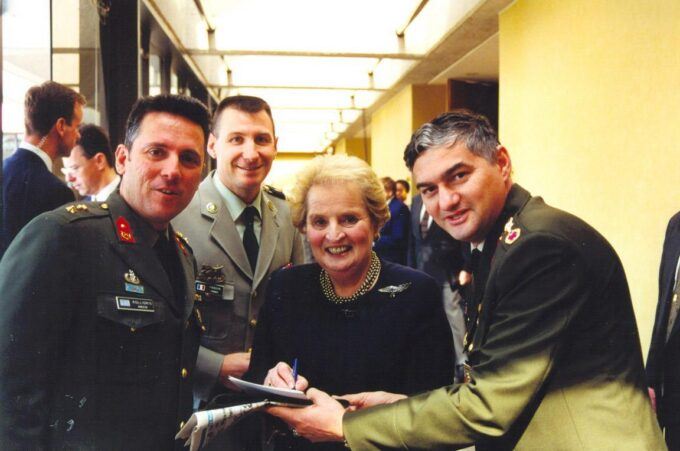
Madeleine Albright with NATO officers. Photo: Basilio C., Wikimedia Commons. Public Domain.
“Future presidents will remember, in short, that the (Iran) war was counterproductive on its own terms and came at the expense of every other foreign and domestic priority. They are also less likely to be taken in by those who cheered this misadventure. Going forward, their promises of cost-free coercion will sound like what they are: a drumbeat for war.”
– Robert Malley and Stephen Wertheim, “The Iran Debacle Could Be a Gift for America,” New York Times, June 25
“As the war in Iran appears to come to a fragile close, Americans are left to wonder why it has accomplished so little. How could a middle power like Iran…face down a global superpower…. Put simply: Because the United States attempted to essentially go it alone.”
– Oona A. Hathaway, “You Can’t Be a Superpower Without Allies,” New York Times, June 21, 2026
Lessons learned are supposed to be insights and practical takeaways from past experience. The guest essays in the New York Times are arguing that such lessons will prevent the repetition of mistakes and lead to continuous improvement when faced with future decisions regarding war and peace. In making these arguments, the writers—all experienced in issues involving international security—are confident that future U.S. leaders will learn from the terrible decision-making of past U.S. leaders.
But what about the lessons of U.S. wars over the past half century? What was learned from the Vietnam War that was based on false assumptions regarding the foreign policies of the Soviet Union and China and the domestic policies of Ho Chi Minh? What was learned from two decades of war against Iraq that was based on lies and deceit? And what was learned from two decades of war in Afghanistan that achieved U.S. objectives in the first several months, which should have led to an immediate withdrawal?
Hathaway’s lesson regarding fighting wars without allies is particularly obtuse because the United States went to war with the strongest military power in the region—Israel. Yet, Hathaway maintains that “even the most powerful state in the world is not all that powerful when it decides to act alone.” Again and again, Hathaway refers to “Trump’s go-it-alone strategy.” A major lesson from the Iran War should have been the dangers and futility of going to war with Israel as a major ally. Even Bush I and Bush II knew better than that in going to war against Iraq in 1991 and 2003, respectively, while paying Israel to stay out of the confrontation.
What the New York Times and its guest essayists fail to recognize is the continuing danger of American exceptionalism, which can be traced to the Puritans and their obsession with raising a “godly city upon a hill” for the “eyes of all people are upon us.” This strand of exceptionalism was written into President Theodore Roosevelt’s corollary to the Monroe Doctrine in 1904 as well as President Barack Obama’s intent to use force against Syria’s deployment of chemical weapons in 2013. Both Roosevelt and Obama cited the United States as having a “higher moral authority.”
Former Secretary of State Madeleine Albright said it best, often referring to the United States as the “indispensable nation” that had a unique duty to defend global freedom, human dignity, and international alliances. American intervention in the Balkans in the 1990s became known as “Madeleine’s War.” “If we have to use force,” she said, “it is because we are America; we are the indispensable nation. We stand tall and we see further than other countries into the future.”
There is no clearer expression of American post-Cold War exceptionalism. It’s time that we remembered Winston Churchill’s observation, “Meeting jaw to jaw is better than war.”