In his massive tome Capitalism: A Global History, Harvard Professor Sven Beckert writes that “the attraction” of The Communist Manifesto is its “ability to combine an incisive critique of the social inequalities produced by capitalism with a deeply optimistic account of the future and the role of workers in bringing about that future.” Only masochists and nihilists would want a steady diet of doom and gloom. To rally the faithful one has to issue at least a glimmer of hope. In On Resistance: A Manifesto (Melville House, $17.99; 2026), Curtis White follows in the footsteps of Marx and Engels and offers both bad news and good news.
A novelist, social critic—and the co-founder with Ronald Sukenick of FC2, a fiction writers’ collective— White tackles what he calls “the philanthropic industrial complex.” He skewers liberals and liberalism, and exposes the failures of American universities to provide students with genuine critical thinking skills.
In the chapter titled “Forget The Beatles,” he urges readers to dump John, Paul, Ringo and George and to leave behind 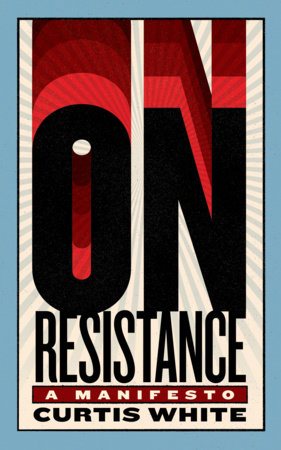 “the counterculture they inspired.” Nostalgia isn’t his thing. Still, he’s asking a lot. White’s Manifesto is provocative, challenging, incisive and optimistic. “Resistant cultures,” he writes, “work through honesty, intelligence and beauty.” A lover of the beautiful, he touts the pivotal role that literature and the arts can play in the making of resistance to conformity and capitalism.
“Make yourself useless! Take back your emptiness! Make something beautiful,” he exclaims and adds, “The arts need to de-shittify and return to peasant energies,” though where one might find those energies he doesn’t say. Perhaps in the work of Rabelais who wasn’t afraid to write about shit, piss and peasants.
The writers that White admires include Jean-Paul Sartre, Paul Goodman—the author of Growing Up Absurd—Ernest Hemingway, the doctor/poet William Carlos Williams and the Russian-born American novelist Vladimir Nabokov, the author of Lolita, who called for a “state of aesthetic bliss” in which “curiosity, tenderness, kindness, ecstasy” are part of everyday life.
I’d call White a utopian who is both playful and fierce. With a vengeance, he goes after fake reformers, fake environmentalists and fake do-gooders. He might have mentioned Robert Tressell’s 1914 novel The Ragged Trousered Philanthropists, a classic of working-class literature, that calls for a socialist revolution and that’s as timely now as when it was first published. Tressell opened my eyes to the true nature of philanthropy.
White writes about himself; indeed, he looks back at his past and calls himself a “working-class suburban boy” who majored in English at San Francisco State University and who grooved to the music of the Dead, Country Joe and the Fish and Big Brother and the Holding Company. His own experiences helped to make him an incisive social critic.
Chapter one, “Psychic Treason,” was published in Counterpunch in August 2025. The first sentence reads, “I am living in a world that no longer exists.” How’s that for provocation? Readers who found “Psychic Treason” food for thought might follow it with White’s Manifesto, which, like the Communist Manifesto, depicts horrific times and the best of times that can be within our reach.