Many activists moved from organizing mass demonstrations and direct actions against Israel’s genocidal war in Gaza to organizing militant demonstrations and direct actions against ICE and for immigrant rights. Today, with a lull in both of these mass movements, activists are asking what are the next steps in building a movement against imperialism in its manifestations of foreign wars and militarism, as well as internal policing and surveillance.
One of the ways to search for such answers is to review the history of American protest, reform and revolutionary movements and organizations. Motown and the Making of Working-Class Revolutionaries / The Story of the League of Revolutionary Black Workers (University of Georgia Press, 2025) is a worthy addition to the multitude of books examining the upsurge of the Long Sixties.
The League of Revolutionary Black Workers (LRBW) had a relatively short but impactful organizational life. The individuals who formed the League in Detroit in 1969 had worked together as early as 1961, and then more concretely after some of the group traveled to Cuba and met with the exiled African American Robert Williams, an advocate of armed self-defense for Black Americans.
The story of the LRBW has previously been told by Dan Georgakas and Marvin Sorkin in their book Detroit: I Do Mind Dying (1975) and the documentary film Finally Got the News (1970). Both of these have merit. 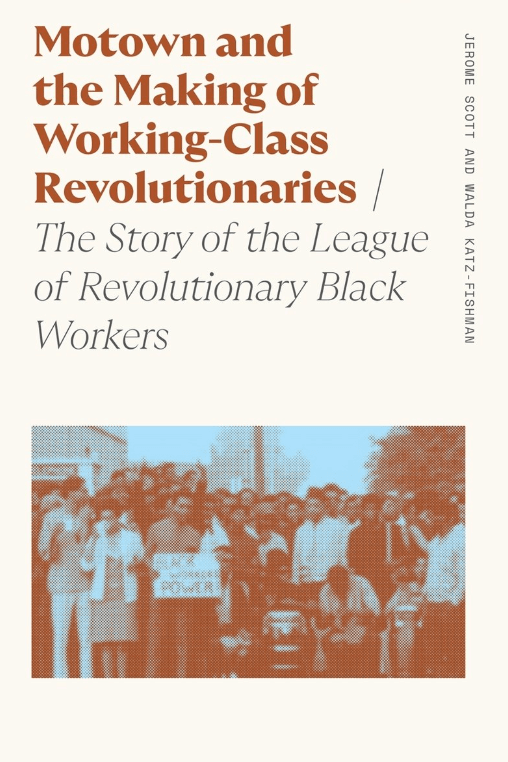
Motown and the Making of Working-Class Revolutionaries by Jerome Scott and Walda Katz-Fishman, tells the story of the LRBW through interview with forty former members of the LRBW largely done in 2017, supplemented by a few earlier interviews.
There are valuable lessons to be gained from this book. Perhaps foremost is the emphasis on evaluation of conditions and study of Marxism to address those conditions. LRBW member William “Mitch” Mitchell, reflected on the lessons from the 1967 Detroit Rebellion:
They had a curfew and Black people had to be in the house from
seven P.M. until four A.M. But during the two week siege, the
curfew was lifted for people with a badge for Crysler, Ford or
General Motors. You could go to work. The National Guard, and
if necessary, the Army would take you. The workers were gonna
build those cars. That said to me if we got any kind of power as
Black people it’s at the point of production. (p. 110)
This was echoed by one of the LRBW founders, Gen Baker:
We learned a fundamental lesson – the only place that Black
people had any value in society was at the point of production,
making profit for the corporations. That’s why we turned our
efforts toward organizing in the factory. (p. 47)
Gen Baker also discussed initiatives in the struggle against the corporations but also with the United Auto Workers. He detailed several tactics that disrupted life as usual, concluding: “We decided where the battleground was gonna be, not them.” (p.50)
Another lesson for our time is what can be learned from the split with the LRBW and what became the Black Workers Congress. As the authors point out, both sides in this split argued for socialism, but differed on the tactics to achieve these ends. Author and LRBW member Jerome Scott says: “Now, I think if we had been more politically developed, and they had been more practically involved, we might not have split.” (p. 119)
The response to the split by the LRBW was to engage in education and study. Those who remained in the LRBW recognized that the flight of the auto plants to non-union locales like the South was irreversible, and the introduction of robotics also was a permanent feature for the industry. They determined that their organization had a weakness in strategic thinking, and unless education and study took place, revolutionaries would always be reacting to crisis.
Embedded in these interviews are comments about the relationship between the LRBW and the Black Panthers, and the thinking that led to the LRBW article “DRUM (Dodge Revolutionary Union Movement) is the Vanguard of the Black Revolution.” A chapter is devoted to race and class, and another on becoming working-class intellectuals.
There is much more in this book such as the importance of consistently developing comradeship, collectivity, revolutionary culture and, yes, fun. In order to address the need for revolutionary culture and fun, the LRBW formed a singing group called the Red Label Strugglers.
This book has weaknesses of course. One is the format which is largely to summarize the interviews, and then quote the interview. An example of how this can lead to boring reading can be found in the section discussing Women and Students. In the summary of Marsha Music’s interview, it concludes: “She also mentioned the philandering of some LRBW guys.” Immediately following is the interview segment, which ends with: “There was a certain amount of philandering among the adults, a craziness that was going on. It wasn’t primary, but it did affect people’s lives.” (p. 88)
Worthwhile books cause the reader to think, and this book does just that. Motown and the Making of Working-Class Revolutionaries is a timely book about Black revolutionaries who have stayed the course, remained committed revolutionaries over the decades, and have lessons that we can learn and apply today. Throughout this book, interviewees emphasize the importance of political education and study. So much has changed since the League of Revolutionary Black Workers recognized the importance of workers at the point of production. Today we are living in a time that seems to require fewer workers due to robotics and artificial intelligence, the internationalism historically extolled by the Left has been implemented by the capitalist class, and the Left in the U.S. no longer has socialist countries to look up to and emulate. The need for Marxist analysis of current conditions, and recommendations as to how to respond is crucial. I recommend this book to revolutionaries and activists who are searching for the next steps in building a movement against U.S. imperialism.