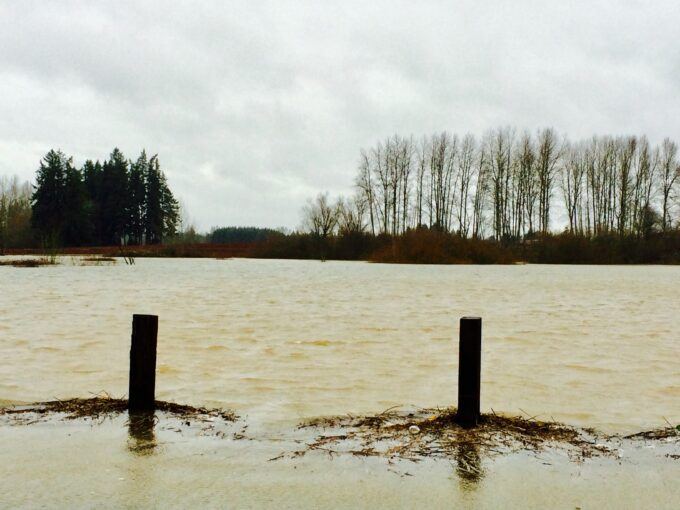
Flooding of the Pudding River, Willamette Valley, Oregon. Photo:Jeffrey St. Clair.
A Moody’s white paper released last week highlights growing concerns about flood insurance protection gaps — apprehensions amplified by a Federal Emergency Management Agency (FEMA) report proposing to make insurance even more unaffordable.
The report points out that the number of homeowners who are inadequately covered is much larger than believed due to outdated FEMA flood maps and a reliance on past data to predict future risk. Moody’s looks at what would happen county-by-county in three simulated scenarios to determine the amount of uninsured damage: a “1-in-100-year” (1 percent probability) flood scenario, a “1-in-500-year” flood, and a “1-in-100-year flood” in an intermediate-emissions scenario by 2050.
In the first scenario, some counties in coastal states such as Florida, Louisiana, South Carolina, and Texas would face the worst damage, around $5 billion, with the uninsured damage at $375 billion nationwide. In the second scenario, rivers would overflow and heavy rains would seep into neighborhoods that normally don’t experience flooding, expanding damage beyond the coast into 11 more states, including Pennsylvania and Illinois. Under this scenario, uninsured losses would increase to over $1 trillion.
While this all sounds pretty grim, just wait. The third scenario accounts for a “1-in-100-year” flood under RCP 4.5, a middle-of-the-road climate model used by the United Nations’ Intergovernmental Panel on Climate Change (IPCC). This model assumes the world doesn’t do nothing, but doesn’t do everything to stem the climate crisis. Under RCP 4.5, global emissions would peak around 2040 before stabilizing, ultimately leading to a temperature increase of approximately 2.4°C. In this scenario, uninsured losses from a “1-in-100-year” flood scenario would increase 25 percent to around $472 billion.
Scientists agree we’re no longer in the worst-scenario — RCP 8.5, which assumes the world is doing nothing, probably most life ends on the planet, and we live in tunnels or something. We’re actually trending closer to RCP 4.5. That should be good news, right? But climate isn’t the only variable that affects uninsured losses. The recent FEMA Review Council report recommends privatizing the National Flood Insurance Program (NFIP), the country’s largest provider of flood insurance. Specifically, the council recommends initiating a “depopulation” program that would move policyholders off NFIP and onto private insurers.
This move may be beneficial to the federal government’s budget, but not to policyholders and the communities they live in. We know this because it’s happened in other areas of the industry. In Florida, the state-run Fair Access to Insurance Requirements (FAIR) plan called Citizens Property Insurance Corporation serves as an insurance provider of last resort for people who have been denied multi-peril disaster coverage in the private market. Seeking to reduce the growing number of FAIR Plan policies and their impact on the state budget, Florida mandated a depopulation program to shift risk from the state to the private market. To motivate policyholders to switch, state legislators have raised Citizens’ premium rates, but often, policyholders are just kicked off Citizens’ rolls. If a private insurance policy rate is offered at up to 20 percent of the policyholder’s Citizens’ renewal premium, that triggers a must-drop rule. However, private insurers participating in the process can cherry-pick policyholders, targeting them with premium offers that conveniently bypass the 20 percent threshold. Unless the policyholder can navigate the system to retain Citizens’ insurance — and many have not — they are automatically enrolled in the far more expensive private insurance, with coverage options that may not mirror their previous policy.
Critics argue that FAIR Plans, which exist in all states but are not all state-run, should remain insurers of last resort, and that if policies are available on the private market, homeowners should switch. In reality, that’s not how people act. Homeowners who are not required to have coverage under their mortgage, or who have paid it off, instead take a calculated risk and choose to go without insurance. In 2022 and 2023, Florida had the highest rate of non-renewals in the US, at around 3 percent of policies statewide. And this is more likely to occur in poorer communities.
Florida’s failure to help homeowners could be the future of the NFIP. And if you combine the effect of a depopulation program with Moody’s scenarios, the picture for the US becomes increasingly clear: We are careening toward a significantly more precarious home insurance market and a worsening affordable housing crisis.
This first appeared on CEPR.