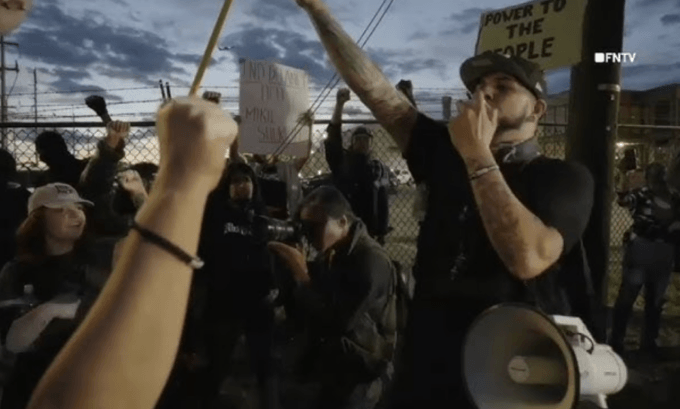
ABC7NY, YouTube screenshot.
On Memorial Day, shortly after the tear gas deployed by Immigration and Customs Enforcement dissipated, community members outside New Jersey’s Delaney Hall began to cover their faces for a different reason: the stench of sewage drifting down Doremus Avenue.
“Nobody wants to be out there. It’s stinky,” X Braithwaite, an environmental justice organizer at Ironbound Community Corporation, told me over the phone. “It’s a public health hazard.”
Delaney Hall is New Jersey’s largest immigration detention facility, reopened by the Trump administration in May 2025. One year later, detainees began a hunger and labor strike to protest the horrific conditions of the for-profit facility, located on toxic land with extensive air and water pollution.
Delaney Hall is located in Newark’s “Chemical Corridor,” an I-3 heavy industrial zone. The city permits the I-3 zone for industrial development and “uses that are incompatible with and even harmful to residents.”
And yet, over 800 detainees are forced to reside in the middle of this corridor. Even after some detainees agree to sign voluntary departure documents, they are kept at Delaney for an additional two to three months. Many are forced to work at the facility for less than $1 per day, while the facility operator, GEO Group, makes record profits.
“We feel vulnerable and, in a way, kidnapped – detained without justification – not to mention that we are being tortured physically and psychologically due to the poor food resources in these detention centers,” reads a letter signed by over 300 detainees.
Those on strike are demanding a meeting with Governor Mikie Sherrill, the immediate release of the young, elderly, and those with medical conditions, and, ultimately, freedom for all.
Many of the immigrants at Delaney were taken at immigration hearings or ICE check-in appointments, while pursuing pathways to legal status. Others were racially profiled and arrested on the street. A recent investigation by The City Reporter found that Latinos represent 93% of ICE’s street arrests in New York and New Jersey, despite representing only 66% of immigrants without legal status.
If ICE takes detainees to Delaney Hall, the largest detention facility in the area, they are placed under the care of GEO Group, a for-profit prison company notorious for its maltreatment of inmates. The striking detainees have reported frozen and worm-infested food, foul-tasting water, inadequate medical care, and abusive security guards. In December, detainee Jean Wilson Brutus died within 24 hours of arriving to the facility.
“There is a reason why they picked the Ironbound to put a detention center up,” Braithwaite said. “The landscape of Delaney – all of that is contaminated soil, contaminated air, and contaminated water, which is partly why the conditions in there are so bad. They put them in the worst possible area.”
Within a one-mile radius of Delaney Hall, there are six major polluting facilities. Braithwaite said they each emit over 100 tons of hazardous pollutants and 10 tons of volatile organic compounds. Delaney Hall’s neighborhood is in the 84th national percentile for exposure to toxic air that can cause cancer and other illnesses.
These facilities include the Passaic Valley Sewage Commission, which treats wastewater, and Darling Ingredients, which processes animal carcasses. Both facilities have faced legal challenges for their pollution.
“They’ve living in a bubble of pollution,” said Braithwaite. “They’re breathing toxic air.”
Detainees have developed asthma, and family members who spent hours waiting outside to visit detainees suffer breathing issues, according to Dr. Norma Bowe, an environmental health professor at Kean University.
Dr. Bowe is the director of Global Grace Mobile Clinic, which visits Delaney Hall every Saturday to provide health services to detainees’ families. After hearing detainees’ complaints of nausea, vomiting, diarrhea, and skin burning after showers, she decided to test Delaney Hall’s water.
In October 2025, she acquired samples from Delaney Hall’s bathroom faucet, a pond, and a sewer drain. She conducted a dipstick test on-site, and the samples revealed the presence of copper, lead, and bacteria. All three water samples showed lead levels of 20 parts per million.
That’s two thousand times the action level set by the Environmental Protection Agency. Health experts say no level of lead is safe for human consumption. Exposure to lead can cause brain or kidney damage, high blood pressure, and reproductive problems.
“All of these things that people are complaining about could possibly be because of the heavy metals in the water,” Dr. Bowe told me over the phone.
The land surrounding Delaney Hall is contaminated from decades of use by the chemical industry. Courts records document the adjacent property’s history as a Texaco petroleum storage facility from the mid-1920s to the 1950s, after which Celanese Chemical Plant manufactured methanol and formaldehyde. In 2003, the EPA issued a letter to Celanese stating they could be responsible for contamination of the Lower Passaic River, a nearby Superfund site.
Across the street from Delaney is Energy Transfer’s Newark petroleum terminal. Signage on the fencing identifies that the site has been under environmental investigation since at least 2009.
Dr. Bowe hoped that her initial dipstick testing would trigger further investigation. On May 28, the seventh day of the detainees’ hunger and labor strike, the New Jersey Department of Health attempted to inspect Delaney Hall but was denied full access. Governor Sherrill and other politicians have also been denied access.
“They don’t want anybody to know what’s really going on in there,” Dr. Bowe said.
Other immigration detention facilities operated by GEO Group share similar stories of neglect and abuse. Detainees at Adelanto ICE Processing Facility in California have reported rotten food, brown water, and inadequate medical care. A 2023 lawsuit alleges that Adelanto detainees were poisoned by GEO Group staff, who sprayed pesticides every half hour during the COVID-19 pandemic.
Meanwhile, at Northwest Detention Center in Washington State, detainees have reported that their laundered clothes and the bathroom water smell like diesel. That facility, like Delaney, is surrounded by contaminated land designated as Superfund sites. The Washington State Department of Health received over 700 complaints in 2023 and 2024 of “brown and possibly contaminated” water at the facility.
Detainees at Adelanto and Northwest are also on hunger strike. There are at least seven detention facilities with recent or ongoing strikes – five of which are operated by GEO Group.
Even as ICE agents have transferred some strikers and assaulted others with pepper spray, detainees have remained steadfast in their demands.
A third letter from Delaney detainees read: “We appreciate the support of everyone who is protesting outside the facility. We want you to know that you give us the strength and determination to keep going. Please, DON’T GIVE UP!”