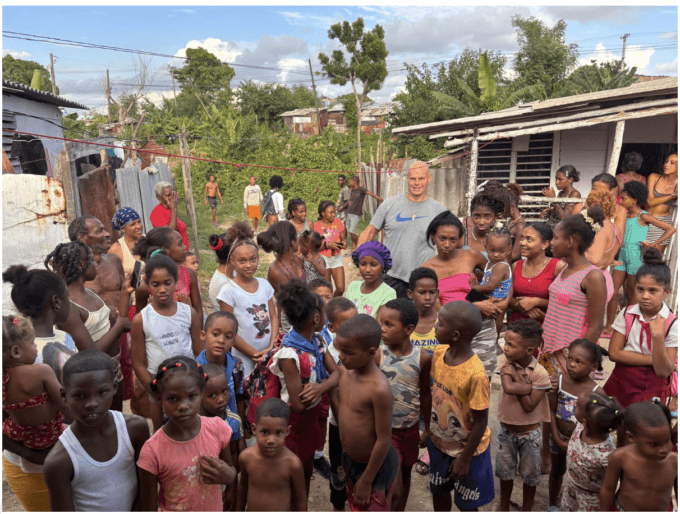
The forgotten Indaya neighborhood of Santiago. Photo: Danny Shaw.
One Month Inside the Trump Administration’s Siege on the Cuban People
All eyes are on Cuba as the corporate press is now reporting that U.S. troops are in place to invade any day. The highly-public announcement of the indictment of Raul Castro in U.S. courts on May 23rd on the flimsiest of grounds and the stationing of the USS Nimitz Carrier Strike Group near Cuba seem to indicate that the blockaded island will have its own January 3rd, the day Venezuelan president Nicolas Maduro was kidnapped. As the latest imperial invasion unfolds against a nation and system so many of us have defended for decades, it is vital to have an honest appreciation of the objective and subjective conditions across Cuba. The failure to file on-the-ground reports which capture this bleak reality can lead us leftists to misjudge the severity of a humanitarian crisis that intensifies by the moment.
The nails of capitalist penetration have been hammering away at economic and political poder popular (popular power) since 1991, the year the Soviet Union collapsed. The last 35 years constitute a tug-of-war between patriotic and anti-patriotic forces, with one side increasingly isolated and the other backed by empire. My work has been to accompany the Cuban masses, from the forgotten barrios of La Lisa in La Habana to the least traveled province, Las Tunas, and collect their testimonies as they fight to survive this historic period of reaction.
The Trump administration is recolonizing Cuba through the ongoing infiltration by foreign private capital. As we anxiously wait for a cataclysmic event toppling the Revolution in a highly visible way, it is important for leftists and human rights defenders to know that the counterrevolution, characterized by the dominance of private property, is already entrenched and advancing every day.
The Genesis of the Counterrevolution
10.5 million abandoned “Gazans of the Caribbean” did not arrive here at this moment of mass hunger, severe energy shortages, and the threat of US military intervention, overnight. 35 years of a Special Period — a period of extreme economic asphyxiation — paved the way for the Trump administration to deliver the knockout blow.
Between 1989 and 1991, in the blink of an eye, the Soviet Union, East Germany and the Socialist block disappeared. Half of the island’s oil supply and 72 percent of its imports vanished between 1989 and 1992. The loss of an estimated $3-$5 billion in mutually beneficial trade (for example, sugar for oil), and annual aid caused Cuba’s GDP to plummet by over 40 percent. The United Nations Food and Agriculture Organisation (UNFAO) documented how Cubans’ average daily caloric intake plummeted from 2,600 in the late 1980s to between 1,000 and 1,500 by 1993. This was what Fidel called, in a speech to the Federation of Cuban Women, “the special period in a time of peace.”
During the special period, the U.S. cut Cuba off from the world, resulting in the return of mass hunger. Meanwhile, foreign capital searched for opportunities to reenter Cuba.
At the October 1992 4th congress of the Cuban Communist Party (CCP), the state sought to replace mutually-beneficial trade with the Soviet Union and socialist camp countries with “enclave resorts and tour programs [that] were created intentionally to ensure the isolation of international tourism from the state-isolated Cuban society.” The dynamic of tourists with dollars and euros worth many times what Cuban workers could earn introduced distortions into Cuban society that harkened back to the pre-revolutionary period. The most visible deformity was the return of prostitution and other forms of hustling around los puntos – Cuban slang for tourists being a potential source of quick earnings that dwarfed their own. Two new generations of Cubans have wondered what the motivation is to be an engineer or doctor if someone working with foreigners could earn their monthly salaries in one night.
The next two decades were, relatively, much better economic times, mainly because of solidarity from Bolivarian Venezuela beginning in 1999 and the 2015 detente facilitated by the Obama administration. Trump’s defeat of Hillary Clinton in 2016 signified the end of modest relief.
In 2017, the billionaire class, pushing Trump into our faces 24/7 as its obnoxious spokesperson, took a scalpel to the Cuban economy, plunging the nation back into the Special Period. With a Gazaesque strategy of surgical precision, they cut off remittances, wiped out tourism and penalized any foreign company that did business with Cuba. By again designating Cuba as a “State Sponsor of Terrorism (SST),” they were able to criminalize any contact with over 230 entities associated with the government, which they frequently updated. The team of White House sadists knew exactly how to reduce the caloric intake of Cubans back to pathetic and emaciated levels. Similar to 1991, but with a population already beaten down with a quarter of a century of hardship, societal measurements of mental health, stress, and life expectancy have been rocked to their core.
Between the economic bullying coming from the hegemon and the 2020 arrival of COVID-19, which ravaged the tourist-dependent economy, Cuba had already been under fire. There were some good years of tourism post-COVID, but that recovery was upended with the reelection of Trump in 2024. Cuba was already down on the ground, reeling before these latest kicks to its head.
The Trump administration’s plan, like the fourteen administrations before them, has been to further isolate the Cuban masses and the vestiges of the socialist state, and cut them off from all their sources of foreign exchange. Trump’s tariff threats have meant that Mexico and Cuba’s other trading partners can no longer send oil to the public sector. The right-wing momentum across the hemisphere, under pressure from the fanatical enemy of the Cuban Revolution, Secretary of State Marco Rubio, has forced countries to shut down Cuban medical missions. Kicking out volunteer doctors has caused harm and anger in Honduras, Jamaica and beyond. This was one of the main sources of foreign exchange for the government. The right-wing government of Daniel Noboa in Quito has gone even further, kicking out Cuba’s diplomats. Costa Rica followed suit.
Meanwhile in Cuba, there has been a new class emerging and gaining economic and political hegemony in Cuba. This is the class, completely hostile to the gains of the revolution for the masses, that for whom Marco Rubio, speaks. Born in Miami to Cuban exile parents, who ironically went into exile during the Machado regime, Rubio is not an organic voice against the Revolution. Israel’s Sheldon Adelson, (and now his widow, Miriam) casino magnate and one of the top fifty richest billionaires in the world, propped him up to be Washington’s voice against a sovereign Cuba. Although he has never visited Cuba, in a rare public address in Spanish on May 20th, Rubio spoke to Cubans, claiming to be on their side and encouraging them to rise up.
Regardless of the exact form of pending military actions, there is what Cuban Secretary of State Bruno Rodriguez calls an “Economic Genocide” already in motion. Millions of Cuban families are suffering generalized insomnia and demoralization, desperate to know how they will access water, food and electricity in the weeks to come.
Is there a New Ruling Class in Cuba?
Partially in response to the 2021 food riots which were egged on by U.S. intelligence, corporate news media, and social media — the state opened up the economy to 8,000-plus new, private businesses. The PYMES Boom, named after the MIPYMES (the acronym for Micro, Small, and Medium-sized enterprises), saw this new class of entrepreneurs expand and establish deeper partnerships with Miami-based exiles and foreign capital. Under Biden’s government, the Treasury Department facilitated licences for the ongoing investment in private businesses. As much as Biden and Trump, Bush and Clinton may have publicly appeared to be rivals, vis-a-vis Cuba and on almost all foreign policy matters, they have had the same objectives. As the revolutionary rhetoric and billboards slowly faded, the capitalist writing was on the wall.
According to many Cubans I have talked to during periodic visits to Cuba since 1995, over time the sons and grandsons of government leaders were pulled into the wheeling-and-dealing vortex of the new economic elite. Government representatives and investors frequent the same dollarized spaces denied to the masses and do favors for one another. They own the best land and make profits off strategic real estate. Their affairs are not interrupted by the blockade. In new imported cars, they speed by crowds waiting all day for any means of transportation. The masses resent them and see them as the closest and most visible incarnation of their oppression. These are the subjective conditions many of us who have supported the revolution often deny.
Most often, lighter-skinned, propertied families — who are Cuban exiles or who have family in Miami or Madrid — own the more than 11,000 MIPYMES. These two parties of élites have shared the symbolic Cuban cake, shutting out the masses who cannot afford to buy in dollars. At the same time, because the public sector is blockaded, the more affordable mom-and-pop MIPYMES function as a lifeline for families who cannot get food anywhere else. Many cubanos de a pie (everyday Cuban workers) see the grandson of Raul, Sandro Castro, and the Castros’ great nephew Deputy Prime Minister Oscar Pérez-Oliva Fraga, as the personification of this new state-capital alliance. There are daily rumors that one of these two dynastic politicians could be the next president and play the role Delcy Rodriguez has been slated to play in Venezuela, to facilitate recolonization.
A veteran Cuban journalist, one of my many confidential barometers of the ideological climate, fearing eight years in prison for spouting “counterrevolutionary” ideas, spoke from within the besieged nation, fleshing out the contours of what he sees as a new ruling class:
“This accumulated capital has continuity from the times of Batista. Many elites left and got richer but came back or invested through family. They are back to dominate the economic arena. We see more clientelism everyday. Like amoeba, the political elites shift in sync with capital. Forget about all the “revolutionary” rhetoric about supporting Palestine and sending doctors abroad. That is all good and are relics of what was, but it is a distraction from the course Cuba is on.”
What I have seen in my most recent visit confirms what many colleagues have been researching. Cuba retains a shell of communism, as capitalism barrels forward over millions of defenseless, battered, disoriented souls, as some of my neighbors in the Plaza de Marte section of Santiago described themselves.
The Gazification of Cuba
On the afternoon of March 16th 2026, Cuba’s national electric grid collapsed. The U.S. press again reported on this as though it were a natural disaster that had nothing to do with foreign pressure. In a relentless case of double speak, the more the most powerful government in the world attacks, isolates and sabotages Cuba, the more loudly they announce that Cuba is a “failed state.”
That day, I was with a family in Los Olmos neighborhood of Santiago that had to make a decision about throwing out goat meat that was quickly thawing out because of the blackout. The meat was already beginning to smell rancid, but this was more protein than they expected to see for the foreseeable future. Children and grandparents have to sleep with humidity & mosquitos, but no fan. No one can charge their phones or watch their favorite shows. Teachers and nurses cannot get to work.
Many Cubans younger than 50 years old told me: “If Trump is going to bomb us, he should do it asap. If the U.S. is going to invade us, then do it. These bombs of dehydration, hunger and blackouts are already murdering us.” Historic leader Raul Castro himself has long recognized that in order to stave off counterrevolution, “beans are more important than cannons.” These same Cuban masses were not talking about resistance and “Patria or Muerte” (“Homeland or Death);” they were plotting and hustling every day to see if they could get their children something to drink and eat.
Like teenagers in Gaza who have for so many decades sat idly by the craters of Zionist and U.S. bombs, the Cuban people watch history pass them by. They’re not allowed daydreams. The idleness is excruciating.
The collective punishment meted out against the Cuban people reflects the deep disdain Miami-based capital feels for the very masses who three generations ago ousted them from their thrones. Black Cubans, poor Cubans, the Cubans of the Revolution, my friends and comrades whose voices and ideas inform this writing and those who gained so much from decades of building people’s power are now slated for starvation. We cannot underestimate the sadism of those who warn that feeling any empathy for other human beings is weakness.
Since 2020, an estimated 2.75 million Cubans have exited their homeland, representing one of the sharpest demographic declines in the history of the Caribbean. These economic refugees send home remittances, buy phone minutes and food packages and fight to keep their family members alive. But what about the vast majority of Cubans who do not have family members to help them? Here again the color line sharpens.
The Nail in the Communist Coffin
Regardless of the exact combination of military force and economic coercion, the U.S. government has put foreign capital back in the drivers’ seat of Cuba’s future. What I have seen, visiting and travelling through Cuba since 1995, and having just traveled one month across Cuba, foreign capital has already deeply penetrated the country and is driving a process of Capitalist Natural Selection.
Washington is demanding President Diaz-Canel to step down. Whether he does or not is inconsequential in the sense that the economic tide has already shifted. Trump will continue to demand Diaz-Canel’s resignation to suit his ego. It matters little whether the Epstein billionaires rule through the existing ruling apparatus, the CCP (the Venezuela strategy), or through elites in Miami that are rumored to be candidates for future office (the Iran “Pahlavi” plan which thus far has been wildly unsuccessful).
The counter revolution is first and foremost the counter revolution of property relations. For decades there has been state ownership over the means of production, limiting the rise of social inequality. Fidel Castro and his generation of leadership hated private property and fought to make sure it never again lorded over the Cuban masses. This generation of Castros, however, spoke openly to CNN, claiming that now “the majority of Cubans want to be capitalist.”
Cuba and the Western Left
Much of what I am translating will appear at first glance to be blasphemy for a left that has long seen Cuba as their guiding ideological light. Does critically investigating this claim make one a “counterrevolutionary,” a gusano or worse even, a “Trotskyist?” I am shielded from western critiques because none of these ideas are mine. I am merely an interlocutor after decades of traveling through popular barrios and campos, debating these ideas with the Cuban people.
According to a recent report on the ground in Havana by the Canadian Broadcasting Corporation (CBC), the Cuban government continues to “try to control the public image.” CBC says they “obtained a recent directive from local media urging positive stories about daily life to fight ‘counterrevolutionary campaigns to promote subversive activities.” Neither the CBC nor any corporate media is trustworthy, but they are confirming what I have heard from los cubanos de a pie (everyday Cubans). Read the state newspapers. Watch the state news programs. The approach is archaic and does not resonate with the youth and everyday people.
The U.S. left holds on to an outdated image of class relations in Cuba. A rigorous study of the class pillars upon which the 2026 Cuban state is built is likely to evoke disillusionment because it is not consistent with the idealized imaginary upon which their solidarity has been founded.
The flotillas are, of course, a beautiful sign of solidarity from people who stand with Cuba. FBI harassment of Americans, who continue to travel to Cuba and challenge the blockade, including the author, shows how far the government is willing to go to starve Cubans. These much-needed supplies will restock some hospitals and pharmacies and save lives. Other supplies could end up being resold by non-idelogical careerists who masquerade as “Marxists.” The revolution attracts the best and worst of us.
These supplies will be a drop in the ocean of human want. The starvation of the Cuban people that is in motion is structural. No amount of modern-day, last gasps of internationalist solidarity, mixed with humanitarian assistance, can retard the ongoing ascent of private property. The Western-based solidarity movement takes their cues from the government, not the Cuban people. We have long assumed the two march shoulder to shoulder. Nearly a decade after Fidel’s death, this is not a safe assumption. Some of the truest Marxists I have met speak of a “dictatorship of fear” in their homeland.
Some foresighted Cuban intellectuals in the diaspora, where it is much easier to speak openly on this topic, call and search for a third way forward, independent of the ossified state and the hateful Miami gusano rhetoric. Others deep within the state bureaucracy, unable to speak out publicly, share this vision. This is not a personalized attack on many self-sacrificing Cuban officials at all levels of government, including President Diaz-Canel. They too are powerless before superpersonal class forces. However, many remain quiet and pretend that popular enthusiasm for the revolution is at 1959 or 1989 levels, refusing to sacrifice their own personal privilege.
Ultimately, in a perpetually besieged state fighting to be free from the genocidal dictates of the U.S., there is no realistic third way forward. The sharp, principled minds critical of the bureaucracy live a semi-clandestine existence in Cuba and have no resources. Any critique of the system is labeled as “counterrevolutionary activity,” punishable with jail time. They see themselves obligated to keep fighting for what was and what could be, from within. Most of Cuba is paralyzed, powerless and hungry, left to wait and see what empire will do with what up until now has been their most defiant holdout.