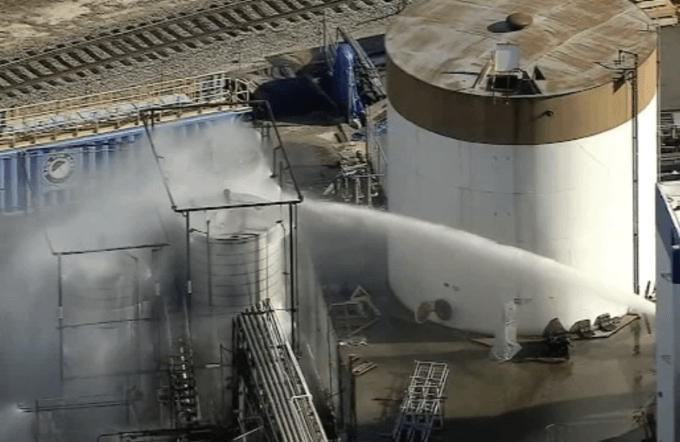
Firefighters attempt to cool down GKN Aerospace’s leaking tank. YouTube screenshot.
This week in the Anthropocene
The news alerts were ominous. A chemical tank at an industrial site in Garden Grove, fifteen miles south of where I live, could blow at any moment. A nervous Orange County Fire Captain warned of two possible outcomes. Either 7,000 gallons of a highly toxic chemical soup would spill from the damaged tank, or, worse, a massive blast could poison a large swath of Southern California.
Over the next few days, the worry escalated from trepidation to panic. 50,000 residents around the facility were evacuated to temporary shelters as water was continuously hosed into the scalding-hot tank to cool it. Gov. Newsom declared a state of emergency, and experts were flown in to develop creative solutions to the impending catastrophe.
The tank, cracked and rapidly overheating, was full of methyl methacrylate, a pungent, highly volatile, flammable liquid used to make resins and heat-resistant coatings for airplane parts. Experts have long known that a chemical “runaway” was possible in old tanks like these, where very rapid polymerization can overheat and cause an explosion.
Fortunately, this worst-case scenario was later averted, and by Wednesday, officials said the tank had been stabilized. Yet no one can say for sure whether the risks won’t return one day.
The company that manages the plant, GKN Aerospace, manufactures components for planes such as the Airbus, as well as parts for a range of military applications. GKN boasts that it provides “cutting-edge solutions” to its customers, with a large Pentagon portfolio that includes supplying parts for the F-35 Lightning II and the Saab Gripen, the country’s most advanced and lethal fighter jets, and for C-130 military transport aircraft. GKN’s business is just one link in the state’s highly profitable and complex military supply chain. 
A single F-35 Lightning II costs more than $109 million. The Saab Gripen and the C-130 run about $85 million each. The F-35 alone is projected to cost taxpayers more than $2 trillion (that’s not a typo) over the next several decades. War is very big business, and California’s aerospace and defense sector is booming. According to state figures, the industry contributed $35 billion to California’s GDP in 2024.
Here’s a bit on how this all works in the case of Israel’s “special” relationship with the United States.
In early May, Israel announced plans to bolster its air power, approving $119 billion to purchase two “combat squadrons” of F-35s. The whole thing is mind-bogglingly insidious. US taxpayers pay to design and build these expensive planes, which are then sold to Israel, which buys them with money the country received from US taxpayers. The death loop is complete, and GKN and many others cash big checks.
Now, the working-class community of Garden Grove is experiencing the consequences of this violent and unhinged war machine, a predicament they paid for but never wanted.
+++
That chemical tank in Orange County wasn’t the only vessel to cause havoc this week. An implosion at a paper mill in Washington state on Tuesday morning killed two people and left eight others missing. The tank that exploded in the town of Longview held nearly one million gallons of a corrosive chemical concoction known as “white liquor,” a mix of sodium hydroxide and sodium sulfide used to break down wood to make kraft paper.
Speaking of blow-ups, risks persist on the other side of Washington state at the Hanford Nuclear Reservation, where dozens of hulking underground tanks holding millions of gallons of radioactive waste are corroding, and several are leaking. An explosion there, which has nearly happened more than once, as I detailed in Atomic Days, would be terrible. A buildup of hydrogen, if ignited, could release a cloud of radioactive material and chemicals across the country.
Not to fret. Only 37% of federal staff at Hanford have been laid off due to Trump’s budget cuts.
For decades, Hanford produced plutonium for our large arsenal of nuclear weapons. When the US began dismantling some of its warheads in the early 1990s, the government had to store its stockpile of leftover weapons-grade plutonium. Now, Trump wants to hand over the deadly material to nuclear power producers because uranium will be in short supply if atomic energy is to make a comeback. Giving weapons-grade plutonium to nuclear start-ups is risky business. After all, Iran’s alleged quest for a nuclear weapon is why Trump went to war.
Enough with the nuclear calamity, let’s talk chilate chaos.
Over in Europe, it’s getting hot. London is boiling. Paris is melting. Dublin just hit a record. People are dying. It’s the first big heat wave of the year, and more are surely coming. Yes, it’s only spring, but this all reminds me of last summer, when nuclear power plants in France and Switzerland had to be shut down because their cooling water would further warm already-overheating rivers. So much for nuclear power’s reliability. The energy needed during the height of summer was rendered ineffective by the very problem it was supposed to solve.
Record heat has also struck India, and despite its economic expansion, many are suffering. Unlike China (and the US before it), which relied on coal, India has gone all in on solar to power its industrialization. Some argue this is an entirely good thing (no doubt solar is better than coal!), but it comes with a cost, including hidden waste and pollution. India is also using water (in the form of pumped storage) instead of commercial batteries to keep the lights on when the sun isn’t shining. This, too, exacts a toll, including biodiversity loss, deforestation, and community displacement.
Rapid growth is clearly benefiting India’s “Billionaire Raj” but not the country’s working poor. Despite India’s renewable-powered industrialization, it still has some of the worst inequality in the world, and the gap between the rich and the poor has widened sharply over the past three decades. The top 10% in India hold 65% of the country’s wealth.
China’s industrialization came at a cost, too, and arguably far worse. Last week, a gas explosion in a northern Chinese coal mine killed at least 90 people and injured dozens more. It was the worst coal mine accident the country had experienced since 2009. In the heyday of China’s economic growth, however, such incidents occurred almost daily. In the early 2000s, 6,000 to 7,000 people were killed in Chinese coal mines every year.
In other news, a new report details how bad conditions will become in New Orleans as sea levels continue to rise. The study found that the city must begin relocating now, as it will be completely submerged within two generations.
Another study found PFAS present in 10 California counties, concentrated in areas with industrial agriculture.
And Madagascar’s largest and oldest baobab tree, known as Tsitakakantsa, is dying. Scientists believe that prolonged, climate-change-induced wet periods triggered a fungal invasion that slowly killed the tree’s root system. The sacred tree first sprouted those roots at the dawn of the Middle Ages. Now, climate change is taking its life.
+++
Despite all this darkness, it wasn’t entirely doom and gloom this week.
The Denver City Council has voted to impose a one-year moratorium on the construction of data centers within city limits. Santa Fe, New Mexico, is considering a similar proposal.
Where there are data center plans, there’s resistance.
St. Charles, Missouri, has permanently banned large data centers. So has Monterey Park in Los Angeles County. Seattle has proposed a one-year ban, and Minneapolis has instituted a six-month moratorium.
Lastly, this is rather astonishing and welcome news. Dam Removal Europe reports that 603 dams were removed across 21 countries last year, the highest number ever. The removals reconnected 2,324 miles of river. Go pick up a copy of Tara Lohan’s book, Undammed. It’s fantastic.
Float on that, and I’ll see you next week.
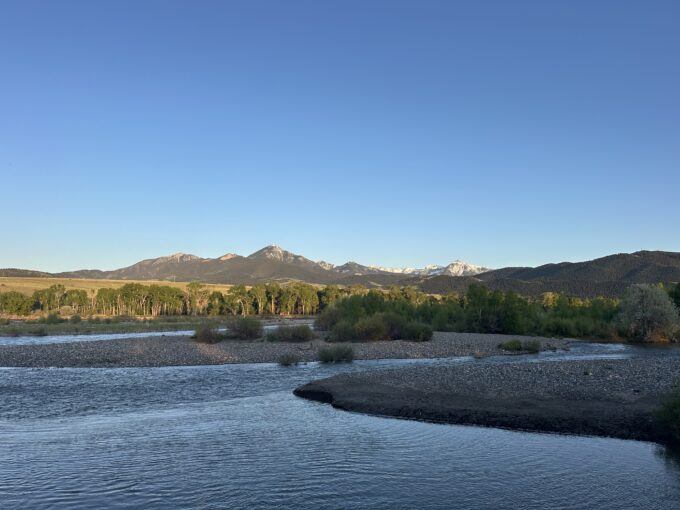
The Yellowstone River, running 692 miles, is the longest free-flowing, undammed river in the contiguous United States. Photo by Joshua Frank, Livingston, Montana, 2025.