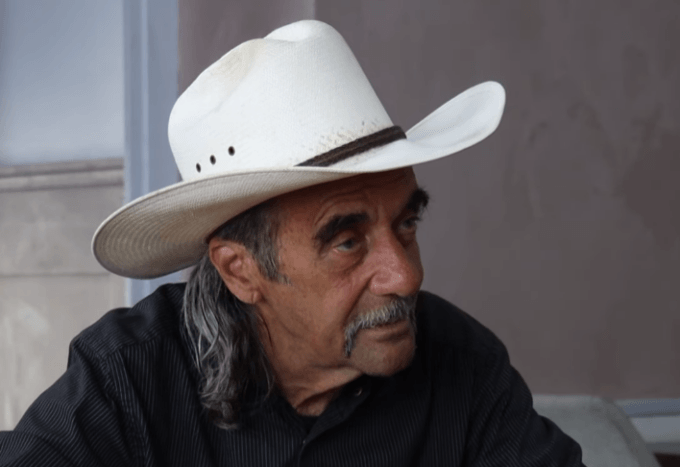
Ben Morea at the International Anti-Authoritarian Meetings of 2023 in Saint-Imier, Switzerland. Photograph Source: Antochkat – CC BY-SA 4.0
In Memory of Ben Morea
On the afternoon of October 10, 1966, six members of Black Mask, a radical anti-arts arts group, marched in front of New York’s Museum of Modern Art (MoMA) handing out leaflets while two members unraveled a large canvas sign announcing, “MUSEUM CLOSED.”
A handout published in Black Mask 1 (November 1966) read, in part, “A new spirit is rising. Like the streets of Watts [i.e., August 1965 riot] we burn with revolution. We assault your Gods – We sing of your death. DESTROY THE MUSEUMS – our struggle cannot be hung on walls.” It continued, “Goddamn your culture, your science, your art. … What purpose do they serve? Your mass-murder cannot be concealed. The industrialist, the banker, the bourgeoisie, with their unlimited pretence [sic] and vulgarity, continue to stockpile art while they slaughter humanity.”
In an accompanying press release, the group clarified its concerns:
“This symbolic action is taken at a time when America is on a path of total destruction, and signals the opening of another front in the world-wide struggle against suppression. We seek a total revolution, cultural, as well as social and political – LET THE STRUGGLE BEGIN.”
The demonstrators were offended by MoMA’s exhibition, “Dada, Surrealism and Their Heritage,” which they felt violated the Dadaist and Surrealists very creative visions.
Museum executives, having been notified by Black Mask about the planned action, informed the police who put up two sawhorses to block the entrance, closing the facility. According to one account, “a nervous and shifty-eyed mob of plain-clothed and uniformed policemen and newsmen [and] one FBI man with a small Japanese camera” observed the demonstration. As the scholar Conor Hannan notes, “Black Mask’s mock-closure of the Museum of Modern Art (MOMA) represents the first true meeting of art and social protest within the setting of 1960s New York.”
During the ‘60s, numerous arts groups emerged that expressed strong political beliefs, including the Art Workers Coalition, the Guerrilla Art Action Group (GAAG), Women Artists in Revolution (WAR), Black Emergency Cultural Coalition Inc. (BECC) and, most importantly, the Black Arts Movement.
Black Mask was different from the other political arts groups in two important ways. First, it drew its radical sensibilities from the post-WW-I Dada and Surrealist movements, a sensibility shared by groups like the Chicago Surrealists, the Amsterdam Provos, the San Francisco Diggers and the UK’s King Mob. Second, it drew its theoretical or analytic perspective – i.e., its critique of the capitalist culture industry — from the radical Marxists tradition that included the Frankfurt School (e.g., Herbert Marcuse and Wilhelm Reich), the anarchist/ecologist Murray Bookchin (i.e., the concept of “post-scarcity”) and the French Situationist International, particularly Guy Debord (i.e., the concept of “the spectacle”).
At the center of Black Mask was Ben Morea (1941-2026), an abstract painter and vibraphonistwho moved to the East Village in the early ‘60s. As he later reflected:
“I had been involved in jazz during my drug addiction days. I was a musician and every time I got out of jail I went back around the jazz world and got re-addicted . . . When I finally kicked for the last time . . . they put me in the prison hospital . . . in Roosevelt Hospital in Manhattan . . . There was an occupational therapist who befriended me . . . She was an art therapist, so I started painting.”
During this period, he hooked up with the Living Theater and, as he recalled, he “was highly influenced by their ideas despite never being theatrically orientated myself.” Morea further explained, “they were the first people to put a name to the way I was feeling and leaning philosophically.” During this period, Morea was introduced to artist Aldo Tambellini (1930-2020) and the radical arts community.
Tambellini, a painter, sculptor and poet who pioneered electronic intermedia, championed a belief that art had to break free from the confines of white-walled galleries. In ’59, he moved to East 10th Street and began publishing a radical anti-art-institution mimeographed newsletter, The Screw, bearing the bold slogan, “Artists in an Anonymous Generation Arise.” The Screw “was created to raise the social consciousness of artists,” Tambellini reflected. “In the newsletter, I voiced my objection to the manipulation I saw in the art establishment which used the artists as a commodity and financial investments rather than cultural entities.” It included tracks like “Fuck the Tastemaker: Wall Street is making our art, the galleries are making our art … the critics are making our art. WHERE THE HELL IS THE ARTIST?” It challenged the commoditization of art.
Tambellini put his words into action by handing out copies of The Screw at “The Club” (a loft at 39 East 8th Street), a regular meeting space for New York School artists like Willem de Kooning, Robert Motherwell and Franz Kline. On July 12, 1962, in an action anticipating Black Mask, he hosted “Event of the Screw” in front of MoMA. He later reflected:
“There, in front of many artists who attended the “Event,” the media, and law enforcement, I dressed in a black suit and tie with a gold screw tie-clip, [and] read the “Manifesto of the Screw.” The Belltones, a Puerto Rican Trio from my neighborhood, also dressed in suits and ties, accompanied me by singing a cappella the “Song of The Screw” which I composed satirizing the conforming artistic “rules of the game.””
At the gathering, he awarded “Golden Screw Awards” – i.e., hardware screws dipped in gold paint — to museum officials as they entered the building.
In 1962, Tambellini, with Morea, Ron Hahne, Elsa Tambellini and Don Snyder, founded Group Center that sought to find new ways to display non-mainstream art. The group organized a local, two-week arts festival in association with the Lower East Side Neighborhood Association at St. Mark’s Church-in-the-Bowery and, in June 1963, an outdoor sculpture show.
Works by Group Center artists were shown at two galleries: Quantum I, in December ‘64 at the Noah Goldowsky Gallery (1078 Madison Avenue), and Quantum II, in January ‘65 at the AM Sachs Gallery (29 West 57th Street). Morea turned to black paintings at the time of the Quantum shows. The New York Herald Tribune reported, “Benn Morea wants to show light emanating from darkness.” Looking deeper, it adds:
“His ‘V-Box, I-Boc’ has two adjoining wall-hanging boxes painted black. Projecting cutout forms in the shape of circles, Vs, and bars jiggle electrically, revealing identical white forms behind. The mechanical device remains subordinate to the pictorial composition. He also shows two black floor boxes, about 30 inches square and one foot high. The top of each box is a black and white oil on paper, placed between two sheets of Lucite illuminated by a lightbulb inside.”
Morea’s paintings were strongly influenced by the work of both Tambellini and Jackson Pollock.
The scholar Nadja Millner–Larsen argues that Tambellini, Morea and others developed Black Zero, a live, mixed-media audiovisual collage that included contribution from jazz musicians (e.g., Bill Dixon), dancers (e.g., Judith Dunn) and writers (e.g., Ismael Reed), among others. It was to bea “community of the arts … [for] those vitally interested in the creative expression of man.” Going further, they declared:
“We believe that the artistic community has reached a new stage of development. In a mobile society, it is no longer sufficient for the creative individual to remain in isolation. We feel the hunger of a society lost in its own vacuum and rise with an open, active commitment to forward a new spirit for mankind.”
They exhibited at East Village sites, public spaces and traditional galleries. Group Center condemned the commercialization of art as well as museums and galleries as elite institutions that separated the artist from ordinary people.
“His painting was very unusual,” noted Bookchin. “It consisted of vast panels of black. Swirling nebulae. Completely black.” By 1966, Morea sought out new ways to realize his artistic vision, most notably through direct interventions and the publication of a radical mimeographed broadside, Black Mask. As the poet Dan Georgakas announced,
“Poetry comes out of the Barrel of a Gun,
“Creative man does not entertain or shock the bourgeoisie. He destroys them!”
The group Black Mask believed in turning radical theory into activist practice. On February 10, 1967, 25 masked men marched down Wall Street with a sign reading, “WALL ST. IS WAR STREET.” In a handout, they declared:
“The traders in stocks and bones shriek for New Frontiers—but the coffins return to the Bronx and Harlem. Bull markets of murder deal in a stock exchange of death. Profits rise to the ticker tape of your dead sons. Poison gas RAINS on Vietnam. You cannot plead “WE DID NOT KNOW.” Television brings the flaming villages into the safety of your home. You commit genocide in the name of freedom. BUT YOU TOO ARE THE VICTIMS! If unemployment rises, you are given work, murderous work. If education is inferior, you are taught to kill. If the blacks get restless, they are sent to die. This is Wall Street’s formula for the great society!”
Noting their artistic backgrounds, they insisted: “We are not abandoning the cultural front but rather showing the interrelatedness of the struggle.”
Nevertheless, the group essentially abandon conventional artistic expression and, increasingly, engaged in direct action. In October ’67, they joined over 100,000 protesters at the March on the Pentagon expressing opposition to the Vietnam War. Morea and several others broke into the Pentagon and were beaten by U.S. soldiers. “It didn’t bring the world any closer to [betterment],” Morea shrugs. “We didn’t know if they would start shooting! They could have. We really thought they might.”
The next month, the Associated Press reported, “A riotous mob screaming ‘Peace’ battled police for control of Sixth Avenue tonight, as a violent anti-war demonstration against Secretary of State Dean Rusk spread half a mile along the busy midtown thorough-fare.” Rusk was in New York to attend a banquet of the Foreign Policy Association, but Black Mask members threw eggs, rocks and bags of cows’ blood at him as he slipped into the hotel unscathed.
In January ‘68, the group staged a mock-assassination of the poet Kenneth Koch at a poetry reading on St. Marks Place. “Koch was a symbol to us of this totally bourgeois, dandy world,” explained Morea. “We were determined to be outrageous in order to force people to decide where they stood on things.” An accompanying flyer made these views more explicit, charging, “[The] act was more poetic than anything Mr. Koch or his like could have read… We must use the poetic act to destroy poetry (as object/spectacle).”
In February, during the city’s garbage strike, Black Mask collected uncollected trash from the Lower East Side and dumped it into the fountains of Lincoln Center. In an accompanying leaflet, they proclaimed: “WE PROPOSE A CULTURAL EXCHANGE … garbage for garbage.” They held the demonstration the night of the opening of “bourgeois cultural event” and the episode was documented in Garbage, a 16-mm black-&-white film produced by Newsreel, a filmmaking collective founded in New York in 1967.
In the wake of the Paris uprising of May ’68, Black Mask morphed into Up Against the Wall Motherfucker (aka UAW/MF), a name appropriated from Amiri Baraka’s (aka LeRoy Jones) poem, Black People, which in turn refers to a repeatedly shouted command by the Newark, NJ, police at Black residents.
The Motherfuckers grew more aggressive in pushing their political demands. Two episodes at the Fillmore East concert hall are most illustrative. They forced the hall’s promoter Bill Graham, to let them use the hall for “Community Nights” on Wednesdays. But the free concerts were short-lived. On December 18, 1968, at an MC5 show, a disagreement between the Motherfuckers and Graham led to a standoff, with Graham standing at the front of the theater holding the Motherfuckers off. A fist fight broke out and one of the Motherfuckers smashed Graham with a chain, breaking his nose.
The radical anti-arts movement reached its worst moment when, on June 3, 1968, Valerie Solanas, the author of S.C.U.M. Manifesto–an acronym for The Society for Cutting Up Men– and the play, Up Your Ass, walked into Warhol’s Union Square offices of The Factory with two guns and shot him three times; she also shot Mario Amaya, a visiting London gallery owner. After fleeing the building, she turned herself in to the police. The shooting caused great controversy and split the emerging second-wave feminist movement.
Morea later discussed this incident, noting, “Valerie came up there [at Columbia University] and found me and asked ‘What would happen if I shot somebody?’ I said ‘It depends on two things – who you shoot and whether they die or not.’ A week later she shot Andy Warhol.” He then elaborated:
“After she shot him I wrote a pamphlet supporting her. I may have been the only person who did that publicly. I went up to MOMA and handed it out there. Everybody I met was very negative about it, but, hey, I disliked Andy Warhol immensely and I loved Valerie. I felt she was right in her anger and that he was way more destructive than she was because he was helping to destroy the whole idea of creativity in art.”
Millner–Larsen reframes the incident, arguing that Solanas’s act implemented the Motherfucker’s notion of “’ARMED LOVE.’ To the Motherfucker’s, the shooting was symptomatic, not of a mental break, but of a desperation borne from the restricted economy of a patriarchal art world that systematically denied access to the ‘wretched of the earth.’”
By the late ‘60s, the Motherfuckers morphed into the International Werewolf Conspiracy and then the Family. “We weren’t really hippies or politicos,” Morea reflected. “We were separate from other groups even though we were part of the wider counterculture. Some people would have placed us as hippies. … We also took a lot of LSD. Even though we were also radicals no one would have mixed us up with the Young Communist League. (laughter)”. Morea was under constant government surveillance and faced increasing legal troubles. During this period, he was drawn to Native American imagery, championed the notion the native “warrior” and rejected the pacifism promoted by Abbie Hoffman and much of the New Left. Morea believed in, when appropriate, armed struggle. In ’69, he split from New York to the Southwest.
In 1964 and 196, Morea’s works appeared with those of Ad Reinhardt and Louise Nevelson, as well as of Louise Bourgeois and Meredith Monk in New York gallery shows. In a 2016 review of his works at the White Column gallery in Chelsey, the Times quoted him, “I always painted in a semi-trance.” Adding, “I just feel like I was able to tap into something powerful, an understanding that we were a speck in the universe.” He went on to state: “I consider Pop Art capitalist realism and I detest it the same way most aesthetically minded people detest socialist realism.”