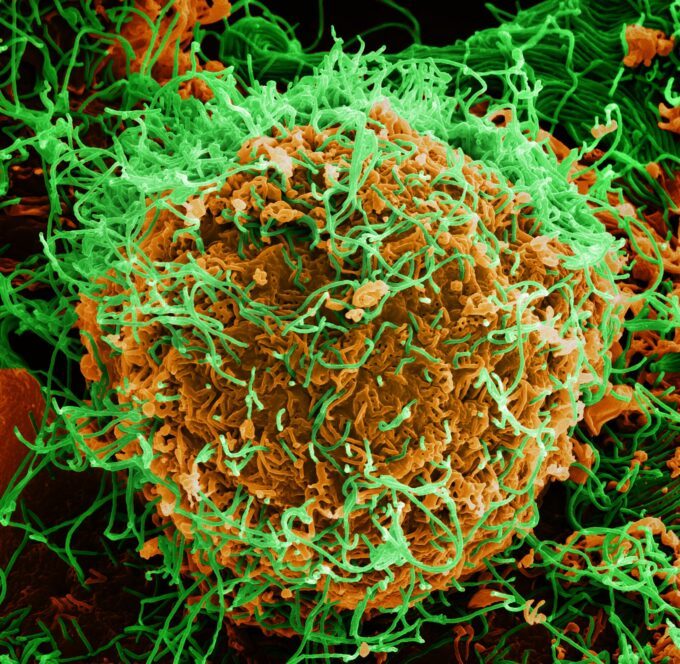
Colorized scanning electron micrograph of Ebola virus particles (green) both budding and attached to the surface of infected VERO E6 cells (orange). Image captured and color-enhanced at the NIAID Integrated Research Facility in Fort Detrick, Maryland. Credit: NIAID.
As I write, news is breaking of at least six Americans exposed to Ebola. I’m no doctor, epidemiologist, or public-health expert, but I have been following closely this latest Ebola outbreak through reports from the WHO, Africa CDC, international news outlets, and disease specialists.
What concentrates the mind is how outbreaks spread, how governments respond, and how political and humanitarian conditions can shape a crisis long before most of the world hears about it.
The current outbreak appears to have begun in Ituri province in the Democratic Republic of Congo. WHO says it was first alerted on 5 May 2026 to a high-mortality illness in Mongbwalu Health Zone. Early testing reportedly failed to detect Ebola because the first laboratory tests came back negative. Further investigation and more detailed testing later confirmed the rarer Bundibugyo strain of the virus on 15 May.
By 16 May, WHO was reporting eight laboratory-confirmed cases, 246 suspected cases, and 80 suspected deaths in Ituri, across at least Bunia, Rwampara, and Mongbwalu health zones. Uganda had also confirmed two imported cases among people who had travelled from the DRC, including one death. WHO declared the outbreak a Public Health Emergency of International Concern—a PHEIC—on 17 May, while making clear that this is not the same as declaring a pandemic.
What struck me personally is that confirmed cases had reached Kampala itself. Kampala is Uganda’s capital, in the south-central part of the country near Lake Victoria, and I was there not that long ago. Even then, it was clear how much pressure the country was under from displacement, migration, and the wider refugee crisis.
One of the reasons Ebola can be difficult to catch early is that it often begins by looking like something far more ordinary: malaria, flu, or another feverish illness. Early symptoms include fatigue, muscle pain, headache, and sore throat. As the disease progresses, patients can develop vomiting, diarrhoea, organ dysfunction, and sometimes internal or external bleeding.
There is also a broader dimension that is hard to ignore. Some people have linked the outbreak to recent cuts in USAID and other international health funding. To be clear, there is no evidence that funding cuts caused Ebola itself. Ebola originates through animal-to-human spillover and then spreads through bodily fluids. But reduced funding can weaken the systems designed to stop outbreaks from escalating once they begin: surveillance networks, laboratories, contact tracing, transport, staffing, protective equipment, and community outreach.
Scientists believe fruit bats are a likely natural reservoir for Ebola viruses, though the virus can infect other mammals too, including monkeys and apes. Human infections often begin through contact with infected animals, such as handling bushmeat, butchering wildlife, or exposure to blood and bodily fluids in forest regions where the virus circulates naturally.
After that, Ebola spreads person-to-person through direct contact with blood, vomit, diarrhoea, saliva, sweat, semen, contaminated bedding, needles, medical equipment, and so on. Ebola is not primarily airborne like Covid or measles. Casual passing contact is usually not enough to spread it.
Where outbreaks become truly dangerous is when healthcare systems start failing. If hospitals lack protective equipment, testing is delayed, contact tracing breaks down, or people avoid treatment centres out of fear or distrust, the virus gains momentum. Conflict and displacement make everything harder. That is one reason eastern Congo has struggled so repeatedly with Ebola outbreaks over the years.
So should the rest of the world be concerned?
Yes.
For Central and East Africa, the concern is genuinely high. Population movement in the region is intense, mining and transport corridors increase transmission risk, and conflict in eastern Congo complicates response efforts. Unlike the Zaire strain, there is currently no licensed vaccine or specific approved treatment for Bundibugyo virus disease.
Globally, the concern is more moderate. Ebola is watched carefully because infected travellers can carry it internationally, and early symptoms can resemble more common illnesses. But Ebola is much harder to spread globally than airborne viruses like influenza or Covid-19. People are usually not infectious until symptoms begin, which makes isolation and contact tracing far more effective.
For Europe and North America, though the US government was in the process of trying to get its US citizens to a safe place for quarantine, the current risk remains low. Imported cases are possible, but sustained community spread is unlikely in countries with strong isolation protocols, infection-control systems, laboratory capacity, and contact-tracing infrastructure.
The deeper concern is less about Ebola suddenly sweeping through Europe or America, and more about whether weakened international surveillance systems make outbreaks harder to detect early enough to stop them regionally.
And Ebola is frightening for good reason. Depending on the strain and access to care, fatality rates can be very high. WHO notes that previous Bundibugyo outbreaks had case fatality rates of around 30% to 50%. During major outbreaks, healthcare systems can effectively collapse. Hospitals become overwhelmed, healthcare workers die, and routine treatment for other diseases breaks down as resources are diverted toward crisis response.
The 2014–16 West Africa epidemic became catastrophic partly because fragile health systems were overwhelmed before international help fully arrived.
At a broader ethical level, outbreaks like this expose something fundamental about how interconnected human beings really are. A virus emerging in a remote forest region can eventually become a regional or global concern. That means global cooperation is not just charity or idealism. It is practical self-interest.
There is also a moral argument—remember those?—that wealthier nations and stronger institutions carry some responsibility to support weaker health systems, scientific research, surveillance networks, and emergency response capacity, because no country is completely insulated from global threats. Isn’t preventing avoidable suffering one of the clearest expressions of human solidarity?
At the same time, of course, experts increasingly worry about the role of public trust. In an outbreak, as we discovered over COVID, trust is not a soft issue. It determines whether people report symptoms, accept isolation, cooperate with contact tracers, allow safe burials, and believe public-health advice. Without trust, even the best technical response in the world can fail.