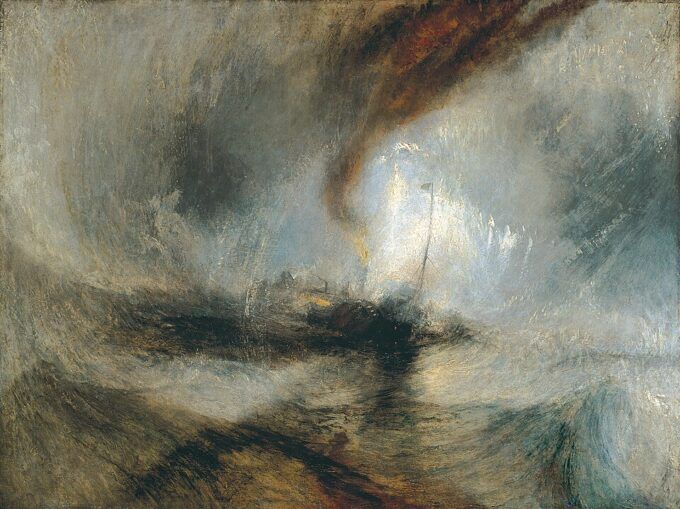
Snow Storm – Steam-Boat off a Harbour’s Mouth by JMW Turner, 1842. Tate Britain.
My children were messaging me from Norway about the biggest storm there in twenty-five years. It was blowing hard here in London too. “Funny that it’s the same storm,” messaged my son, as I watched the trees outside bow to the wind.
I thought of how storms always find us—wherever we are, in every season. “There is no such thing as bad weather,” tried John Ruskin, “only different kinds of good weather.”
The first time I remember it finding me was in Scotland, the winter of 1969. I was a boy, bundled in scratchy wool, stumbling through a sudden storm on the beach blanking out the local town, part-smothering my aunt’s voice.
“Don’t get blown away,” I said to her. “Perish the thought,” she said.
“The world is full of magic things, patiently waiting for our senses to grow sharper,” wrote W. B. Yeats. The wind came at us sideways. I felt both frightened and elated—as though nature had chosen to reveal its true power for some specific but undeclared purpose. I felt lucky.
Seven years later, in 1976, in Rome—the city of the seven hills—I watched the sky break after a very hot day. Rain fell so hard it flattened Rome. Lightning split the sky above Piazza Navona. Thunder rolled along baroque façades. Cobblestones became rivers.
Strangers who had been tourists or passersby were comrades—squealing, laughing, caught in the same flood of joy. “The air was full of dreams and music, as if the old gods were not quite dead,” wrote F. Scott Fitzgerald.
In Pakistan, March 1983, the rain was warm and ceaseless, as though the sky had toppled over. Streets already mysterious also became rivers. My shirt clung to my back as children splashed barefoot, shrieking with delight. It was not menace, but relief—a rinsing of dust, a cleansing of the air.
But Georgia, 1987, was menace. Tornado country. Other cars sped past; the sky went green. Then the funnels dropped like claws—more than one, dark and furious, ripping across the fields. When the sun returned, whole trees were gone, houses bent. “Nature is not a temple, but a workshop, and man’s the workman in it,” said Ivan Turgenev, neatly shifting marvel to survival.
Each storm carried its own character, its own lesson—some merciful, some monstrous, all demanding attention.
Jordan was different again. Just before the Gulf War, the desert turned almost liquid one day with airborne sand. A wall of grit, swallowing the horizon, stinging skin, filling eyes and teeth. The world had turned sepia, and for a few mad hours, the land was as alien as Mars.
Then there was the sea, 1993, heading into the Channel towards the Isle of Wight. I was on an old brigantine, improbably enough. A Force 7 gale hit. The sails cracked like gunfire. The rigging shrieked. The waves both lifted and hurled us down again. I clung to whatever was close—certain to be swallowed up.
I had just joined her. I was showing my inexperience. Force 7 to the crew was nothing. Yet I was drunk on the exaltation of being at the mercy of something vast and uncontrollable. “The sea has never been friendly to man. At most it has been the accomplice of human restlessness,” wrote Conrad.
London, the turn of the millennium, less dramatic but no less memorable. Soho, a night out, a film party, when the heavens opened: neon streaks down rain-slicked streets, people’s mascara running, everyone ducking into doorways—drenched, ridiculous, alive, the storm granting the city a new kind of theatre.
In South Africa, ten years later, near Johannesburg, a highveld storm came with violence—wind so strong it seemed determined to pry open every car door, the rain driving in sheets, corrugated roofs lifting into the air.
Then Manhattan, later still. Winter rain freezing, glazing the streets with treachery. I slid like a clown on Broadway, then by Fanelli’s on Prince, gripping scaffolding poles, watching yellow cabs fishtail as though the city an ice rink. Steam rose predictably from subway grates, mixing with crystalline air, and every step felt borrowed.
And most recently, Greenwich Park, 2024, caught under an oak as the rain hammered down, fat and merciless. Runners splashing through puddles, finally surrendering, while strangers gathered shoulder to shoulder beneath the tree. Everyone laughed at the power of it—soaked, caught together in the same absurd storm, frightened of possible lightning.
Childhood snow, summer thunder, desert sand, sea gales, city floods—each once a gift. Now the same feel different. Wonder, edged with warning.